Why in news?
National Institute of Ocean Technology is about to set up green, self-powered desalination plant in Lakshadweep
What is desalination?
- Desalination is the process of removing salt from sea water so that it can be used for drinking, or for watering crops.
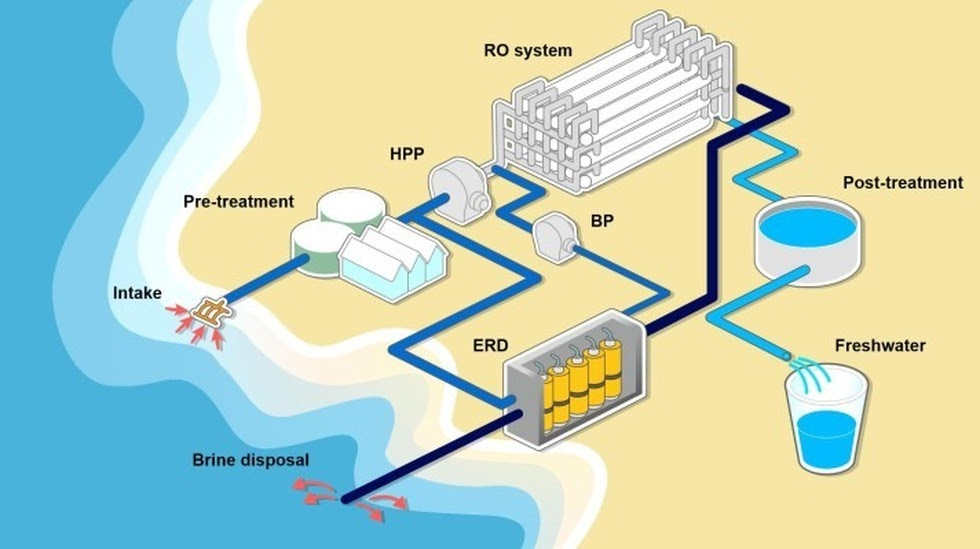
- Desalination uses thermal distillation or a reverse osmosis membrane to separate salt from the sea.
- Reverse osmosis involves applying external pressure to force solvents through a membrane from a high-solute concentration portion to a low-solute concentration area.
Around 47% of the world’s desalinated water is produced in the Middle East and North Africa alone
What is the status of desalination plants in India?
- The first desalination plant in India is Minjur in Tamil Nadu state in the year 2010.
- The second plant was inaugurated at Nemmeli in Tamil Nadu.
- The second-largest desalination plant situated in Jamnagar of Gujarat
- National Institute of Ocean Technology to set up green, self-powered desalination plant in Lakshadweep.
What is Low Temperature Thermal Desalination (LTTD)?
- The LTTD is a process under which the warm surface seawater is flash evaporated at low pressure and the vapour is condensed with cold deep seawater.
What are the advantages of desalination?
- The cost of desalination plants have decreased tremendously
- The desalination plants could ensure water security throughout the year.
- Use of solar energy in desalination plants can mitigate climate change.
- The quality of the water is not compromised
- The source is unlimited
- Helps preserve current freshwater supplies
Sustainable Development Goal-6 (SDG-6) - Clean water and sanitation for all
What are the disadvantages of desalination?
- Emits more greenhouse gases
- High-salinity brine effluents affects the marine ecosystem
- May lead to hypoxia
- Exacerbate climate change if renewable energy is not used as source of power
- Chemical compounds involved in pre-treatment process can be toxic to marine organisms
What is the need of the hour?
- To use renewable energy to power desalination plants
- Safe Disposal of hypersaline wastewater or brine away from the marine organisms
Quick facts
- About 2.2 billion people in the world are deprived of access to safe water.
- Nearly three out of four natural disasters are linked to water, and a quarter of the planet lives without safely managed water services or clean drinking water.
- The World Water Day (WWD) has been observed on March 22 every year since 1993
- While around 70% of Earth’s surface is covered with water, less than 1% per cent is actually drinkable.
References
- PIB │ Low Temperature Thermal Desalination (Lttd)
- The Indian Express │Desalination Plants



