0.1072
7667766266
x

Carbon-Dioxide Removal

iasparliament Logo
November 27, 2023

Why in news?

As nations gather for the COP 28 in Dubai, the question of carbon capture’s future role in a climate-friendly world will be in focus.

What is Carbon Dioxide Removal (CDR)?

  • Carbon removal- Using technologies, practices, and approaches to remove carbon dioxide (CO2) from our atmosphere through deliberate and intentional human actions.
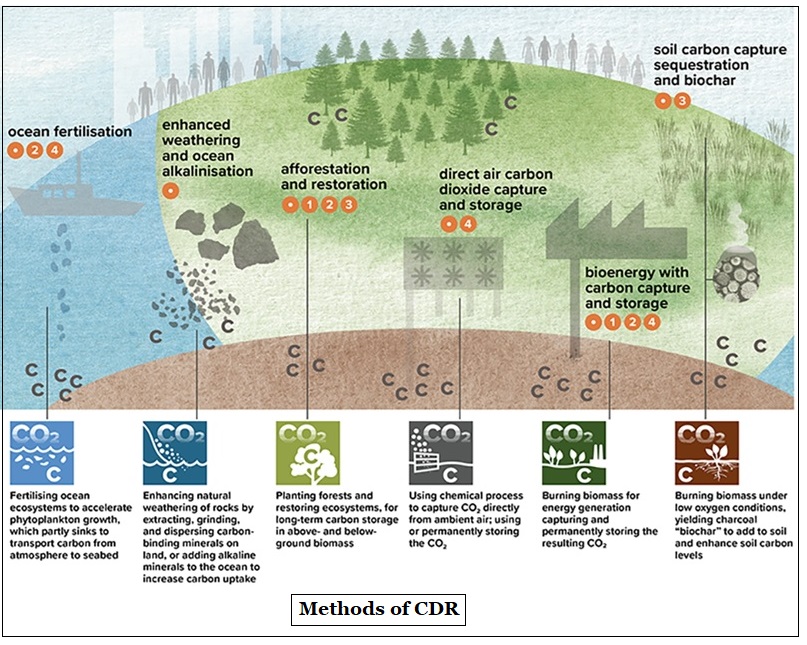
  • It captures CO2 from the atmosphere and locks it away for decades or centuries in plants, soils, oceans, rocks, saline aquifers, depleted oil wells, or long- lived products like cement.

Co2-removal

  • Process- CDR can be done through traditional or technological processes or both.

Process

Examples

Traditional

process

  • Afforestation
  • Reforestation
  • Agricultural practices that sequester carbon in soils (carbon farming)

Technological process

  • Bioenergy with Carbon Capture and Storage (BECCS)
  • Direct Air Carbon Capture and Storage (DACCS)
  • Enhanced rock weathering
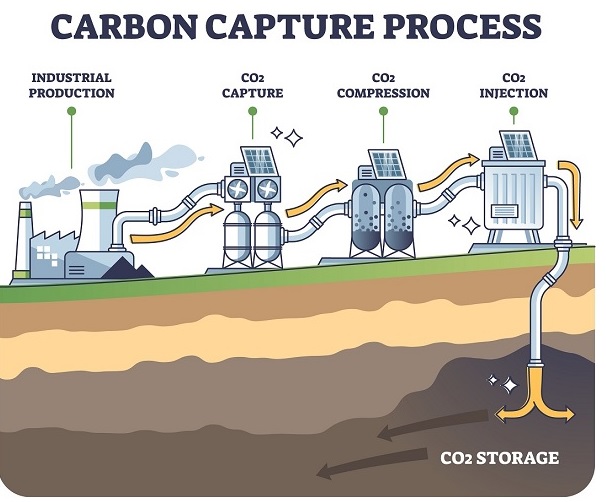
  • Forms of CDR- The most common form of carbon capture technology involves capturing the gas from a point source like an industrial smokestack.
  • Carbon storage- It includes
    • Carbon capture and storage (CCS) - The carbon can be moved directly to permanent underground storage.
    • Carbon capture, utilization, and storage (CCUS) – Carbon can be used in another industrial purpose first.

As of 2023, CDR is estimated to remove around 2 gigatons of CO2 per year, which is equivalent to 4% of the greenhouse gases emitted per year by human activities.

What are the different CDR methods?

CDR method

About

Challenges

Afforestation/ Reforestation

  • Converts abandoned or degraded agricultural lands into forests.
  • Additional trees can sequester more carbon dioxide from the atmosphere.
  • Increases the competition for land.
  • May limit the options for food production and biodiversity conservation.

Biochar

  • A substance produced by burning organic waste from agricultural lands and forests in a controlled process called pyrolysis.
  • Improve soil quality, which in turn improves soil fertility, productivity and crop yield.
  • Health and environmental impacts of particulate matter produced during pyrolysis.
  • Sourcing sustainable biomass at a scale.

BECCS

  • Combines energy production, biological carbon removal and geological storage.
  • Uses biomass in combustion to generate energy, then captures the emitted carbon for geological injection.
  • Can create competition for land use with food production, placing pressure on food security.
  • Can increase the use of fertilisers.

DACCS

  • Extracts CO2 directly from the atmosphere, and is permanently stored in geological formation or used for other application.
  • Accelerates fossil fuel extraction activities, potential CO₂ leakage from storage sites

Enhanced rock weathering

  • Involves pulverising silicate rocks to bypass the conventionally slow weathering action.
  • Energy intensive process and generates emissions.

Ocean alkalinity enhancement

  • A chemical removal method that involves adding alkaline substances to seawater to accelerate the natural sink.
  • Potential for increased greenhouse gas emissions and can release by-products like trace metals.

/co2-removalWhat lies ahead?

  • CDR methods require appropriate governance and policies as they can cause adverse side-effects apart from the predicted benefits.
  • The need of the hour is to accelerate research and development and incentivise CDR deployment, a political commitment, including reliable measurement, reporting, and verification of carbon flows as recommended by IPCC.


References

  1. The Hindu- What is CO2 removal explained
  2. The Hindu- Why carbon capture is no easy solution
Login or Register to Post Comments
There are no reviews yet. Be the first one to review.

ARCHIVES

sidetext
Free UPSC Interview Guidance Programme
sidetext