Why in news?
The share of women owners and workers in unincorporated enterprises was relatively high in the southern States, according to the recent Annual Survey of Unincorporated Sector 2022-23.
What is unincorporated sector?
- Unincorporated sector – It includes a range of jobs that require little to no capital and skills and that involves considerable investment and expertise.
- Little or no capital – street Vending
- Higher investment & expertise – Tailoring and car repair
- Operation – The shop may be operated by an individual or a self-employed entrepreneur.
- Employees – The operator may enlist unpaid family members or employ paid workers.
- Work location – They may work from a fixed location or in homes, small shops, and workshops.
- Surveying in India - National Statistics Office (NSO), Ministry of Statistics and Programme Implementation (MoSPI) publishes Annual Survey of Unincorporated Sector Enterprises (ASUSE).
- ASUSE aims to provide data on all aspects of unincorporated non-agricultural enterprises to supplement the corporate sector data.
- Classification - ASUSE divides such workers into 4 Broad Activity Categories (BAC) which includes
- Manufacturing
- non-captive electricity generation
- Trade
- Other services
- Exclusion – The sector excludes establishments registered under the Companies Act and covered under the Annual Survey of Industries, and public sector/government companies.
|
Different Types of Establishments
|
- Hired Worker Establishment (HWE) – It is an establishment which is employing at least one hired worker on a fairly regular basis.
- Perennial establishment – These are establishments that run more or less regularly throughout the year.
- Seasonal establishment – Those establishments which are usually run in a particular season or fixed months of a year.
- Casual establishment – These are establishments that run occasionally, for a total of at least 30 days in the last 365 days.
|
To know about Annual Survey of Unincorporated Sector, click here
What is the status of women in unincorporated sector?
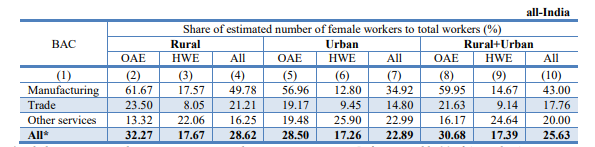
- Female participation – Only 25.63% of the total workers were female during ASUSE 2022-23.
- In Broad Activity Categories – Among 4 categories, it is participation of female workers is the highest in manufacturing.
- In manufacturing sector 43% of the total workers are females.
- Own Account Establishments (OAE) – There is significant presence of female workers to the tune of 31% of the total workforce of the OAEs.
- Unpaid Family Workers - The share of women among unpaid family workers was much higher than other job-types in every State.
- Even in States where women did not play a major role in unincorporated enterprises in hired/ownership roles, their share among unpaid family workers was higher.
- Regional disparities in participation
- Highest – In Southern states
- High – In some Eastern states
- Low – In the western, northern, and central States
- Ownership – More than 30% of the proprietary establishments have been run by women entrepreneur in 3 major states like Telangana, West Bengal and Karnataka.
- Concerns - In many cases, they take no payment and have little say in how the enterprise is run.
What are the significance of women in unincorporated Sectors?
- Empowers women - Engaging in business activities empowers women by enhancing their decision-making abilities, confidence, and social status.
- Brings diversity - Women bring diverse perspectives and innovative solutions to business challenges, fostering creativity and growth.
- Alleviates poverty - Women's participation in these sectors helps lift families out of poverty by providing additional income sources.
- Promotes community development - Women-led enterprises often invest in their communities, promoting social cohesion and community well-being.
- Boosts economic growth - They contribute substantially to the economy by generating income, creating jobs, and driving local economic growth.
- Builds economic resilience – Especially in rural areas and in marginalized communities, by diversifying income sources and reducing vulnerability to economic shocks.
- Promote sustainable practices – As they engage in sustainable practices, contributing to environmental preservation and resource management.
Reference
The Hindu| Women in Unincorporated Sector



