Why in News?
Recent policy reforms, on MSMEs have significantly strengthened the sector, enabling millions of enterprises to integrate with formal markets and global value chains.
What is MSME?
- MSME – Micro, Small, Medium Enterprises (MSMEs) are entities that are involved in the production, manufacturing and processing of goods and commodities.
- Legal backing – The concept of MSME was first introduced by the government of India through the Micro, Small & Medium Enterprises Development (MSMED) Act, 2006.
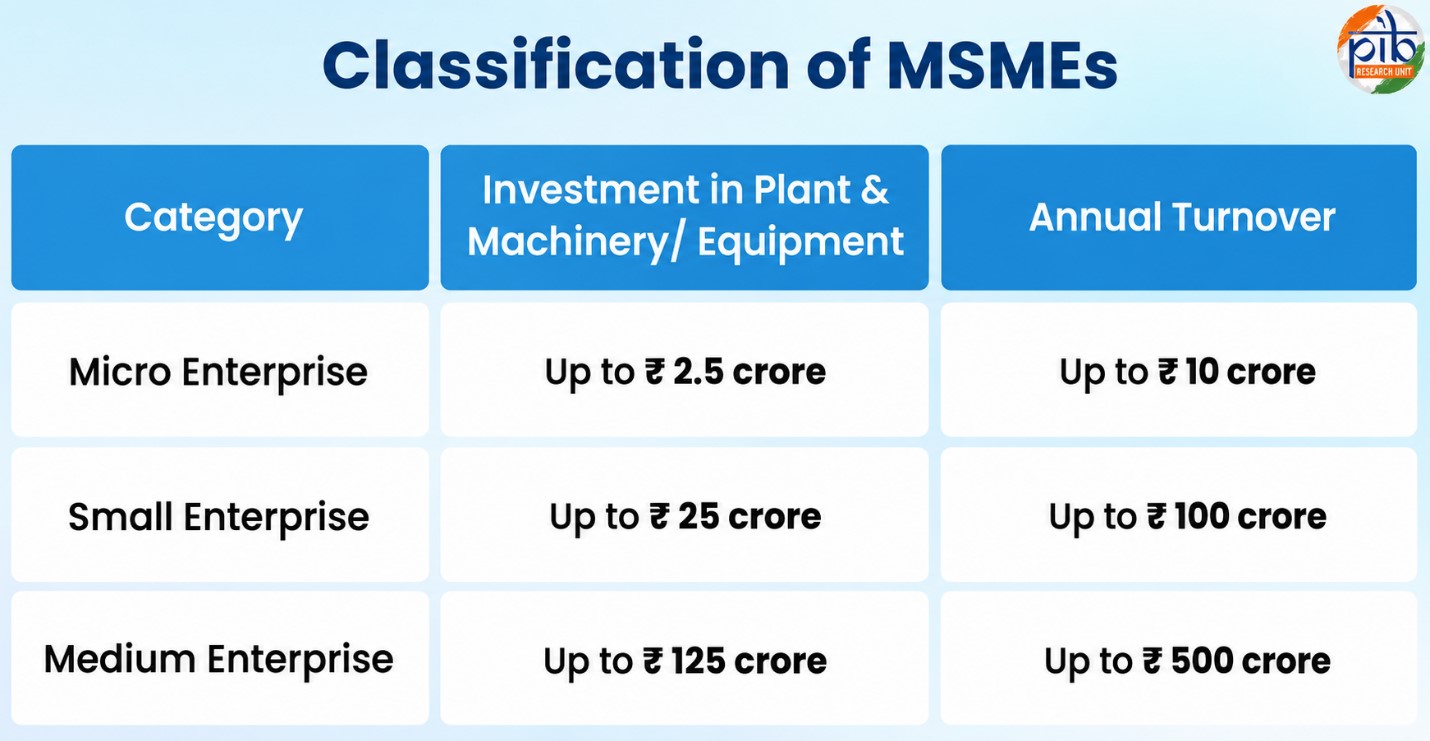
- Importance of MSMEs – MSMEs play a multidimensional role in India's development:
- Contribute around 31.1% of India's GDP, demonstrating their significant role in national income.
- Account for 35.4% of manufacturing output, supporting industrial diversification.
- Generate nearly 48.6% of India's exports, making them vital for foreign exchange earnings.
- Employ more than 38.9 crore people, making MSMEs the second-largest source of employment after agriculture.
- Promote inclusive development by encouraging entrepreneurship among women, youth, Scheduled Castes, Scheduled Tribes and rural populations.
- Preserve traditional industries such as khadi, handicrafts, coir and village enterprises while simultaneously supporting innovation-based enterprises.
- Thus, MSMEs are not merely business entities but instruments of socio-economic transformation.
What are the major reforms strengthening the MSME ecosystem?
- Formalisation and Digitalisation – The Government has undertaken several measures to bring enterprises into the formal economy.
- Udyam Registration Portal and Udyam Assist Platform have together registered over 8.7 crore enterprises.
- Formalisation improves access to institutional credit, government procurement, subsidies and legal protection.
- Digital initiatives have reduced compliance costs and enhanced ease of doing business.
- Enhanced Credit Availability – The Credit Guarantee Fund Trust for Micro and Small Enterprises (CGTMSE) expanded collateral-free guarantee coverage from Rs.5 crore to Rs.10 crore.
- The Digital Credit Assessment Model is simplifying credit appraisal through data-driven lending.
- Additional Rs.2,000 crore has been allocated to the Self-Reliant India (SRI) Fund to provide equity support for high-growth MSMEs.
- These initiatives reduce dependence on informal credit and encourage enterprise expansion.
What are the government schemes for promoting MSMEs?
- PM Vishwakarma – The scheme provides end-to-end support to artisans engaged in traditional occupations through:
- Skill development
- Toolkit incentives
- Digital literacy
- Concessional collateral-free loans
- Marketing assistance
- Over 24 lakh artisans have received training while loans worth more than Rs.5,133 crore have been sanctioned.
- Prime Minister's Employment Generation Programme (PMEGP) – PMEGP promotes self-employment by providing credit-linked subsidies for establishing micro-enterprises.
- Achievements include:
- Over 10.84 lakh enterprises established
- Employment generation for more than 97 lakh people
- Subsidies exceeding Rs.29,000 crore
- The scheme now accepts applications in multiple regional languages, enhancing accessibility.
- MSME Champions Scheme – The scheme focuses on making MSMEs globally competitive through three pillars:
- Innovative – Incubation, design support and intellectual property facilitation.
- Sustainable – Zero Defect Zero Effect (ZED) certification promoting environmentally responsible manufacturing.
- Competitive – Lean Manufacturing Programme improving productivity and reducing waste.
- This promotes innovation-led industrial growth.
- ASPIRE Scheme – A Scheme for Promotion of Innovation, Rural Industry and Entrepreneurship (ASPIRE) encourages rural entrepreneurship through incubation centres and livelihood training.
- It has:
- Trained over 1.23 lakh beneficiaries
- Established more than 1,000 rural enterprises
- Enhanced employment opportunities in rural India.
What are the intitiatives for strengthening market access and technology?
- Public Procurement – Government procurement through the MSME Sambandh Portal has significantly improved market access.
- More than 54% of procurement by Central Public Sector Enterprises has been sourced from MSMEs, benefiting nearly 30,000 enterprises.
- Cluster Development – The Micro and Small Enterprises Cluster Development Programme (MSE-CDP) strengthens industrial clusters by creating Common Facility Centres and upgrading infrastructure.
- Over 600 cluster projects have been approved, improving technology access and economies of scale.
- Technology Centres – Technology Centres support MSMEs through:
- Skill development
- Product design
- Advanced manufacturing technologies
- Testing and quality certification
- Expansion of Technology Centres and Extension Centres is preparing MSMEs for Industry 4.0.
How MSMEs promote inclusive growth?
- Women Entrepreneurship – Government-supported exhibitions and trade fairs have allocated over 67% of stalls to women entrepreneurs, encouraging women's economic participation.
- SC/ST Entrepreneurship – The National SC-ST Hub facilitates:
- Vendor development
- Capacity building
- Access to government procurement
- Public procurement from SC/ST enterprises has increased substantially over the past decade.
- North-East Development – Special schemes promote industrial infrastructure, tourism and manufacturing across North-Eastern states and Sikkim, helping reduce regional disparities.
- Technology-Driven Governance – Governance reforms have improved transparency and ease of doing business.
- MSME Samadhaan Portal addresses delayed payment disputes, a major concern for small enterprises.
- CHAMPIONS Portal provides grievance redressal with nearly 100% disposal rates.
- Online Dispute Resolution (ODR) mechanisms reduce litigation costs and improve business confidence.
- Digital governance has significantly enhanced institutional responsiveness.
- Emerging Challenges – Despite remarkable progress, several structural challenges remain:
- Limited access to affordable long-term finance.
- Low technology adoption among micro enterprises.
- Inadequate participation in global value chains.
- High compliance burden for very small enterprises.
- Infrastructure gaps in rural and remote regions.
- Low productivity and informality in traditional sectors.
- Limited research and innovation capacity.
- Vulnerability to global economic shocks and supply-chain disruptions.
- Addressing these constraints will determine the sector's future competitiveness.
What should be done?
- Technological reform – Expanding digital financial inclusion and fintech-based lending.
- Promoting Industry 4.0 technologies such as Artificial Intelligence, Internet of Things and automation.
- Certification – Strengthening export competitiveness through quality certification and branding.
- Skill development – Enhancing skill development aligned with emerging technologies.
- Deepening cluster-based industrial development.
- Encouraging green manufacturing and circular economy practices.
- Inclusion – Increasing women's participation in entrepreneurship through targeted financial and mentoring support.
- Simplifying regulatory compliance through a single digital interface.
- Financial reforms – Expanding equity financing and venture capital support for growth-oriented MSMEs.
- These reforms can transform MSMEs from survival enterprises into globally competitive businesses.
What are the ethical dimensions involved?
- The MSME ecosystem reflects important ethical values such as inclusive growth, social justice, and equity by promoting entrepreneurship among women, SC/ST communities, artisans and rural populations.
- Schemes like PM Vishwakarma and PMEGP uphold the principles of dignity of labour, empowerment, and economic justice.
- Digital platforms such as Udyam, Samadhaan and CHAMPIONS enhance transparency, accountability, and good governance through efficient service delivery and grievance redressal.
- Promotion of ZED certification and green manufacturing demonstrates environmental responsibility and intergenerational equity.
- However, ensuring fair access to finance, reducing regional disparities, preventing bureaucratic delays, and bridging the digital divide remain essential ethical imperatives for achieving sustainable and inclusive development.
What lies ahead?
- India's MSME sector represents far more than a collection of small businesses—it is a powerful driver of employment, innovation, regional development and social inclusion.
- Recent reforms have strengthened access to finance, technology, markets and institutional support, enabling enterprises to become more productive and competitive.
- As India pursues the vision of Aatmanirbhar Bharat and Viksit Bharat 2047, MSMEs will continue to serve as engines of inclusive economic growth, empowering millions of entrepreneurs while laying the foundation for a resilient, self-reliant and globally competitive economy.
To take mains test click here
Reference
PIB| MSMEs



