Why in news?
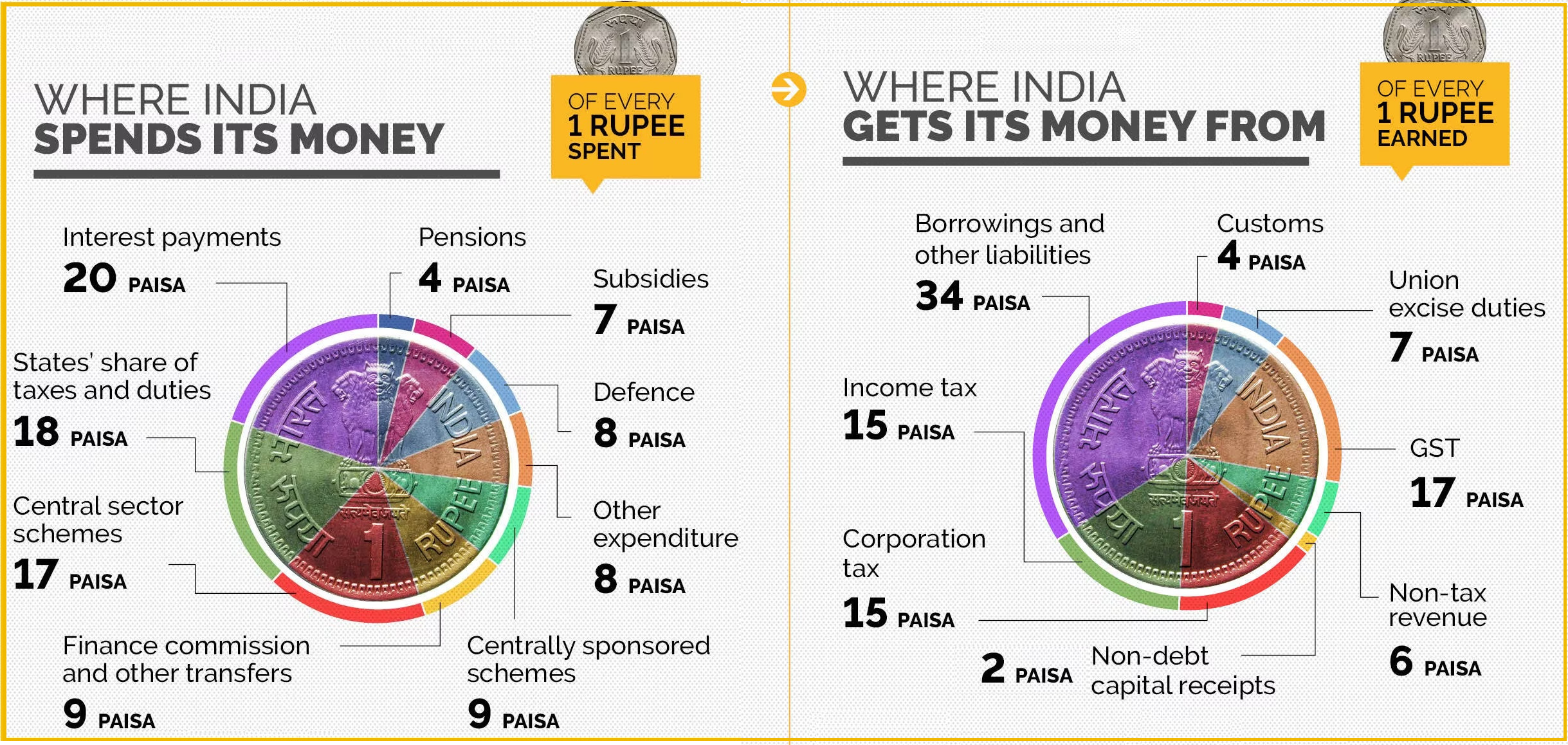
For the third year in a row, interest payments continue to be the single largest component of Centre’s total expenditure.
How is the picture of Centre’s expenditure?
- Interest expense is the cost incurred by an entity for borrowed funds it is a non-operating expense shown on the income statement.
- It represents interest payable on any borrowings—bonds, loans, convertible debt or lines of credit.
- When compared to 2018, the Centre’s interest expenditure went up by 52% to Rs 8.05-lakh crore as of FY22.
- Interest payment of the government has increased to 3.1% of the GDP to Rs 7.31 lakh crore in 2021-22,
- Interest payments accounts for 20%, the single largest component of the Centre’s total expenditure.
- Market borrowings through G-Secs & Treasury Bills accounts for 68% of the total sources of financing the fiscal deficit.
The Government has announced its commitment to reduce the fiscal deficit to a level below 4.5 % of GDP by FY 2025-26.
What are the factors that holding interest expenditures so high?
- COVID led disruption - With the pandemic-led fiscal disruption forcing the government to borrow more, the proportion of interest expenditure also went up proportionately.
- Fiscal deficit - Market borrowings through G-Secs & Treasury Bills accounts for 68 % of the total sources of financing the fiscal deficit.
- Market borrowings - Not the only source that adds to the interest burden but the small savings collections also carries higher interest burden for the government.
- External debt – It accounts for less than 2% of the government’s total source of funding.
- Higher projections - Higher projections of the Government's public finances, including a contraction in GDP/denominator.
What has the FRBM act mandated?
- The Fiscal Responsibility and Budget Management (FRBM) Act, 2003 requires the central government to progressively reduce its outstanding debt, revenue deficit and fiscal deficit.
- Targets - The central government gives three-year rolling targets for these indicators when it presents the Union Budget each year.
- The government was supposed to achieve fiscal deficit of 3.1% by 2022-23.
- In 2021-22, the government has not provided target for the next three years, and will amend the FRBM Act to accommodate the higher fiscal deficit.
Objectives
- Reduction of fiscal deficit and revenue deficit
- To achieve inter-generational equity in fiscal management by reducing the debt burden of the future generation
- Achieving long-term macroeconomic stability
- Better coordination between fiscal and monetary policy
- Transparency in fiscal operations of the Government
References
- The Hindu Businessline|Interest costs account for a fifth of Centre’s total expenditure
- Business Standard|Interest payment by govt rises 3.1% of GDP



