Why in news?
Data released by the government shows that India’s exports and imports declined by 6.59% and 3.63% respectively in January 2023.
What is balance of payments (BoP)?
Balance of Payments (BOP)
- The BoP record the transactions in goods, services and assets between residents of a country with the rest of the world for a specified time period typically a year.
- BoP follows the Double Entry System to record transactions with the rest of the world and has two sides – Credit side and Debit side
|
BoP Surplus
|
Balanced BoP
|
BoP Deficit
|
|
Credit Side > Debit Side
|
Credit Side = Debit Side
|
Credit Side < Debit Side
|
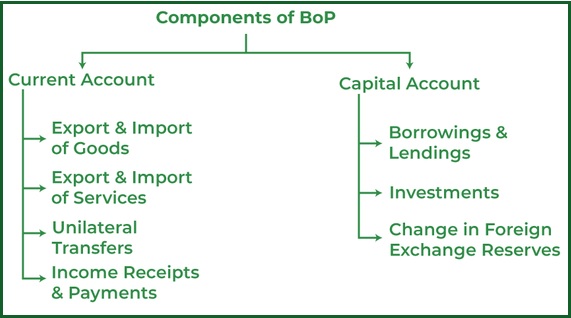
- Accounts in the BoP includes
- Current account
- Capital account
Current Account
- It is the record of trade in goods and services and transfer payments.
- It records all the transactions that relate to the actual receipts and payments of the visible items, invisible items, and unilateral transfers during a specific period of time.
- Components of Current Account includes
- Trade in goods (Visible Trade or Merchandise Transactions) – It includes exports and imports of goods.
- Trade in services (Invisible Trade) – It includes factor income and non-factor income transactions.
- Factor income - Includes net international earnings on factors of production (like labour, land and capital).
- Non-factor income - It is net sale of service products like shipping, banking, tourism, software services, etc.
- Transfer payments – They are the receipts which the residents get for free without having to provide any goods or services in return. They consist of gifts, remittances and grants.
- Income receipts and payments to and from abroad - It involves investment income in the form of rent, profits, and interest.
|
Current Account Surplus
|
Balanced Current Account
|
Current Account Deficit
|
|
Receipts > Payments
|
Receipts = Payments
|
Receipts < Payments
|
A surplus current account - The nation is a lender to other countries
A deficit current account - The nation is a borrower from other countries
- Components of Current Account includes
- Balance of Trade
- Balance on Invisibles
- Balance of Trade (BOT) – It is the difference between the value of exports and value of imports of goods of a country in a given period of time.
- It is also known as Trade Balance.
|
Trade Surplus
|
Balanced BOT
|
Trade Deficit
|
|
Exports > Imports
|
Exports = Imports
|
Exports < Imports
|
- Net Invisibles – It is the difference between the value of exports and value of imports of invisibles of a country in a given period of time.
- Invisibles include services, transfers and flows of income that take place between different countries.
- Services trade includes both factor and non-factor income.
Capital Account
- It includes those transactions, which cause a change in the assets or liabilities of a country’s residents or its government.
- Components of Capital Account includes
- Borrowings and Lendings to and from abroad – Includes all the transactions related to borrowings from abroad by the government, private sector, etc.
- Investments to and from abroad – Includes all the investments by the rest of the world in shares of Indian companies, real estate, etc. The investments to and from abroad are:
- Foreign Direct Investment - FDI consists of the purchase of an asset, which gives direct control to the buyer over the asset. For example, purchase of land, building, etc.
- Portfolio Investment – It is the cross-border transactions and positions involving equity or debt securities, other than direct investment or reserve assets. Ex - FII (Foreign Institutional Investment).
- Change in Foreign Exchange Reserves - The financial assets of the government held in the central bank are Foreign Exchange Reserves.
|
Capital Account Surplus
|
Capital Current Account
|
Capital Account Deficit
|
|
Capital inflows > Capital outflows
|
Capital inflows = Capital outflows
|
Capital inflows < Capital outflows
|
A country could use its forex reserves to balance its balance of payments deficit.
The reserve bank sells foreign exchange when there is a deficit. This is called official reserve sale.
The decrease (increase) in official reserves is called the overall balance of payments deficit (surplus).
What is the case with India?
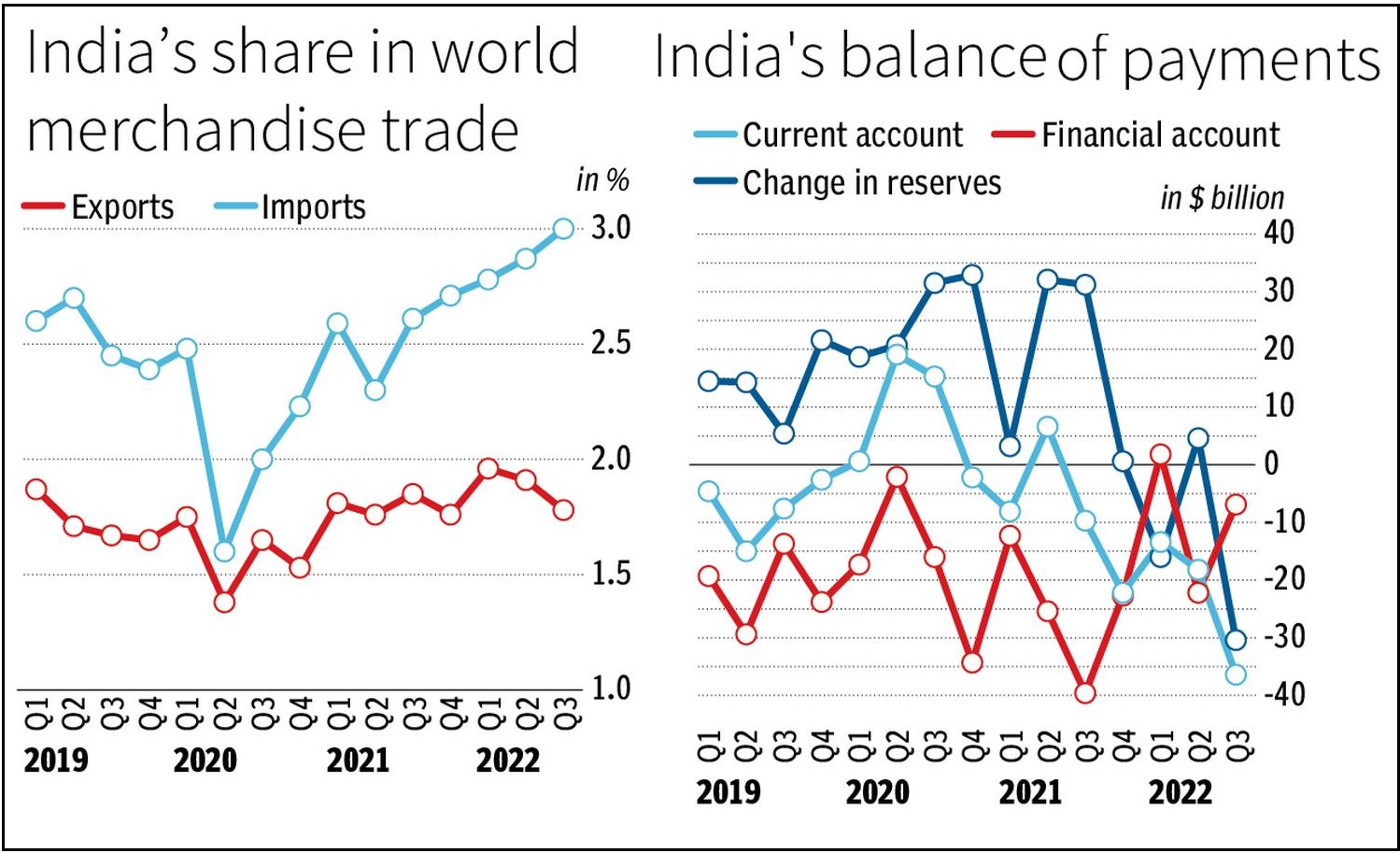
- According to the RBI, the Current Account Deficit (CAD for the first half of 2022-23 stood at 3.3% of GDP.
- It is expected to moderate in the second half of 2022-23 and remain eminently manageable within the parameters of viability.
- In January 2023, trade deficit narrowed to $17.7 billion, led by a sharp fall in non-oil imports. Also,
- FPI outflows have come down
- Workers’ remittances went up
- Gold imports have declined
How will moderating CAD impact the market?
- The reduction in CAD due to services exports, is a positive sign.
- The rising CAD raises concerns among investors as it hurts the currency and thereby the inflow of funds into the markets.
- The value of an economy depends a lot on the value of its currency and thereby, it also supports the equity markets by keeping the fund flow intact.
Quick facts
Reserve assets are financial assets denominated in foreign currencies and held by central banks that are primarily used to balance payments.
References
- The Indian Express | Factors behind moderating CAD
- The Indian Express | Exports drop by 6.6% in Jan
- NCERT | Balance of Payments



