Why in News?
Recently the GDP revision introduced 2022-23 as the base year replacing 2011-12 series.
What is GDP revision?
- GDP – Gross Domestic Product (GDP) represents the total value of all final goods and services produced within a country during a given year, net of material inputs.
- It is the most widely used indicator to measure the size and performance of an economy.
- It also referred to as Gross Value Added (GVA), are prepared using extensive data on production, prices, and other economic indicators.
- These estimates follow the global framework of the United Nations System of National Accounts (UNSNA).
- Global practice – To ensure accuracy and reflect structural changes in the economy, countries periodically revise the National Accounts Statistics (NAS) base year.
- Indian scenario – The National Statistical Office (NSO) undertakes this exercise roughly every 5–10 years.
- The latest revision introduces 2022–23 as the new base year, replacing the earlier 2011–12 series.
Why base year revision is necessary?
- Capturing economic change – Rebasing the GDP series helps capture changes in production patterns, prices, and the structure of the economy.
- Ensuring accuracy – As economies grow, the relative importance of sectors such as agriculture, manufacturing, and services evolves.
- Updating the base year ensures that the GDP estimates accurately reflect these shifts.
- Better data – Such revisions also incorporate improved datasets, better statistical techniques, and updated classifications.
- Consequently, they affect GDP estimates as well as related macroeconomic aggregates such as national savings, investment, and consumption.
What are the background & concerns with the 2011–12 GDP series?
- Higher manufacturing growth estimates – The revised data showed higher growth rates compared with earlier series.
- Structural shifts – The size of the non-financial private corporate sector (PCS) appeared much larger than previously estimated.
- Data credibility issues – Many analysts argued that GDP growth during the past decade may have been overestimated.
- These concerns were further highlighted when the International Monetary Fund (IMF) assigned India a ‘C’ grade for the quality of its National Accounts Statistics in a review of member countries’ statistical systems.
- Given this context, the new GDP series with 2022–23 as the base year attracted considerable attention.
What are the key changes in the new GDP series?
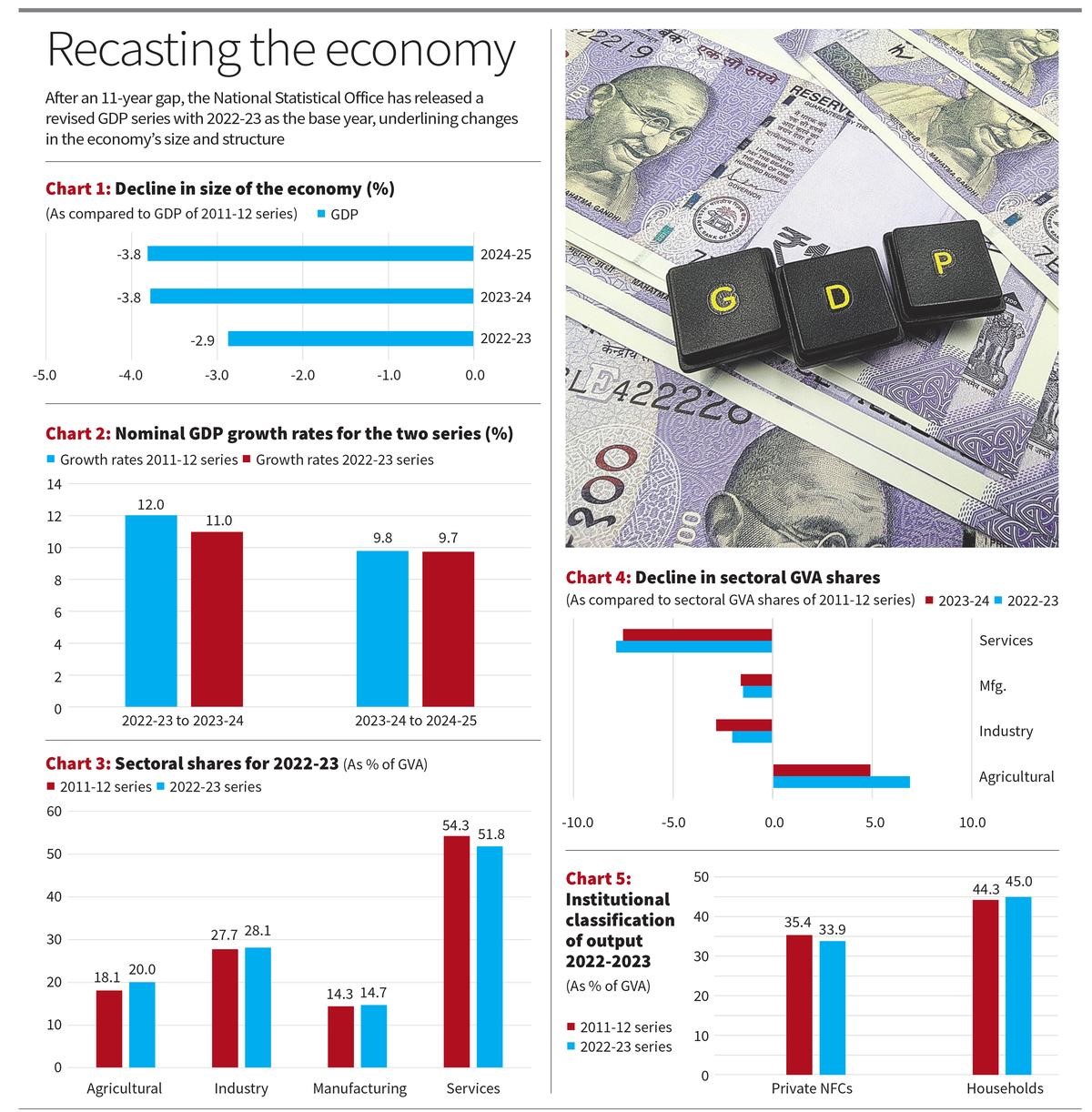
- Reduction in Absolute GDP Size – The revised estimates indicate that India’s GDP at current prices is about 3–4% smaller compared with the estimates based on the 2011–12 series.
- Although the size of GDP has been revised downward, annual growth rates remain broadly similar, with differences generally within ±1 percentage point.
- Changes in Sectoral Composition – The new series shows modest shifts in the production structure:
- Agriculture and allied sectors – Share in GDP has increased slightly.
- Industry (secondary sector) – Its share has also increased.
- Services sector – The share has declined somewhat compared to the earlier series.
- Within the industrial sector, manufacturing share has increased marginally from 14.3% to 14.7% of GDP.
- However, the absolute size of manufacturing has declined by about 1.5–1.6% relative to the earlier estimates.
- This is significant because manufacturing estimates were a major point of debate in the previous GDP revision.
- Institutional Sector Changes – The revision also alters the contribution of different institutional sectors:
- Non-financial private corporate sector (PCS):
- Declined from 35.4% to 33.9% of GDP in 2022–23.
- The difference widens to 3.4 percentage points in 2023–24.
- Household or informal sector:
- Its share has increased marginally.
- The rise is mainly attributed to agriculture-related activities.
- These changes partially address earlier criticisms regarding the overstated role of the corporate sector in GDP.
- Interpreting the Changes – In principle, rebasing should not significantly alter the absolute GDP size at current prices, because the underlying economy remains unchanged.
- If anything, revisions usually increase GDP size, as improved data capture previously unrecorded activities.
- Therefore, the reduction in GDP size in the new series appears surprising.
- However, considering the widespread view that earlier estimates overstated growth, this downward revision may represent a correction of past overestimation.
What are the economic and policy implications?
- Reassessment of Economic Performance – A smaller GDP base may lead to a reassessment of India’s growth trajectory over the past decade.
- Impact on Economic Targets – The correction could delay the target of achieving a $5 trillion economy, first articulated by Narendra Modi in 2019.
- Policy Formulation – Sectoral shifts, particularly the modest rise in agriculture and industry shares, may influence industrial and agricultural policies.
- Statistical Credibility – The revision is also important for restoring confidence in India’s statistical system, especially after concerns raised by the IMF.
- Outstanding Concerns – Despite the improvements, several issues remain:
- It is unclear whether all methodological problems in the 2011–12 series have been resolved.
- Changes in growth rates could result from new datasets, revised ratios, or methodological adjustments, rather than actual economic changes.
- Detailed methodological documentation from the NSO is required for a comprehensive evaluation.
What lies ahead?
- The revision of India’s GDP series with 2022–23 as the base year marks an important step in updating the country’s national accounts.
- While the downward revision in GDP size may correct earlier overestimations and partially address concerns about data reliability, a full assessment of the new series requires greater transparency in methodology.
- Strengthening statistical credibility will be essential for informed policymaking and for maintaining confidence among domestic and international stakeholders.
Reference
The Hindu| Revision of GDP



