Why in News?
Recently, the 1st Advance Estimates (FAEs) released by the government showed that India’s GDP will grow by 7.3% in the current financial year (2023-24), slightly faster than the 7.2% growth in 2022-23.
What is GDP?
- Gross Domestic Product – GDP is defined as total market value of all final goods and services in an economy.
- It is used to assess the size of economy and the country’s performance can be measured across years.
- Growth of GDP can be either due to increase in actual production or due to increase in prices of goods and services or combination of both.
- Nominal GDP – It is the value of GDP at the current prevailing prices.
- Real GDP – It is the value of GDP at some constant set of prices which is calculated by removing the effects of price inflation from the nominal GDP by using a GDP or price deflator.
- Since these prices remain fixed, if the Real GDP changes, then it is due to the changes in volume of production.
- Real GDP growth rate = Nominal rate – Inflation (GDP Deflator)
- GDP deflator – It is the ratio of nominal to real GDP which gives us an idea of how the prices have moved from the base year to the current year.
- GDP Deflator = GDP/gdp (GDP – nominal GDP; gdp – real GDP)
Base Year is the year whose prices are being used to calculate the real GDP. In 2015, India’s Central Statistics Office (CSO) introduced a new series which revised the base year from 2004-05 to 2011-12.
|
Parameter
|
GDP
|
GVA
|
|
Name
|
Gross Domestic Product
|
Gross Value Added
|
|
Definition
|
It is the market values of all final goods and services produced within the territorial boundaries of a country in a given period.
|
It is total value of goods and services produced within a country after deducting the costs of raw materials and inputs.
|
|
Measurement
|
Output, Income and Expenditure approaches.
|
By output reach and used as a proxy for GDP.
|
|
Purpose
|
It is internationally expected measure of overall economic growth of the country.
|
It is used to measure sector-wise details of economic activity from production side.
|
 |
Gross National Product (GNP) takes into account the value of economic activities of those who are not residents of the country as well.
GNP = GDP + Net Income Property from abroad
What is contributing to India’s growth?
- GDP is calculated by 3 different methods.
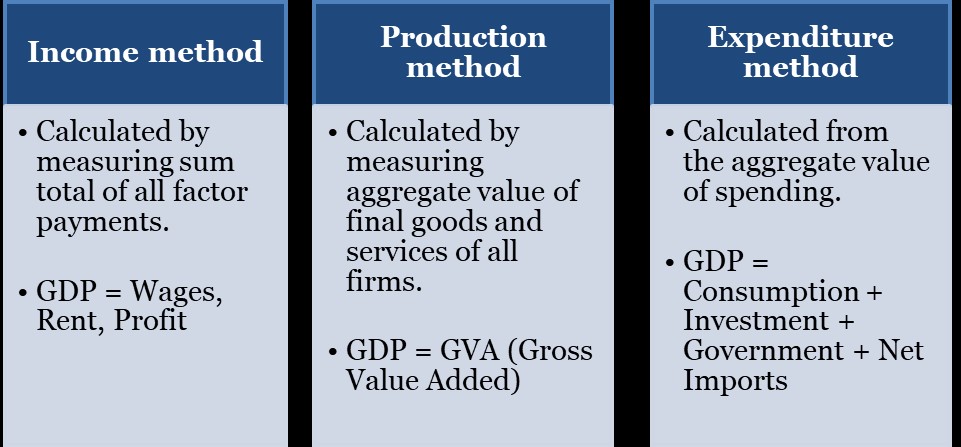
- GDP calculation in India – Calculated through income method and expenditure method.
- Data released by – National Statistical Office (NSO) under the Ministry of Statistics and Programme Implementation (MoSPI).
4 main engines of GDP growth – On basis of demand side.
- Private Final Consumption Expenditure (PFCE) – It is the spending by people in their individual capacity that accounts for almost 60% of India’s GDP.
- Gross Fixed Capital Formation (GFCF) – It is the spending towards investments in boosting the productive capacity of the economy which typically accounts for 30% of the GDP.
- Government Final Consumption Expenditure (GFCE) – It is the spending by governments to meet daily expenditures such as salaries which accounts for around 10% of GDP.
- Net exports – It is the net spending as a result of Indians spending on imports and foreigners spending on Indian exports.
- Since India typically imports more than it exports, it drags down GDP calculations, and shows up with a minus sign.
- As such, negative growth rates here are a good development and for the current year, this drag effect has grown by 144%.
What are Advance Estimates of National Income?
- They are indicator-based and are compiled using the benchmark-indicator method, i.e. the estimates available for the previous year (2022-23) are extrapolated using the relevant indicators reflecting the performance of sectors.
- Compiled by –MoSPI
- 1st Advance Estimates (FAE) – They are presented at the end of the 1st week of January every year, the 1st estimates of growth for that financial year.
- Calculation of FEA – Based on the performance of the economy over the 1st 7-odd months, and the data are extrapolated to arrive at an annual picture.
- Significance of the FAE – They are the last GDP data released before the Union Budget of any financial year and it constitute the base for the Budget numbers.
Union Budget is presented on February 1 every financial year. In the year of Lok Sabha elections like in 2024, a full-fledged Union Budget will not be presented.
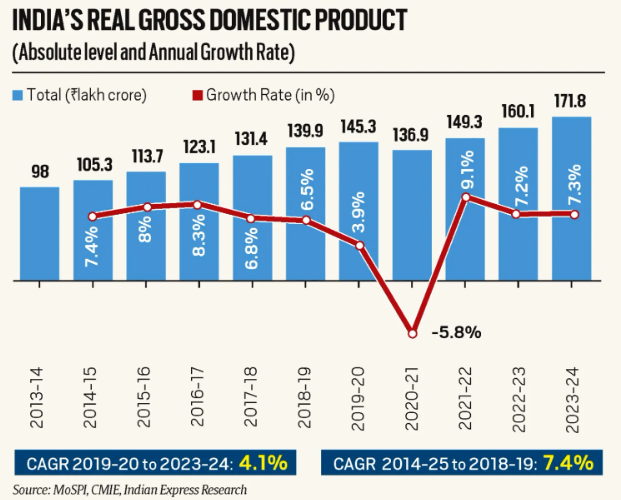
- Findings of FEA – By the end of March 2024, India’s GDP is expected to rise to almost Rs 172 lakh crore and on an annual basis, the growth rate estimated for 2023-24 is 7.3%.
- 2nd Advance Estimates – It is released by the end of February every year.
- Provisional Estimates – It is released by the end of May.
- Revised Estimates – The GDP estimates continue to be revised and in the coming 3 years, the 1st, 2nd, and 3rd Revised Estimates of this year’s GDP will be released.
- Actuals – It is the final number of GDP.
References
- The Indian Express| First Advanced Estimates (FEA)
- The Indian Express| Gross Domestic Product (GDP)



