Why in News?
Indian Government is developing national indicator to measure “extreme poverty”
What is extreme poverty?
- Definition – According to World Bank, the people in extreme poverty is who live on less than $2.15 per day.
- Currently, around 700 million people live on extreme poverty.
- Vulnerability – Extreme poverty remains concentrated in parts of Sub-Saharan Africa, fragile and conflict-affected areas, and rural areas.
- Global measures – The United Nations have adopted the Sustainable Development Goals (SDG) in 2015 and have set an explicit target of eradicating extreme poverty by 2030.
- SDG 1 – End poverty in all its forms everywhere
- Challenges – After decades of progress, the pace of global poverty reduction began to slow by 2015, in tandem with subdued economic growth.
- Impact of COVID-19 – Global poverty reduction was dealt a severe blow by the COVID-19 pandemic and a series of major shocks during 2020-22, causing three years of lost progress.
- In 2022, a total of 712 million people globally were living in extreme poverty, an increase of 23 million people compared to 2019.
- Low-income countries were most impacted and have yet to recover.
- Impact of Climate change – It is hindering poverty reduction and is a major threat going forward.
- The lives and livelihoods of poor people are the most vulnerable to climate-related risks.
- Millions of households are pushed into, or trapped in, poverty by natural disasters every year.
What is the status of Extreme Poverty in India?
- Extreme poverty – According to ‘The World Poverty Clock’ report in 2024, India’s extreme poverty at less than 3%.
- It has taken $2.15 a day income to present the finding.
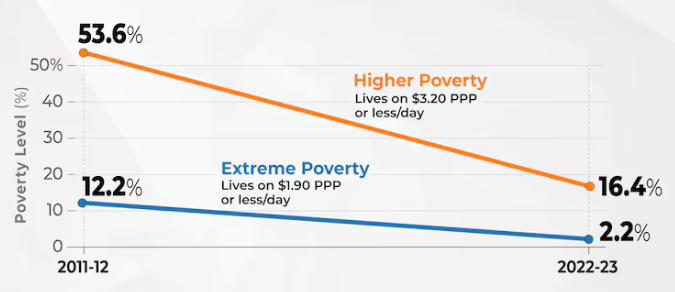
- The number of people living in extreme poverty has come down to 2.4% from 3.3% in 2022.
- Extreme poverty line – India has been without an official poverty line for a while, and the policy has shifted to from income-based poverty estimates to one based on multi-dimensional deprivations.
- Now, India government reckons anyone with income below $1.25/a day as living in “extreme poverty”.
- Interestingly, the World Bank definition of extreme poverty roughly corresponds to the poverty line computed by Tendulkar committee for 2004-05 (Rs 33 per day), if adjusted for inflation.
- Niti Aayog – It says that the proportion of men, women and children of all ages living in poverty in “all its dimensions” reduced to 14.96% in 2019-21 from 24.85% in 2015-16.
- An estimated 248.2 million people moved out of multidimensional poverty between 2013-14 and 2022-23, a key SDG goal.
- Multidimensional poverty index (MPI) estimates between 2005-06 and 2015-16, the headcount ratio for the year 2013-14 comes to 29.17%.
- Consumption expenditure data for 2022-23 – It provided the first official survey-based poverty estimates for India in over ten years.
- High growth and large decline in inequality have combined to eliminate poverty in India for the PPP$ 1.9 poverty line.
|
Poverty Headcount Ratio (HCR)
|
- It is a measure that indicates the percentage of a population living below the poverty line.
- It reflects the proportion of people in a specific region or country whose income or consumption levels fall below an established poverty threshold, such as $1.90 or $3.20 per day based on PPP.
- The HCR provides a clear picture of the extent of poverty and is used to compare poverty levels across different regions and over time.
|
- Reason for India’s poverty reduction - It has been possible due to sustained economic growth during the period (6.7% average growth between FY16-FY20), and implementation of several welfare schemes focused on
- Nutrition
- Health
- Education
- Housing
- Drinking water
- Sanitation
- Skill development
- Social protection
- Future prospects – India is much ahead of the target of reducing poverty in all its dimensions by half, by the year 2030
Why India needs a new method to count its poor?
- Different methodologies – There is vast difference in poverty estimates is the difference in the methodology of each paper.
- No official data - There are no official poverty figures in India between 2013 and 2023.
- Data mismatch – Various research estimates suggest that the people living in poverty varies from 2.5% to 29.5% of the population, depending on the source and the time between 2013 and 2023.
- India's current official poverty line does not match its status as a lower-middle-income country.
- The World Bank's $3.20 PPP poverty line is designed for such countries and is suitable for measuring poverty, especially for international comparisons.
What lies ahead?
- There is a need to address intertwined global challenges, including slow economic growth, fragility and conflict, and climate change.
- Countries need to improve people’s well-being in a comprehensive way, including through more equitable access to health, education, and basic infrastructure and services, including digital.
- Policymakers must intensify efforts to grow their economies in a way that creates high quality jobs and employment, while protecting the most vulnerable.
- Jobs and employment are the surest way to reduce poverty and inequality.
- Impact is further multiplied in communities and across generations by empowering women and girls, and young people.
References
- Financial Express| India is developing an indicator to measure Extreme Poverty
- World Bank| Extreme Poverty across the World



