Why in news?
The Palghar district in northern Maharastra has been witnessing an unusual frequency of earthquakes since November, 2018.
What happened recently?
- Dahanu town in Maharashtra’s Palghar district has been hit by some 30 low-intensity earthquakes since November 2018.
- Palghar was rocked by a series of minor earthquakes (6 tremors) on a single day recently.
- The magnitudes of the quakes ranged between 3 and 4.1 on the Richter scale.
- Many aftershocks of lesser magnitude have also been observed in the area.
- Data collected so far point to an “earthquake swarm”.
What is an “earthquake swarm”?
- It is a series of many (sometimes thousands) low magnitude earthquakes without a discernible main shock.
- They occur in a localised region and over a period of time ranging from days, weeks to even months, without a clear sequence of foreshocks, main quakes and aftershocks.
- When seismic energy piles up inside the Earth and is released in small amounts from certain points, such a series of earthquakes can occur.
- Sometimes, these are also accompanied by acoustic or sound emissions.
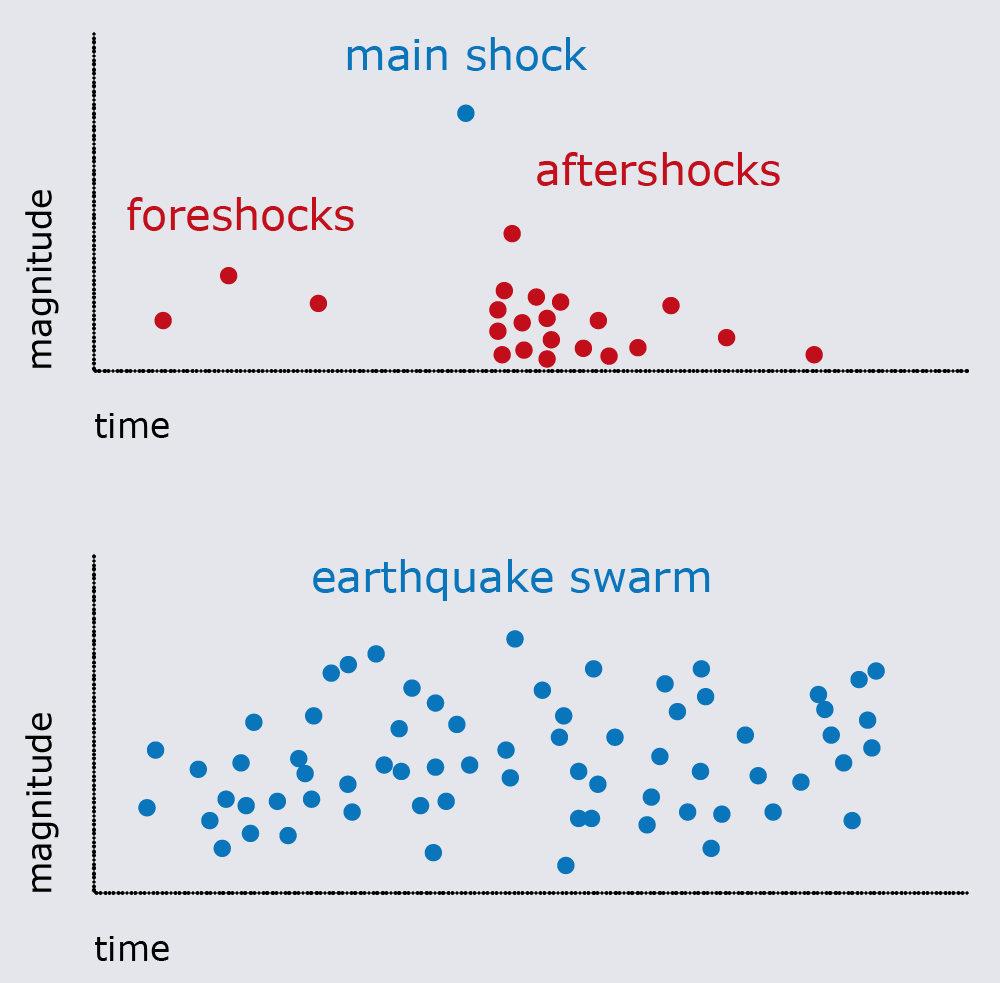
What is the case with the Deccan region?
- In India, sequences of low-intensity quakes are common in areas that have been hit previously. E.g. Saurashtra in Gujarat, Koyna in Maharashtra
- But they are also seen in areas without a history of seismic activity and, swarms are normal in peninsular India.
- Notably, no mining activity has been found and there are no small reservoirs too to explain the cause for the quakes.
- Deccan Plateau is not an earthquake-prone zone because of its hard rock crust, as seismic waves travel faster in hard rocks which helps the tremors dissipate faster.
- But there is also loose soil which makes the waves stay longer, release more energy and cause more damage.
- Earthquake swarms are not limited to the Peninsula. In 2016, a series of 58 earthquakes were recorded in the Rampur area of Himachal Pradesh.
- This Himalayan swarm was later attributed to low strength of the earth’s crust in the area which could not hold the tectonic energy.
What is the need for caution?
- Many major earthquakes in the region have been preceded by earthquake swarm activity as foreshocks.
- E.g. Latur and Koyna earthquakes in 1993 and 1967 respectively
- It is not certain yet if the current quakes had been caused by seismic activity, hydro-seismicity due to water percolation post-monsoon, or magmatic activity in the region.
- So without more data, it would be premature to draw a definite conclusion.
- Also, identifying the quakes as a swarm would suggest there is little threat of a deadlier one hitting in the near future.
- The possibility of either the quakes now subsiding or of a big one coming is not ruled out yet.
- Significantly, kachcha homes, about a third of the buildings in areas hit by the quakes, would be especially vulnerable in a large quake.
- So a more closer and scientific look into the causes of the earthquakes is essential now.
- The district authorities must draw up a community disaster management plan, with Standard Operating Procedures.
Source: Indian Express, Down to Earth



