What is the issue?
Amid talk of MSP guarantee and Punjab’s wheat-paddy cropping, experts feel that the state must follow cropping pattern as per its agro-climatic and soil conditions to protect the environment and increase farmers’ income.
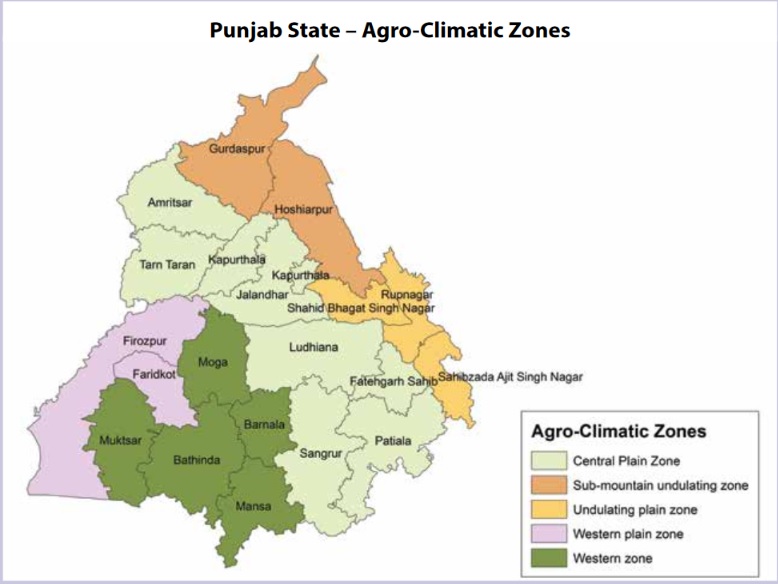
What are the Agro-climatic zones in Punjab?
- According to Punjab Agriculture University (PAU), Ludhiana, there are 6 agro-climatic zones in Punjab which include
- Sub-Mountain Undulating Region
- Undulating Plain Region (UPR)
- Central Plain Region (CPR)
- Western Plain Region (WPR)
- Western Region (WR)
- Flood Plain Region (FPR)
- These regions have rainfall variations from 165 mm to 2000 mm annually and climate from humid to cold-arid to arid and extreme arid.
- The variations in soil range from hill soils, tarai, brown hill, alluvial to desert.
How were the zones classified?
- In Zone 1 and 2, district like Pathnakot, Ropar, Mohali, Gurdaspur, and Hoshiarpur are included.
- The temperatures are cold, humid to sub-humid, and semi-arid to humid and the rainfall varies between 165 mm to over 1000 mm.
- The soil of these areas is suitable to grow vegetables, wheat, maize, basmati sugarcane, jowar, bajra, barley etc.
- Growing paddy here is not suitable because it requires continuous standing water for days which makes maize practically a default crop for farmers.
- In Zone 3 districts like Amritsar, Tarn Taran, Kapurthala, Jalandhar, Ludhiana, Fatehgarh Sahib, Patiala and Sangrur are included.
- In Amritsar and Gurdaspur areas, there is some area which is highly suitable for growing basmati whose aroma is unique which cannot be found in any part of the state.
- In Zone 4, Ferozepur, Moga, Barnala, and Faridkot are the districts included and are suitable for cotton growing and mustard.
- Zone 5, Mukatsar, Fazilka, Bathinda and Mansa are included.
- In Zone 6, the parts of various districts along with Beas, Sutlej, Ravi, Ghaggar rivers are included which are the flood-prone.
- The state has a flood plain region which is also called Bet area and it has homogenous climatic conditions.
- In these zones all agro-climatic conditions, rainfall pattern, distribution, soil texture are taken into account to have a suitable cropping pattern.
What is the plan ahead?
- The over usage of fertilisers and over exploitation of ground water for decades need for research and development work for modifying the cropping pattern.
- The government wants to divide the whole state into zones according to the soil fertility and the respective suitable produce and for that a vision document is being prepared which will be adopted in the state to bring good reforms in the agriculture sector of the state.
Reference
- https://indianexpress.com/article/explained/punjabs-six-agro-climatic-zones-might-hold-key-to-its-diversification-conundrum-7655281/



