Why in news?
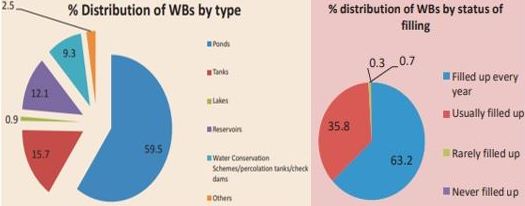
The Jal Shakti ministry has released the report of India’s first water- body census, which provides a comprehensive database of ponds, tanks, lakes and reservoirs in the country.
What is the need for water-body census?
- To get a more accurate picture of the status of India’s water.
- To formulate policies to address ground water crisis and biodiversity loss.
- Water bodies contribute to food and water security and livelihoods by recharging ground water.
- Water bodies are the sources of irrigation and livestock.
- Water bodies have an important role in supporting biodiversity.
- Water bodies are increasingly under threat from pollution, encroachment, urbanization, and drying up.
The country’s water resources have become extremely polluted, with 70% of surface water found to be “unfit” for human consumption.
What are the salient features of the census?
- Objective - To develop a national database for all water bodies by collecting information on all important aspects of the subject including their size, condition, status of encroachments, use, storage capacity, status of filling up of storage.
- Water bodies - Are structures where water from ice-melts, streams, springs, rain or drainage from residential or other areas is accumulated.
- Storage of water diverted from a stream, river is also included.
- The definition excludes oceans, rivers, waterfalls, and swimming pools, covered water tanks made by individuals, factories and temporary water bodies.
- Water bodies - India has 2.42 million water bodies, out of which 97.1% are in rural areas and 2.9% in urban areas.
- Non-functional - 83.7% are ‘in use’ and the remaining 16.3% are non-functional on account of drying up, silting and construction activities and so on.
- Private entities - 55.2% are owned by private entities and 44.8% are under public ownership.
- In the wetter states like Kerala, West Bengal and North Eastern states more than three-quarters of the water bodies are privately owned.
- Encroachment - Only 1.6% water bodies out of all the enumerated bodies have been encroached out of which 95.4% are in rural areas and remaining 4.6% in urban areas.
- Water conservation - Maharashtra State is the leading state for water conservation schemes.
- Others - West Bengal has highest number of ponds and reservoirs.
- Andhra Pradesh has highest number of tanks.
- Tamil Nadu has highest number of lakes.
- Mid-sized water bodies are largely panchayat-owned.
- In drier states, the water bodies are primarily used for irrigation and groundwater recharge.
More than 80% of water in the country is consumed in agriculture while the rest is used for domestic and industrial purposes.
What are the shortcoming of the census?
India accounts for 18% of the world’s population, but has only 4% of its fresh water resources.
Quick facts
|
India-Water Resources Information System (WRIS)
|
- Provides a single window solution for all water resources data and information in a standardized national GIS framework.
- Funded by the Central Water Commission.
- Initiated through a Memorandum of Understanding signed on December 2008 between
- Central Water Commission (CWC), Ministry of Jal Shakti and the Indian Space Research Organization (ISRO), Department of Space.
- Under National Hydrology Project, a central sector scheme.
|
References
- The Hindu│ Shortcomings Of The Census
- PIB│ Features Of The Census



