Prelims: Current events of national and international importance | Science & Technology
Why in news?
Recently, the astronomers have discovered a star that appears green, an unusual celestial sight that could change how scientists understand the colours of dying stars.
- White Dwarf – It is the super-dense, glowing leftover core of a dying, low- to medium-mass star (like our Sun) after it runs out of nuclear fuel.
- It has an estimated temperature of around 4,000 degrees Celsius and is extremely compact, roughly comparable in size to Earth.
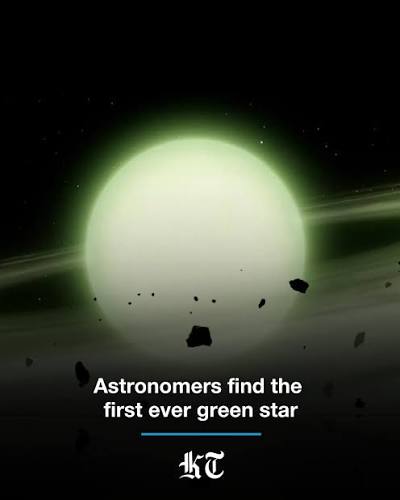
- WD J1330+6435 – It is an unusual green coloured white dwarf is located about 280 light-years from Earth in the constellation Draco.
A light-year is the distance light travels in one year, around 9.46 trillion kilometres.
- The light travelling from this star takes approximately 280 years to reach Earth.
- When astronomers observe it today, they are effectively looking at the star as it appeared 280 years ago.
- Appearance – The white dwarf WD J1330+6435 appears chartreuse green due to the interaction of sodium and helium in its dense atmosphere, which modifies the wavelengths of light absorbed by the star.
- This demonstrates how the chemical composition of a star's atmosphere can influence its observed colour.
- Under these conditions, sodium interacts with helium in ways that alter the wavelengths of light absorbed by the star, while other elements, including calcium, also influence its spectrum.
- Researchers used spectral data and models of human colour perception to calculate how the star would appear, rather than relying on a direct photograph showing it as green.
- Colour of normal star – The colors that normal stars can have are pretty much only orange, white or blue.
- Significance – The study suggests that white dwarfs may exhibit a much wider range of colours than previously thought, including pale blue, cyan, pink, purple, and green, depending on their atmospheric chemistry.
- Another white dwarf examined in the study, WD J1011+2845, showed a salmon-pink appearance due to its carbon-rich atmosphere.
Reference
TOI | Astronomers discover green star 280 light-years away



