Building Roads, Growing Green
- Expansion beyond connectivity – India’s highways are no longer just corridors of connectivity, becoming an important part of the country’s broader infrastructure transformation.
- As road infrastructure expands, the focus is also shifting towards building corridors that are efficient, resilient and environmentally responsible.
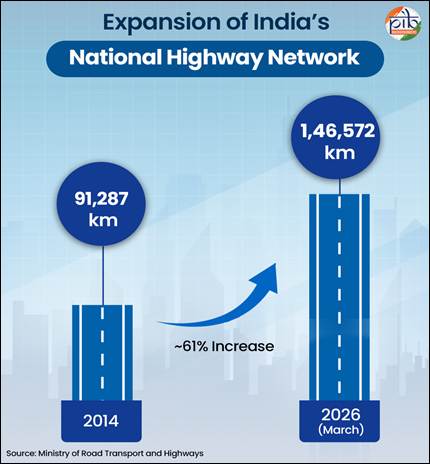
- Growth of National Highway network – Over the past decade, India’s National Highway network has grown by nearly 61%, from 91,287 km in 2014 to 1,46,572 km by March 2026.
- This rapid development has strengthened connectivity, improved access to markets and supported faster movement of people and goods.
- Sustainability focus – As road infrastructure expands, the focus is shifting towards building corridors that are efficient, resilient and environmentally responsible.
- Large-scale plantation along National Highways (NH), the use of recycled and waste-derived materials, energy-efficient construction practices, and satellite-based monitoring of green cover are contributing to a more sustainable highway network.
Green Highways Policy, 2015: Policy Evolution
- Green Highways Policy, 2015 – The greening of India’s National Highway network is guided by the Green Highways (Plantation, Transplantation, Beautification and Maintenance) Policy, 2015.
- The Policy was formulated to
- Evolve a policy framework for plantation along National Highways.
- Reduce the impact of air pollution and dust, as trees and shrubs are known to be natural sinks for air pollutants.
- Arrest soil erosion at the embankment slopes.
- Moderate the effect of wind and incoming radiation.
- Create employment opportunities for local people.
- Implementation – The implementation of the policy brings together multiple stakeholders.
- Plantation activities are undertaken by Self Help Groups, private agencies, State Forest Departments, Forest Corporations and contractors, according to the scope of sanctioned works.
- A Plantation Cell has been established for overall monitoring through regional offices of the National Highways Authority of India (NHAI) and other agencies.
Greening the Corridors: Plantation & Afforestation
- Green cover expansion – The greening of National Highways is increasingly being measured by the number of saplings planted, their survival, growth and distribution along highway corridors.
- As of July 2026, more than 3.61 crore saplings have been planted across approximately 1.32 lakh km of National Highways during the last five years.
- The approach has also expanded from plantation to broader environmental management.
- Technology-Driven Monitoring – Earlier, monitoring of plantations relied primarily on-site visits by field personnel, but, today, this is being supplemented by drone and satellite-based monitoring.
- Afforestation measures – Miyawaki plantations have been introduced to increase green cover & wherever tree felling is necessary for highway development, compensatory afforestation and tree transplantation are being undertaken.
|
Miyawaki Plantations
|
- The Miyawaki technique is a method of creating dense forests within limited spaces.
- Also known as the ‘pot plantation method’, it involves planting trees and shrubs close to one another to promote rapid growth and establish forest-like ecosystems in a shorter period.
- Plants can grow up to 10 times faster under this method, making it particularly suitable for expanding green cover in space-constrained urban areas.
|
- NHAI’s Plantation Standards – Plantation and landscaping have become an integral part of National Highway development and project completion. NHAI’s September 2026 guidelines reinforce this approach.
- Plantation works will be considered compliant for provisional completion certification only when at least 80% of the available Right of Way (RoW) earmarked for plantation has been covered.
- RoW refers to the designated land area that is legally required for the construction, operation, and maintenance of highway infrastructure.
- The planted saplings must also have a minimum 90% survival rate at the time of inspection by officials.
- The same survival benchmark applies during the Operations and Maintenance period, with provisions for timely replacement of plants that do not survive.
Green Highways Excellence Awards
- To encourage good practices, NHAI instituted the Green Highways Excellence Awards in 2025.
- Criteria – The 2026 awards gave significant importance to
- Plantation survival rates
- Species diversity
- Use of native plant species
- Site-specific plantation plans
- Protection and maintenance measures
- Award-winning projects
- In the Avenue Plantations category, the Six-Laning of the Chilakaluripet Bypass on NH-16 in Andhra Pradesh secured the First Prize.
- In the Median Plantations category, the Four-Laning of the Hyderabad–Yadgiri section of NH-163was awarded the First Prize.
- The Jamtha Clover Leaf Oxygen Bird Park on NH-44, Nagpur, received the First Prize in the Plantation in Land Parcels category.
National Highways – Green Cover Index (NH-GCI)
- Marking a new milestone in sustainable highway development, the first Annual Report on the National Highways Green Cover Index (NH-GCI) 2025–26 has been released.
- Prepared in collaboration with the National Remote Sensing Centre (NRSC) of ISRO, the report provides the country's first scientific and quantitative assessment of green cover within the RoW along National Highways.
- The assessment covers nearly 30,000 kilometres of National Highways under the Operation and Maintenance (O&M) phase across 24 states.
- It includes observations recorded before and after the monsoon season.
- Using advanced space-based technologies, it establishes a reliable baseline for monitoring and enhancing roadside plantations.
- The assessment reveals significant variation in green cover along National Highways.
- The findings enable comparison, ranking, and targeted interventions for improved plantation management.
Driving the Shift to Sustainable Materials
- India’s highways are also transitioning from fossil-fuel-based materials towards bio-based, regenerative solutions.
- Bio-Bitumen Innovation – A major scientific breakthrough was announced in January 2026 with the technology transfer of Bio-Bitumen produced via pyrolysis of farm residue.
- Technology transfer (TT) is a process that allows scientific findings, knowledge and intellectual property to flow from universities and research institutions to public and private users.
- The innovation, “Bio-Bitumen via Pyrolysis: From Farm Residue to Roads”, was developed jointly by CSIR-Central Road Research Institute (CSIR-CRRI), New Delhi, and CSIR-Indian Institute of Petroleum (CSIR-IIP), Dehradun.
- Bitumen is a mixture of organic liquids and hydrocarbons, used for paving roads, and is known as black gold in the pavement industry.
- Currently, India meets nearly 50% of its bitumen requirement through imports.
- Innovations such as bio-bitumen can reduce import dependence while strengthening domestic production capabilities.

- The process uses post-harvest rice straw as feedstock for producing bio-oil through pyrolysis.
- Multiple Valuable Outputs – The bio-oil is subsequently blended with conventional bitumen to produce the bio-bitumen blend.
- The technology uses biomass pyrolysis to produce multiple value streams, including bio-binders for roads, energy-efficient gaseous fuel, bio-pesticide fractions and high-grade carbon.
- Applications – Batteries, water purification and advanced materials, offering an emission-free and cost-effective solution for the future.
- Successful Field Trial – A 100-metre trial stretch using bio-bitumen has been successfully laid on the Jorabat–Shillong Expressway (NH-40) in Meghalaya, demonstrating its feasibility. The technology also supports management of farm residue.
- Plans are underway to integrate this into national highway construction standards.
- With this, India has emerged as the first country to scale bio-bitumen technology to industrial and commercial levels within the same year.
Growing Use of Recycled Materials
- The shift towards alternative materials is also visible in the wider use of recycled and industrial by-products in highway construction.
- Fly ash, a thermal power plant by-product, and pond ash are increasingly used in embankments and structural works.
- Reclaimed Asphalt Pavement (RAP), Construction and Demolition (C&D) waste and recycled aggregates are also used in suitable highway works, as per technical specifications.
- Other materials being promoted include plastic waste, slag, crumb rubber, bio-bitumen and other recycled or industrial by-products.
- Together, these practices improve resource efficiency, conserve natural resources and help address environmental concerns associated with highway construction.
Community Engagement & Public Awareness
- The impact of green highway initiatives is most visible on the ground, where plantations are being linked with biodiversity and community participation.
- Experiences from different States show how highway spaces can become platforms for wider environmental action.
Turning Highway Greenery into Pollinator Corridors
- Green corridors along highways can serve purposes beyond shade and landscape improvement.
- Along identified stretches of the Delhi-Amritsar-Katra Expressway, pollinator corridors under the “Trees for Bees” campaign are being developed.
- The initiative uses flowering and locally suitable species to provide nectar and pollen across seasons, creating continuous habitat for bees and other pollinators.
Sustaining the Green Cover
- Andhra Pradesh has seen sustained plantation activity along its National Highway network.
- Between 2010 and 2025, around 18 lakh seedlings were planted through avenue and median plantations.
- These plantations are being maintained to mitigate the adverse impacts of climate change and ensure safer travel for highway users.
- For 2026–27, a further 3.86 lakh saplings have been targeted for avenue and median plantation across the State.
- On World Environment Day 2026, around 3,200 saplings were planted across Andhra Pradesh under the “Ek Ped Maa Ke Naam” initiative.
- Together, these efforts reflect a shift from planting trees along highways to nurturing green corridors that communities can help sustain over time.
Building the Highways of Tomorrow
- India’s highway sector today stands at the intersection of large-scale infrastructure delivery and environmental stewardship.
- Each initiative, from grassroots plantation to indigenous bio-bitumen, reflects a common thread.
- Growth need not come at the expense of green cover.
- The Green Highways story is woven into India’s larger national priorities. These span climate action, self-reliance and inclusive growth.
- It reinforces the vision of Viksit Bharat through sustainable, technology-backed infrastructure.
- As India’s highway network expands, its green cover is expanding alongside it.
Reference
PIB | Green Highways



