Prelims: Current events of national and international importance | Infrastructure
Why in News?
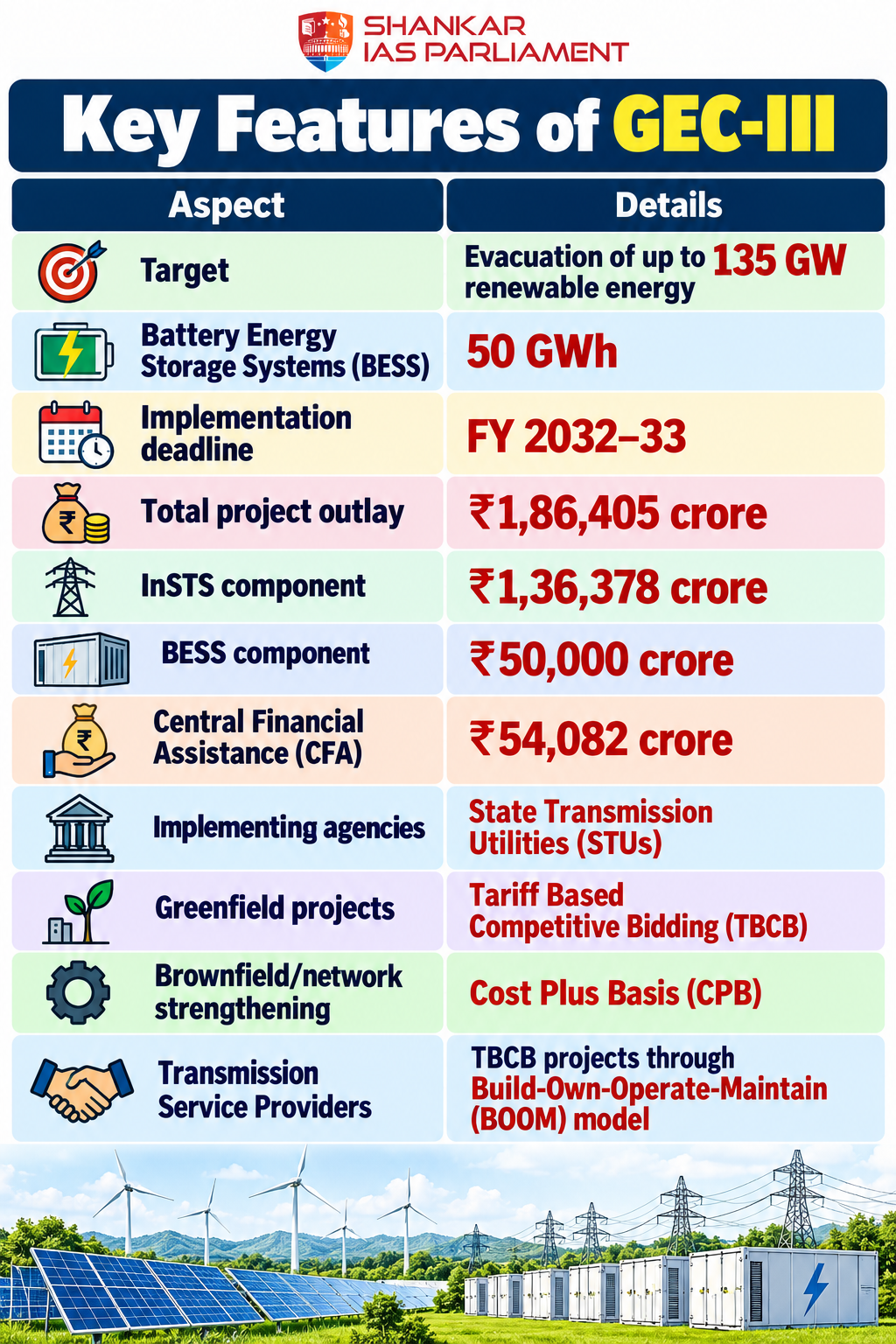
Recently, the Union Cabinet approved the Green Energy Corridor Phase-III (GEC-III) on 30 September 2026.
Green Energy Corridor Phase-III
- Aim – To strengthen the Intra-State Transmission System (InSTS) to facilitate the evacuation and integration of renewable energy.
- All Greenfield projects under the InSTS component will be implemented through Tariff Based Competitive Bidding (TBCB) mode.
- While brownfield upgradation and network strengthening works will be executed under Cost Plus Basis (CPB).
- Implementing agencies – State Transmission Utilities (STUs)
- Transmission Service Providers (TSPs) will participate under TBCB on a Build-Own-Operate-Maintain (BOOM) model.
Battery Energy Storage System (BESS)
- It is a technological system designed to store electrical energy in rechargeable batteries and release it as required.
- Role – BESS will address the following challenges:
- Intermittency in renewable energy generation
- Grid congestion
- Curtailment during peak hours
- Electricity demand during non-solar hours
- Overall grid flexibility and stability
- Significance
- It facilitates intra-state renewable power evacuation and supports grid integration.
- It supports India's goal of achieving 900 GW of installed non-fossil fuel capacity by 2035.
- The CFA offsets intra-state transmission charges, helping to contain electricity costs.
- BESS promotes energy security and reduces the carbon footprint.
- It generates employment in the power, manufacturing, construction, and energy storage sectors.
Reference
PM India | Green Energy Corridor Phase-III



