0.1234
7667766266
x

Glacial Lake Outburst Flood (GLOF) in Bhutan 2026

iasparliament Logo
October 31, 2026

Prelims: Current events of national and international importance | Geography

Why in News?

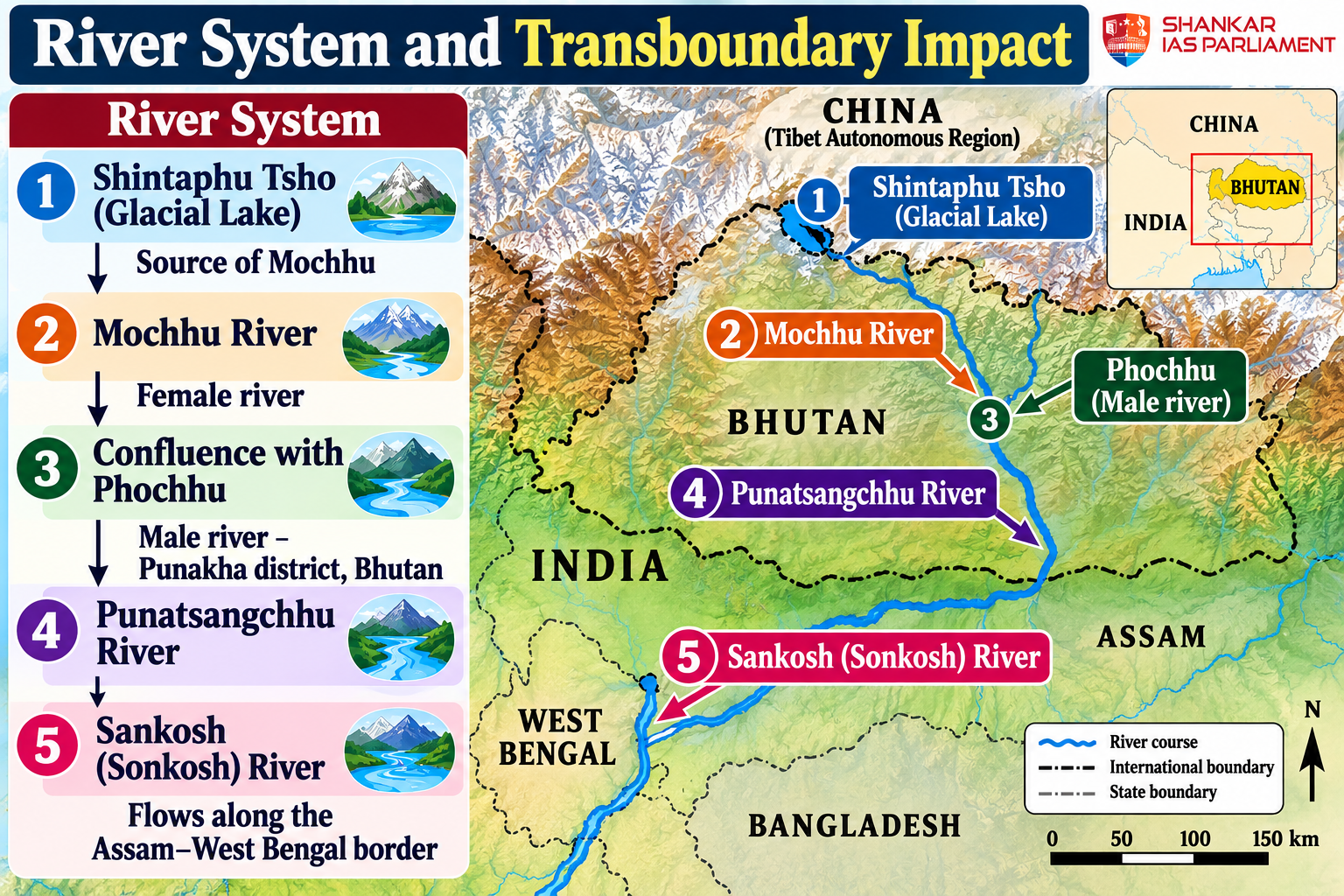
A Glacial Lake Outburst Flood (GLOF) originating from Shintaphu Tsho (Sintaphu Lake) in the northwestern Gasa district of Bhutan.

Origin and Location

  • Glacial lake involved – Shintaphu Tsho (Sintaphu Lake).
  • Location of the event – Laya area, Gasa district, northwestern Bhutan.
  • Affected river – Mochhu River.

river-system-and-transboundary-impact-1.png

Water Volume

  • Prior to the outburst, the lake contained an estimated 6 to 7 million cubic metres of water.
  • This volume is equivalent to approximately 2,400 to 2,800 Olympic-sized swimming pools.
  • The precise volume of water released is still under assessment.

Impact

  • Infrastructure, including roads and bridges, sustained damage in Bhutan.
  • A Bailey bridge in Punakha district, constructed in 2022 with support from India, was washed away.
  • The Gasa Tshachu hot spring sustained extensive damage.
  • No human casualties were reported as of October 30, 2026.
  • A new artificial lake formed near Taktsemakhang, downstream of Laya, which has raised concerns regarding another potential outburst.
  • Bhutanese authorities ordered the evacuation of vulnerable individuals and personnel from affected locations.
  • Downstream alerts were issued for regions in West Bengal and Assam.

Glacial Lake Outburst Floods (GLOFs)

  • A Glacial Lake Outburst Flood (GLOF) refers to the sudden release of a substantial volume of water from a glacial lake resulting from the failure or breaching of its natural dam.
  • Glacial lakes typically form through the accumulation of meltwater originating from glaciers.
  • These lakes are commonly dammed by the following natural barriers:
    • Moraines, which are accumulations of glacial debris.
    • Ice formations, bedrock, or other natural barriers.

Major Triggers of GLOFs

  • Glacier melting – Rising temperatures increase meltwater and lake volume.
  • Moraine Dam Failure – Weak or unstable moraine barriers may collapse.
  • Avalanches – Ice, snow, or rock avalanches can enter lakes and generate displacement waves.
  • Earthquakes – Seismic activity can destabilise natural dams.
  • Heavy rainfall – Excessive rain can raise lake levels and destabilise surrounding slopes.

Reference

The Hindu | Bhutan GLOF 2026

There are no reviews yet. Be the first one to review.

ARCHIVES

sidetext