Prelims: Current events of national and international importance | Species
Why in News?
The giant African snail is spreading rapidly across Tirunavaya Panchayat in Kerala, raising health concerns among students.
Scientific Name – Lissachatina fulica
It is one of the world’s largest and most damaging land snails, which is one of the invasive species in India.
Distribution & Habitat – Native to Eastern Africa, it has quickly spread around the world and is now established in most tropical countries, especially in forest habitats.
Introduction to India – It was introduced to India in 1847 and reached Madras in the early 1900s.
It was first reported in Kerala in the 1950s at Elapully, Palakkad & the major spread waves followed in the 1970s and again in 2005.
Key Features
Size – The adult shell is typically in 50-100mm long, but can grow upto 200mm.
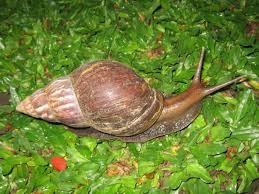
Appearance – Adult snails are very large with a long, narrow, cone-shaped shell.
Colour – They can vary in colour; however, they are usually light brown, with alternating brown and cream bands on their upper whorls.
Diet – They can eat plant matter (leaves, fruits, vegetables), and also occasionally dead animal remains, eggshells, stones, sand, bones and concrete (for calcium to strengthen shells).
Lifespan – They can live for 3 to 5 years, and sometimes up to 10 years in captivity.
Conservation Status – It is not listed in the IUCN Red List, but recognised by IUCN as one among the world’s 100 worst invasive alien species.
Impacts – It can affect plants by eating more than 500 crops and ornamental plants, carrying disease-causing organisms, including the rat lungworm that causes meningitis and bacteria linked to septicemia and peritonitis, causing health impacts.