Mains: GS II – Social Justice | Judiciary | Governance
The Supreme Court has released a new report urging trial court judges to adopt gender-sensitive courtroom practices and use compassionate, legally grounded language in judgments.
Title – “Judgments and Gender: Sensitivity and compassion in writing judgments”.
Drafted by – An expert committee headed by former Supreme Court judge.
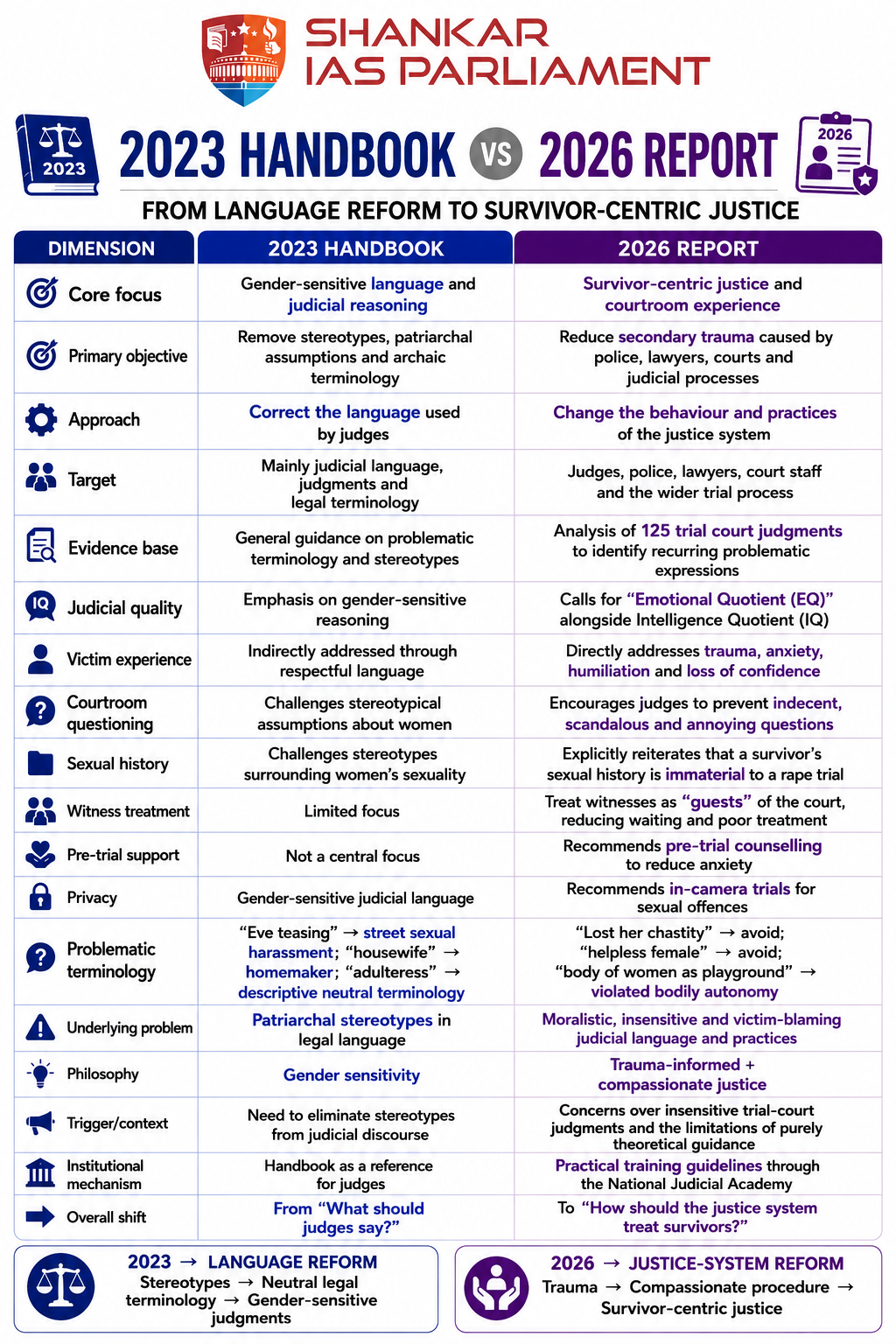
Objective – To emphasises practical courtroom management and ensuring that the legal process does not re-traumatise victims.
Differ from – The 2023 “Handbook on Combating Gender Stereotypes” published by the apex court that had focused on helping judges identify and avoid patriarchal language.
Key finding – The justice system can itself become a source of secondary trauma when survivors are subjected to insensitive police remarks, humiliating questioning, prolonged court proceedings, insufficient privacy, or moralistic judicial language.
 .
.
Human Dignity – A survivor should be treated with dignity and respect, rather than as an object of investigation or moral judgment.
Non-Maleficence – “Do No Further Harm” - The justice system must avoid becoming an additional source of trauma by preventing insensitive questioning, humiliating remarks, or unnecessarily prolonged proceedings.
Compassion & Empathy – Judicial competence encompasses both cognitive intelligence (IQ), which pertains to legal reasoning, and emotional intelligence (EQ), which involves sensitivity to the survivor's circumstances.
Impartiality – Judges should refrain from making patriarchal, moralistic, or culturally biased assumptions regarding a woman's character, clothing, sexuality, or conduct.
Respect for Autonomy – The choices, testimony, and bodily autonomy of survivors must be respected rather than evaluated based on notions of “chastity” or “character.”
Privacy & Confidentiality – Conducting proceedings in camera and handling testimony with sensitivity safeguard survivors against unnecessary exposure and social stigma.
Procedural Justice – Fairness extends beyond the final verdict. It also includes respectful questioning, timely proceedings, and dignified treatment of witnesses.
Truth & Evidence – Questions should focus on establishing facts. When a survivor's sexual history is not legally relevant, it must not be used to undermine their character.
Institutional Responsibility – Police, lawyers, judges, and court staff have an ethical duty to ensure a safe and respectful justice environment.
Gender Justice – Using neutral legal language instead of stereotypes ensures women are evaluated based on law and evidence rather than social norms.
Compassion should be balanced with due process by ensuring the protection of survivor dignity, privacy, and autonomy, while also safeguarding the accused’s right to a fair trial.
Indian Express | Gender-Sensitivity Guidelines for Trial Judges



