Prelims: Current events of national and international importance| Science and Technology
Why in News?
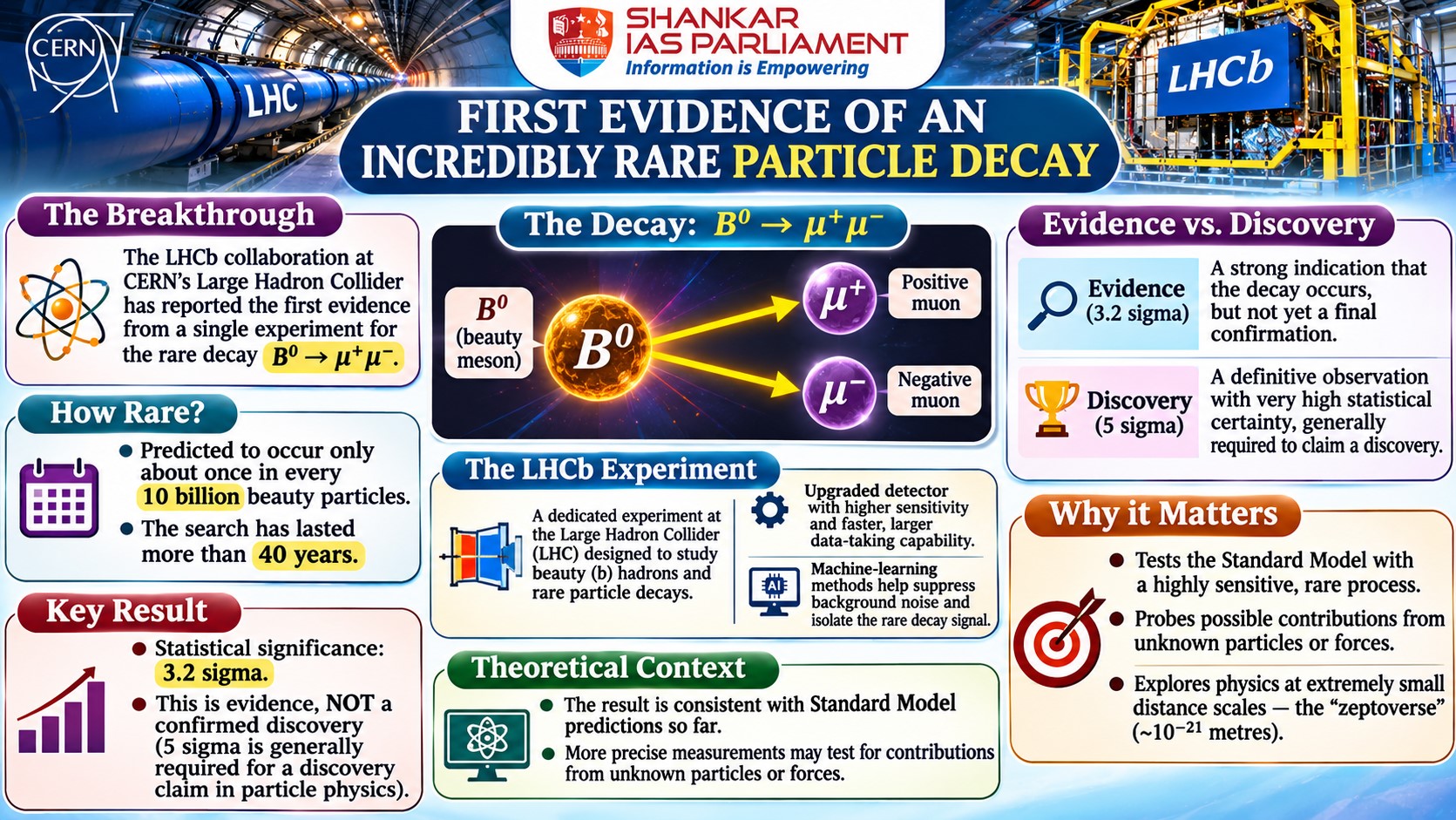
Physicists on the LHCb collaboration at CERN's Large Hadron Collider have found the first single-experiment evidence of the \(B_d \to \mu^+\mu^-\) decay, a process where a beauty (\(B_{d}\)) meson decays into two muons.
Announced on November 3, 2026, the decay is theorized to happen only about once in every 10 billion beauty particle decays.
- The Decay Process– A \(B_{d}\) particle (made of a beauty quark and a down antiquark) transforms into a muon and an antimuon (\(\mu ^{+}\mu ^{-}\)).
- Decades-Long Search– Theorized since 1984, it took over 40 years of searching to reach evidence from a single experiment.
- Statistical Significance– The result reaches 3.2 sigma using combined data from 2011–2018 and 2024–2025. This meets the threshold for "evidence," though particle physicists require 5 sigma to claim a confirmed discovery.
- Measured Rate– The combined analysis indicates a \(B^{0}\) (\(B_{d}\)) decay rate of roughly 1.14 in 10 billion, matching Standard Model predictions.
Why It Matters?
- Testing the Standard Model– Rare decays act as sensitive probes into the "zeptoverse" (scales around a billionth of a trillionth of a meter).
- Probing New Physics– Any deviation from predicted rates could hint at undiscovered particles, new forces, or clues about dark matter, while alignment tightens limits on where unseen heavy particles might hide.
- Upgraded Detector– Higher collision recording rates, upgraded LHCb hardware, and machine learning helped isolate the rare signal alongside more precise measurements of the related \(B_s \to \mu^+\mu^-\) decay.
Reference
Science Daily| First evidence of an incredibly rare particle decay



