Why in News?
The rupee-to-dollar exchange rate, or the rupees needed to purchase a U.S. dollar, crossed 96 in May this year; the graph of the Indian rupee has been snaking sharply downward.
What is the Exchange Rate?
- Exchange Rate – It is the value of one nation's currency vs the currency of another nation or economic zone.
- Typically, exchange rates can be free-floating or fixed.
- Free-Floating Exchange Rate – It rises and falls due to changes in the foreign exchange market.
- Fixed Exchange Rate – It is pegged to the value of another currency.
- The rupee’s exchange rate vis-à-vis a particular currency, say the US dollar, tells us how many rupees are required to buy a US dollar.
To know more about Exchange Rates, click here
What is the impact of trade deficits on the rupee’s value?
- Demand – The demand for the rupee rises with India’s exports and falls with imports.
- Impact of Increased Export – When firms in Ludhiana export garments, the dollars or euros they receive from foreign buyers are exchanged for rupees to pay workers and suppliers, thereby increasing demand for the rupee.
- Impact of Reduced Imports – On the other hand, Indian companies import oil by exchanging rupees for dollars, thereby reducing the demand for the rupee.
- Even individuals travelling abroad exchange rupees for foreign currency (destination country), further reducing rupee demand.
- Balance of Payments Link – Overall, if India’s imports exceed exports, the foreign currency payments it must make to the rest of the world exceed the foreign currency payments it receives.
- That implies more rupees are exchanged for dollars, leading to declines in the demand for, and the value of the rupee (requiring more rupees to purchase one dollar).
- Thus, a currency’s exchange rate is closely tied to the country’s balance of (foreign currency) payments (to and from the rest of the world).
- India’s Trade Deficit – India has consistently run a merchandise trade deficit, with imports of goods (especially oil) exceeding exports.
- Oil imports are a major contributor.
- This deficit is partly offset by a surplus in India’s invisibles -
- Service exports (especially IT/software).
- Remittances from migrant workers in West Asia.
- Current Account Deficit – Overall, India’s current account, which is the sum of merchandise trade and the invisibles accounts, has been in deficit.
- To bridge the current account gap, India relies on capital inflows, mainly
- Foreign investment.
- External loans.
- Role of Forex Reserves – If capital inflows exceed the current account deficit, the surplus adds to India’s forex reserves.
- These reserves act as a buffer to stabilise the rupee during volatility.
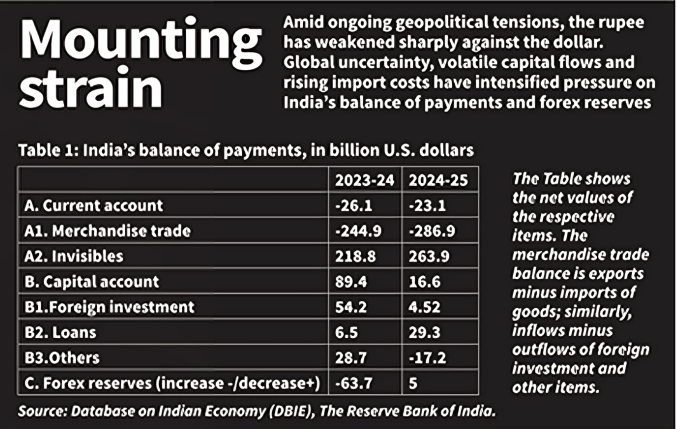
How do capital outflows weaken the rupee?
- Forex Reserves as a Safety Net – A country’s forex reserves are as valuable as a family’s treasure trove.
- The reserves are tapped to pay for critical imports during periods of insufficient foreign currency inflows, and to defend the currency’s value when capital outflows are too large.
- FDI vs FPI
- Foreign Direct Investment (FDI) – It is mostly in new or existing factories and businesses and, as a result, has some ties binding it to the host country.
- Foreign Portfolio Investment (FPI) – It involves purchases of stocks or bonds, is highly volatile and driven by speculation.
- Portfolio investors enter a country seeking quick financial returns and exit at the first sign of risk or when higher returns are offered elsewhere.
- Impact of FPI Flows – When FPI surges in, the stock markets are on a roll; when it flows out, it leaves a trail of destruction.
- This leads to
- Falling demand for the rupee &
- Depreciation of the exchange rate (more rupees needed per dollar).
- Capital Outflows & Rupee Weakness – Capital outflows imply that investors withdraw their investments in rupee assets and exchange them for dollar assets, leading to a tumble in demand for the rupee and in its exchange rate.
- The Periods of Rupee Depreciation
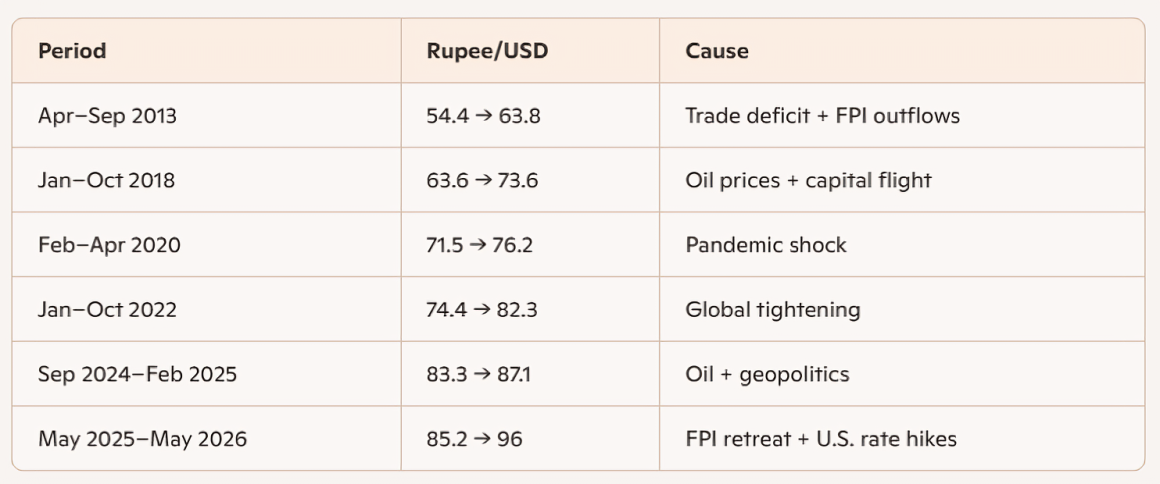
- It has each been characterised by worsening of the trade account, FPI outflows, or both.
- Investors Retreat – The rupee’s recent fall is mainly because foreign investors are pulling money out of India, choosing safer markets due to rising U.S. interest rates and global tensions.
- Rising Import Costs – The depreciation of the rupee imposes a high cost on the Indian economy.
- To purchase a barrel of oil at $100, Indian companies now must pay Rs. 9,600, compared to Rs. 8,500, had the exchange rate remained at Rs. 85 per dollar.
- Export Advantage – However, a depressed rupee can help boost exports: a shirt costing Rs. 1,200 can be sold in the U.S. market at $12.5 now; if the exchange rate were Rs. 80 per dollar, the price would have been $15.
- Limitations – But rupee depreciation alone may not help much, given the range of supply and demand constraints weighing on Indian manufacturing.
- Structural reforms are needed to fully leverage currency depreciation.
What is the role of the RBI?
- RBI’s Intervention – The Reserve Bank of India (RBI) intervenes to prevent the exchange rate from falling to very low levels.
- When foreign investors rush out by selling their rupee assets for dollars, the RBI props up the rupee by selling some of the dollars (or treasury bonds) from its reserves.
- This raises the demand for rupee and slows its decline (as it did during October 2024-January 2025 and August-December 2025).
- Strength of Forex Reserves – India’s forex reserves remain sufficiently large.
- They stood at around USD 691.11 billion at the end of March 2026, enough to cover 10.8 months’ worth of the country’s imports (as of the end of December 2025).
- These reserves are a powerful shield against speculative attacks on the rupee.
What lies ahead?
- The ongoing geopolitical tensions and the threat of further oil price increases pose severe challenges.
- India could be at risk of paying more dollars per barrel of oil and more rupees per dollar.
- The country must take steps to regulate speculative capital outflows and reduce its dependence on oil imports.
Reference
The Hindu | Why is the Indian Rupee falling?



