Why in news?
Expanding biosphere reserves across the world will help millions of people realise a better future in harmony with nature.
What are biosphere reserves?
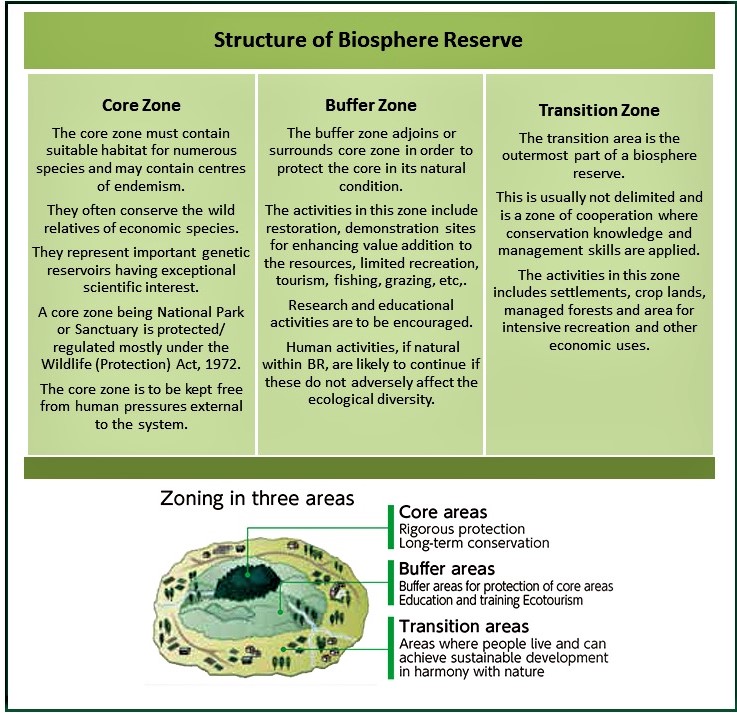
- Biosphere Reserve (BR) is an international designation by UNESCO for representative parts of natural and cultural landscapes extending over large area of terrestrial or coastal/marine ecosystems or a combination thereof.
- BRs are are living examples of how human beings and nature can co-exist while respecting each others’ needs.
Criteria for designation of BR
- The site must contain an effectively protected and minimally disturbed core area of value of nature conservation.
- The core area should be typical of a bio-geographical unit and large enough to sustain viable populations representing all trophic levels in the ecosystem.
- The management authority to ensure the cooperation of local communities while managing and containing the conflicts.
- Areas potential for preservation of traditional tribal or rural modes of living for harmonious use of environment.
What are World Network of Biosphere Reserves?
- The World Network of Biosphere Reserves of the MAB Programme consists of a dynamic and interactive network of sites of excellence.
- It was formed in 1971, as a backbone for biodiversity conservation, ecosystem restoration, and living in harmony with nature.
- There are now 738 properties in 134 countries.
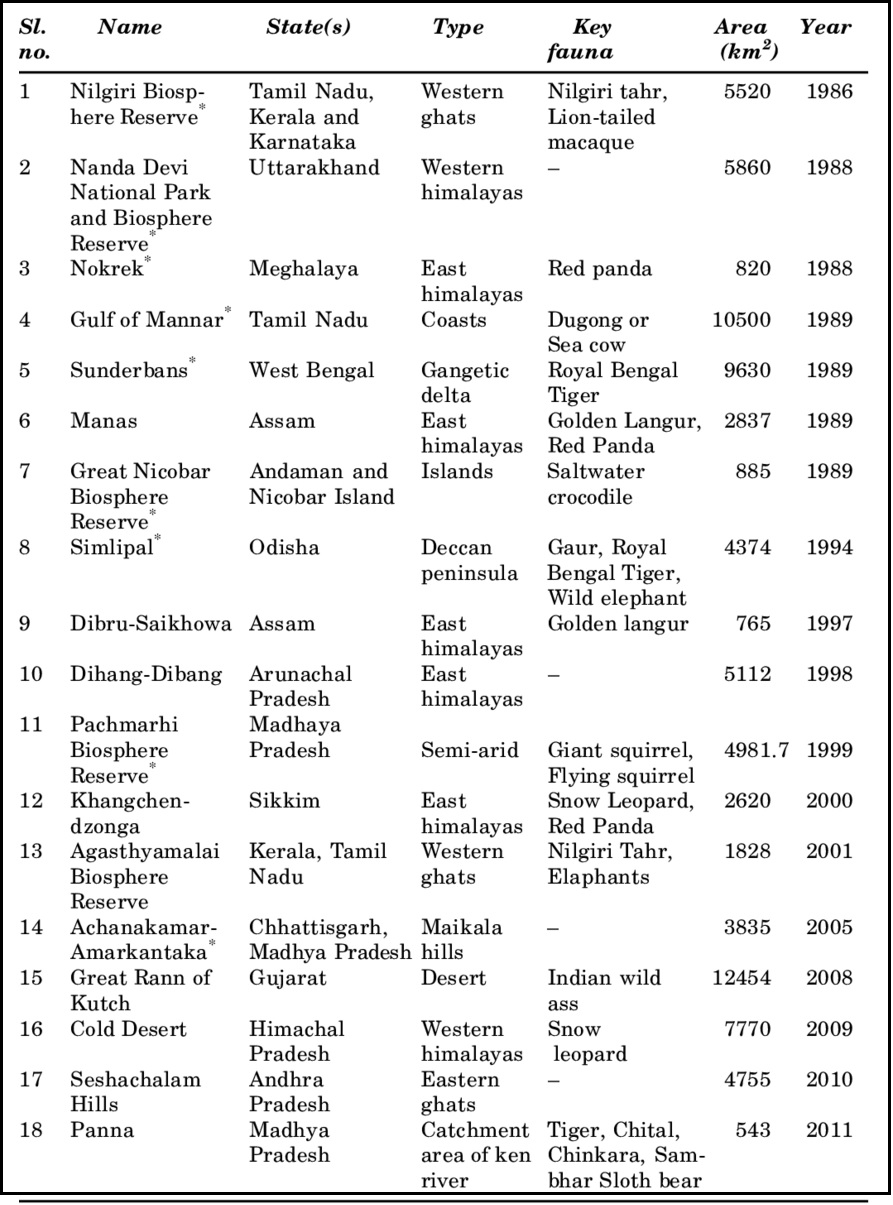
- There are 18 biosphere reserves in India, out of which 12 are recognized internationally under the MAB programme.
- Spain is one of the lead participating WNBR countries globally, with 53 properties.
- The first biosphere reserve in South Asia was the Hurulu Biosphere Reserve, in Sri Lanka.
- Bangladesh, Bhutan, and Nepal do not have biospheres as yet.
What is the significance of World Network of Biosphere Reserves?
- It is a unique tool for cooperation through sharing knowledge, exchanging experiences, building capacity and promoting best practices.
- Support of members is of great importance because the ecological carrying capacity of the planet earth has been exceeded.
- The best concept for ‘Living in Harmony with Nature’ that exists in the United Nations system, is the WNBR.
- Concerns – The long-term threats includes biodiversity loss, climate change, pollution and population dynamics, accelerated by the blind belief in technological solutions for all problems.
References
- The Hindu│ A chance to expand the world’s biosphere footprint
- UNESCO│ Biosphere Reserves
- UNESCO│ Man and the Biosphere (MAB) Programme
- Vikaspedia│Biosphere reserves in India
Quick facts
UNESCO’s Man and the Biosphere Programme (MAB)
- UNESCO’s Man and the Biosphere Programme (MAB) is an intergovernmental scientific programme that was launched in 1971.
- It aims to establish a scientific basis for the improvement of relationships between people and their environments.
- It proposes interdisciplinary research, demonstration and training in natural resources management.
- MAB helps national governments with the planning and implementation of research and training programmes with technical assistance and scientific advice.
- India is a signatory to the landscape approach supported by UNESCO's MAB programme.
Biosphere reserves in India
- Biosphere reserves in India are announced by state and central government.
- First biosphere reserve in India - The Nilgiri Biosphere Reserve
- Largest biosphere reserve in India - Great Rann of Kutch
- Smallest biosphere reserve in India - Dibru-Saikhowa (Assam)



