Prelims: Current events of national and international importance | Species
Why in News?
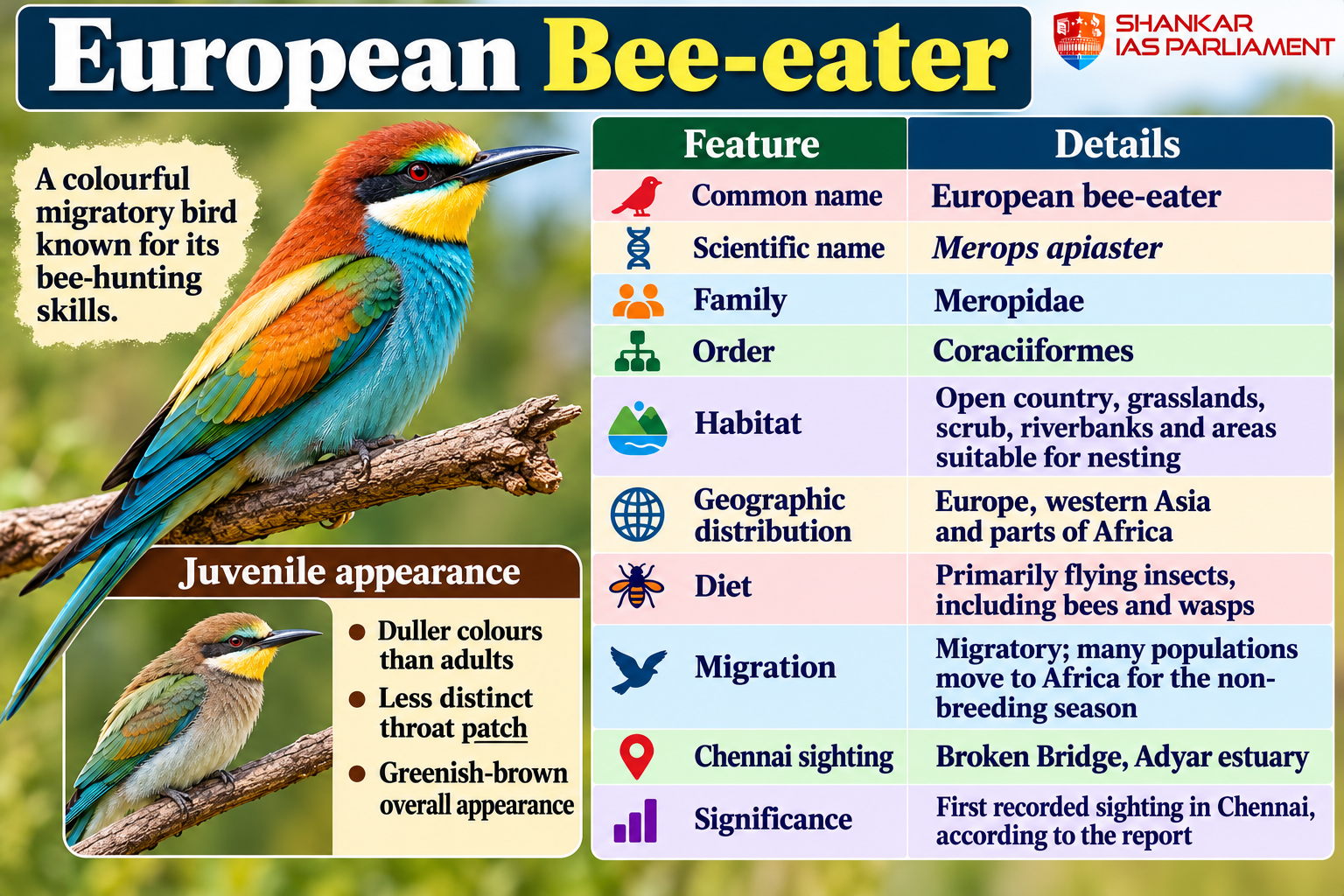
Recently, a European bee-eater was documented for the first time in Chennai at Broken Bridge, adjacent to the Adyar River Estuary.
- The observation was submitted to eBird, a global bird observation database, where it was reviewed and accepted.
- The bird was identified as a juvenile based on its plumage as well as distinctive throat and wing markings.
- Additionally, a Eurasian wryneck, another rare species, was observed on the same day.
- Identification Features
- Exhibits brightly coloured plumage, particularly with blue-green hues.
- Displays a distinctive yellow throat.
- Presents a broad dark trailing edge along the wing, as observed during identification.
- Feeds primarily by capturing flying insects, such as bees.
European Bee-eater vs. Blue-tailed Bee-eater
|
Feature
|
European bee-eater
|
Blue-tailed bee-eater
|
|
Scientific name
|
Merops apiaster
|
Merops philippinus
|
|
Family
|
Meropidae
|
Meropidae
|
|
Distinguishing feature
|
Yellow throat and characteristic dark trailing wing edge
|
Blue tail and a different combination of plumage markings
|
|
Status in Chennai
|
Extremely rare; first recorded sighting reported
|
Seen more regularly
|
|
Diet
|
Flying insects
|
Flying insects
|
Eurasian Wryneck: Notable Rare Sighting
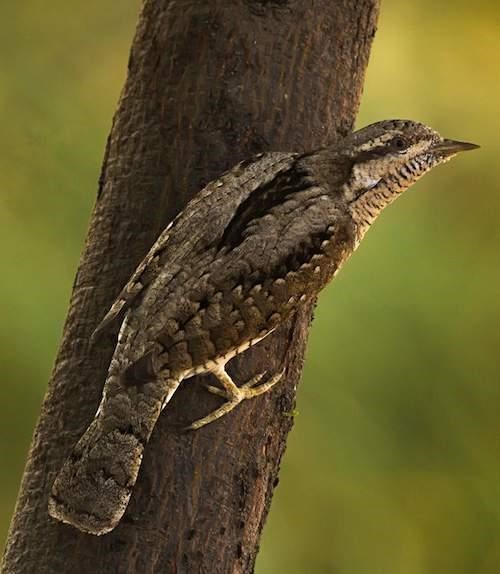
- Scientific name – Jynx torquilla
- This species belongs to the woodpecker family, Picidae.
- It uses camouflage to blend into tree bark.
- Its diet consists primarily of ants and other small invertebrates.
- The species is named for its distinctive snake-like threat display.
- Distinctive Behaviour – When threatened, the Eurasian wryneck exhibits the following behaviors:
- It elongates and twists its neck.
- It turns its head from side to side.
- It produces a hissing sound.
- This behavior can startle predators by mimicking both the appearance and sound of a snake.
- Notably, despite its unusual behavior, the Eurasian wryneck is classified as a woodpecker, not a snake or a member of the bee-eater family.
Reference
The Hindu | European Bee-eater Spotted in Chennai



