Why in news?
India in ‘G20 Energy Ministers’ 2023, has rolled out 20% ethanol-blended petrol in 2023 and aims to cover the entire country by 2025.
What is ethanol blended petrol?
- Ethyl alcohol or Ethanol (C2H5OH) is a biofuel that is naturally made by fermenting sugar.
- It is basically 99.9% pure alcohol that can be blended with petrol.
- While it is mostly derived by extracting sugar from sugarcane, other organic matter like foodgrains can also be used for their production.
|
Status of Ethanol Production in India
|
- India is the world’s 3rd largest energy consuming nation and a significant part of India’s energy requirement is met through oil imports.
- Ethanol production capacity increased more than 2.5 times and no. of distilleries increased by 66% in 8 years.
- Most of the ethanol production in India comes from B Heavy Molasses.
- Ethanol Industry is expected to grow by 500%.
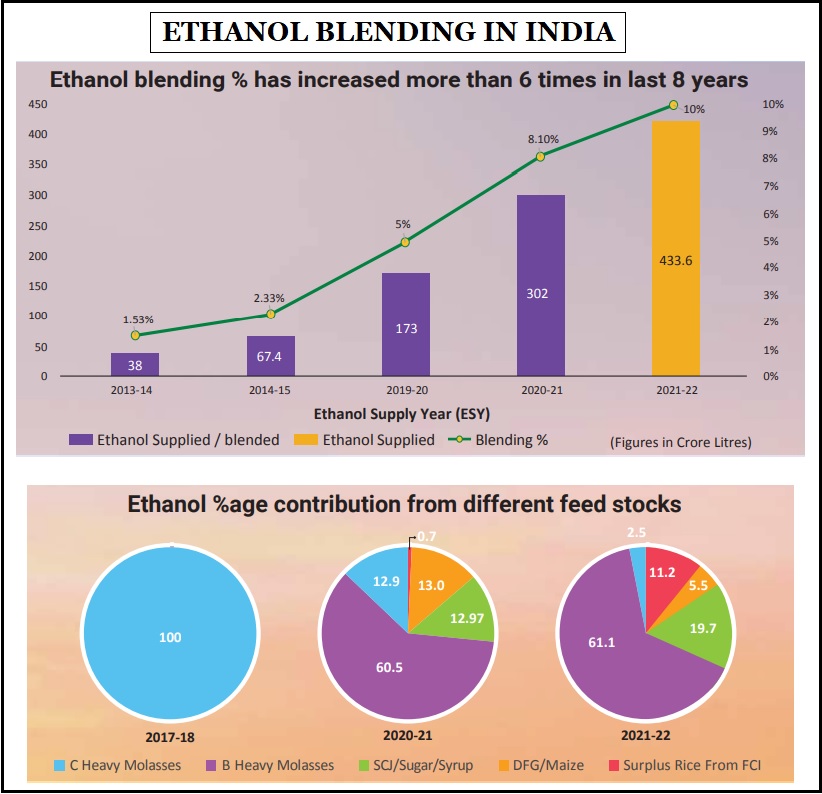
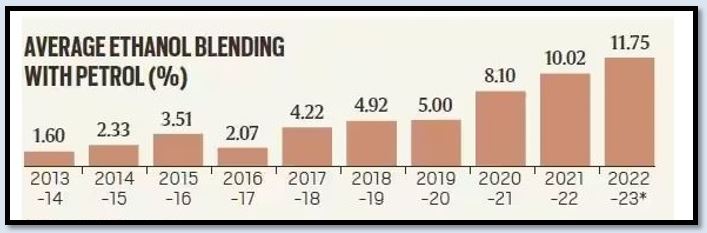
- India has doubled ethanol blending with petrol to 10% in the last two years.
- Ethanol blending will reach 12% in 2023 and meet the target of 25% by 2025.
|
What are the advantages?
- Energy security- It will reduce the import bill and save Rs 30,000 crore of foreign exchange per year and lower the carbon emissions.
- Farmers’ income- As the ethanol feedstock is diversified (rice, maize, jowar etc.,) it will increase farmers’ income.
Ashok Dalwai committee recommends for doubling farmers income by farm diversification.
- Employment generation- With new technology and ethanol production there will more employment opportunities created.
- Sustainability- Ethanol can be procured even from the damaged foodgrain and vegetable waste, so that it does not compromise on food security.
- Fuel India- Uttar Pradesh and Bihar would “fuel India” in future as Punjab, Haryana, Maharashtra feeds India.
Uttar Pradesh is a major sugarcane producer, Bihar is the major producer of maize.
- By-products- The new molasses-based distilleries gives around 28% of potash that can be used as fertilizer and the by-product can be sold as animal feed.
What are the issues with ethanol blending?
- Availability of sufficient feedstock- The ethanol production via food grains which is the staple crop of India may pose a challenge to the food security.
- Regional disparity- There are some states which produce ethanol more than the requirement for blending within the State.
- Climate Change- Weather related events like flood, drought pose significant challenge on food grains.
- Low energy content- The energy content of ethanol is low (almost 35%) than that of petrol. Thus, vehicles running on ethanol have poor mileage.
- Engine stalling- This is due to phase separation as ethanol has high affinity for water, it gets separated from petrol when it comes in contact with water.
|
Steps Taken to Promote Ethanol Blending in India
|
- Nodal agency- Department of Food and Public distribution is the nodal agency for promotion of fuel grade ethanol producing distilleries in the country.
- Ethanol procurement- Government has allowed ethanol procurement from sugar cane based raw materials, surplus rice and maize from Food Corporation of India.
- Ethanol Blended Petrol Program- It was launched in 2003 with the aim to promote the use of renewable fuels.
- Started with 5% blending, it has set a target of 10% ethanol blending by 2022 and 20% blending (E20) by 2030 which was now shifted to 2025-26.
- National Policy on Bio fuels – It was launched in 2018 which prescribes as indicative target of 5% blending of biodiesel in diesel by 2030.
- Differential pricing- The Government fixed higher prices for ethanol produced from B-heavy molasses and whole sugarcane syrup to compensate mills for revenues foregone from reduced/nil production of sugar.
- GST- Goods & Service Tax (GST) on ethanol meant for EBP Programme has been reduced from 18% to 5%.
- Interest Subvention Scheme-It is for enhancement and augmentation of the ethanol production capacity which would help in year round production.
- Roadmap for ethanol blending in India 2020-25- It is released by Niti Aayog which recommends measures for ethanol blending in India.
|
What lies ahead?
- Feedstock diversification- Ethanol yields from grains are actually higher than from molasses.
- For example, 1 tonne of rice yields around 450-480 litres of ethanol.
- Augment Ethanol production capacity- There should be uniform availability of ethanol blends in the country.
- Infrastructure- Oil Marketing Companies will need to prepare for the projected requirement of ethanol storage, handling, blending and dispensing infrastructure.
- Single window clearances- Faster regulatory clearances are the need of the hour for ethanol production units
- Ethanol compatible vehicles - Higher ethanol compatible vehicles need to be produced through incentives.
References
- Indian Express| Explained how to blend more and better
- Times of India| What is ethanol blending petrol
- PIB| Ethanol Blending Program



