Mains: GS III - Environmental Pollution and Degradation
Why in the news?
A recent study on aerosols levels of 141 cities in India from 2003 to 2020 by IIT at Bhubaneswar, has shed new light on urban aerosol pollution patterns across India, revealing a north-south divide in how pollution domes form over cities.
What is urban aerosol pollution?
|
Aerosols
|
- It is a suspension of fine solid particles or liquid droplets in a gas, most commonly in air.
- Sources
- Natural cause – Volcanoes
- Anthropogenic cause - Burning fossil fuels.
- Size – They are typically small, with diameters often less than 1 micrometre, allowing them to remain suspended for extended periods.
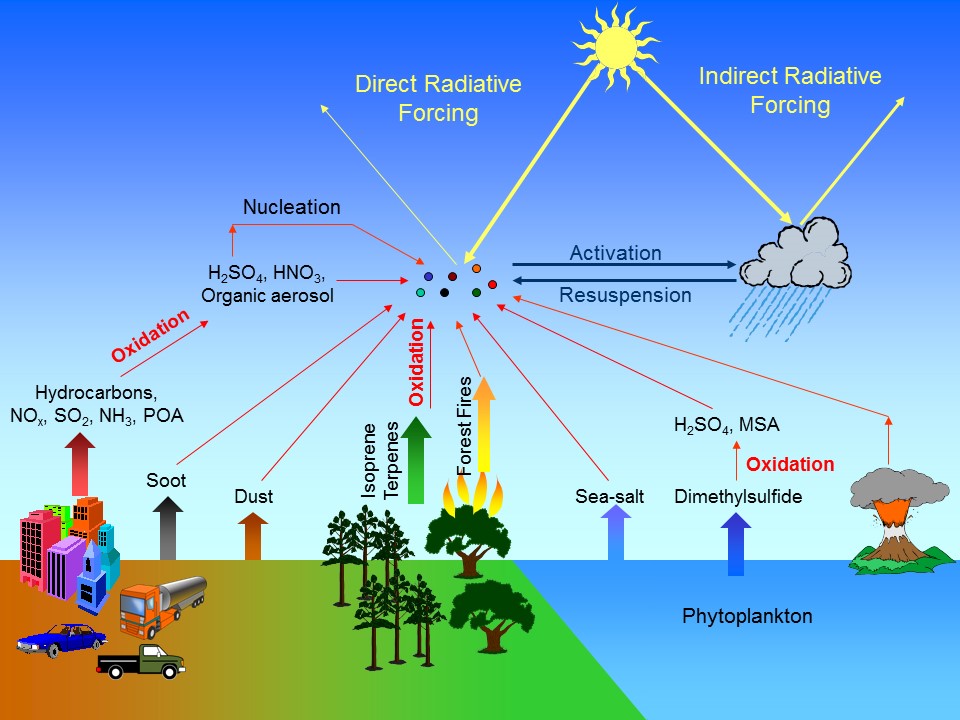
- Role – They play a role in atmospheric processes, influencing air quality, weather, and climate.
|
- Urban aerosol pollution – It refers to the presence of small, solid, or liquid particles suspended in the atmosphere within cities.
- Two types
- Urban aerosol pollution island
- Urban aerosol clean island
- Urban aerosol Pollution Island – It refers to the cities that show higher aerosol levels than the surrounding areas.
- It occurs, whenever less transport of aerosol or pollution is happening irrespective of the season.
- The aerosol levels were not uniformly higher in the surrounding areas compared with the city.
- Urban aerosol clean island – It refers to the cities that show relatively lower aerosol levels compared with the surrounding areas.
What is the level of urban aerosol pollution Island in India?
- Regional variation – 57% Cities in south and southeast India show higher aerosol levels inside the city compared to neighbouring parts.
- Causes – This occurs due to local pollution sources which dominates aerosol presence and lack any large external source of pollutants coming from elsewhere.
- It became distinct in many cities during no dust scenario.
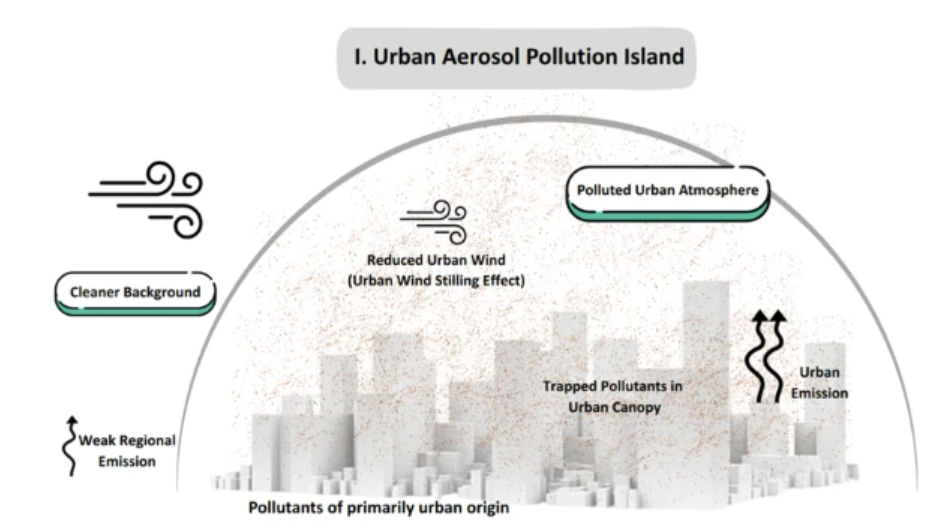
- Consequences – This results in a typical “pollution dome” where urban areas are more polluted than their rural surroundings.
A pollution dome is a phenomenon where pollutants, such as smog and particulate matter, become concentrated and trapped in the atmosphere usually above a city or industrial area, forming a dome-like layer of polluted air.
- Higher level – It is in the areas southwest of the city, which are located upstream of the dust flow.
- Lower level – It is in the northeast side of the city situated downstream of the dust flow that exhibited less aerosol levels which almost matched the levels seen in the city.
- It is a trail that continues downwind for some distance.
What is the level of urban aerosol clean Island in India?
- Regional variation – 43% of cities in northwest and northern Indo-Gangetic Plain display lower aerosol levels within city limits than in surrounding areas.
- North Indian cities, despite being blamed for poor air quality, are found to have no consistent pollution domes.
- External aerosol source - Aerosols from external sources such as dust from the Thar Desert and biomass burning contribute heavily to background pollution.
- It became pronounced in many cities in high dust case.
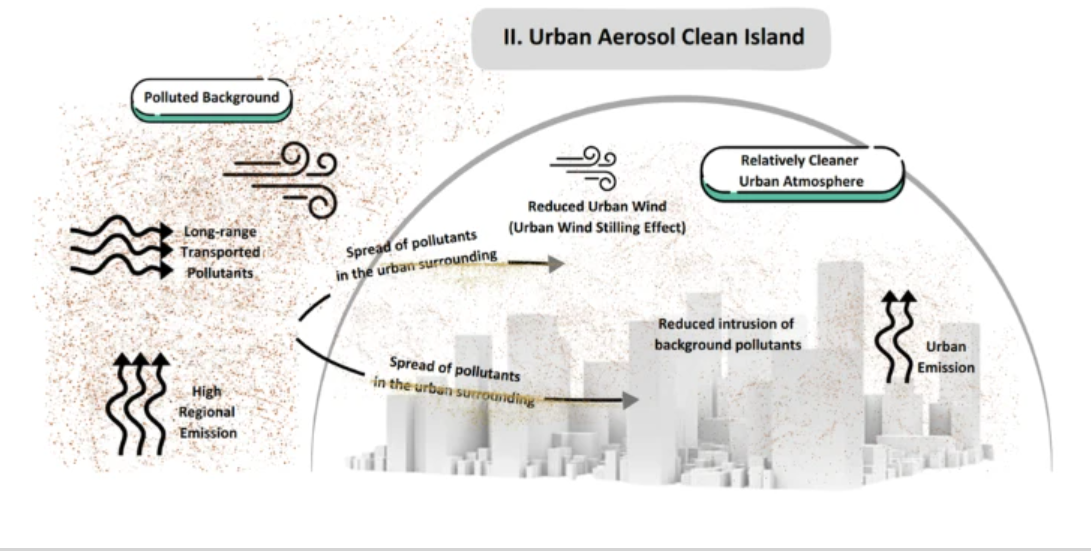
- Clean island effect is whenever the pollution transport from outside is enhanced.
- Cities as barriers – The infrastructures of the cities block aerosol entry and creating cleaner urban zones compared to their surroundings.
- This unexpected pattern is linked to a phenomenon known as urban wind stilling effect.
|
Wind Stilling Effect
|
- It refers to a weakening of surface winds across highly urbanised cities where the buildings and infrastructure reshape local climates, creating zones of atmospheric stagnation.
- These zones collectively lead to invisible barriers around the city in the upwind regions.
- They partially block the entry of long-range aerosol pollution, especially mineral dust from the nearby arid regions.
- This results in cities having relatively less aerosol loading than the surrounding areas.
- Global megacities such as Shanghai, Atlanta and a few European cities have urban aerosol clean islands.
|
- Seasonal variation in India
- During monsoon – Not studied due to non-availability of data due to clouds and rain.
- Pre-monsoon – Clearly observable.
- Post-monsoon – Normally disappears but seen again in winter due to dry conditions.
What lies ahead?
- Deeper scientific understanding could help to evolve an idea on how urban growth and emerging micro-climates influence air pollution and its spatial patterns.
- Creation of truly sustainable, climate-resilient cities will depend on our capability to understand and anticipate these multifaceted interactions as cities continue to grow.
Reference
The Hindu| Urban Aerosol Pollution



