Mains: GS III – Environmental Pollution and Degradation
Why in News?
The noise pollution is one of the health hazard that has crept up unacknowledged on Indian cities.
What is noise pollution?
- Noise pollution - Noise pollution is the presence of excessive, loud, or unwanted sound in the environment that negatively affects human and animal health, well-being, and the surrounding ecosystem.
- Major sources – These include transportation, industrial activities, construction, and household appliances.
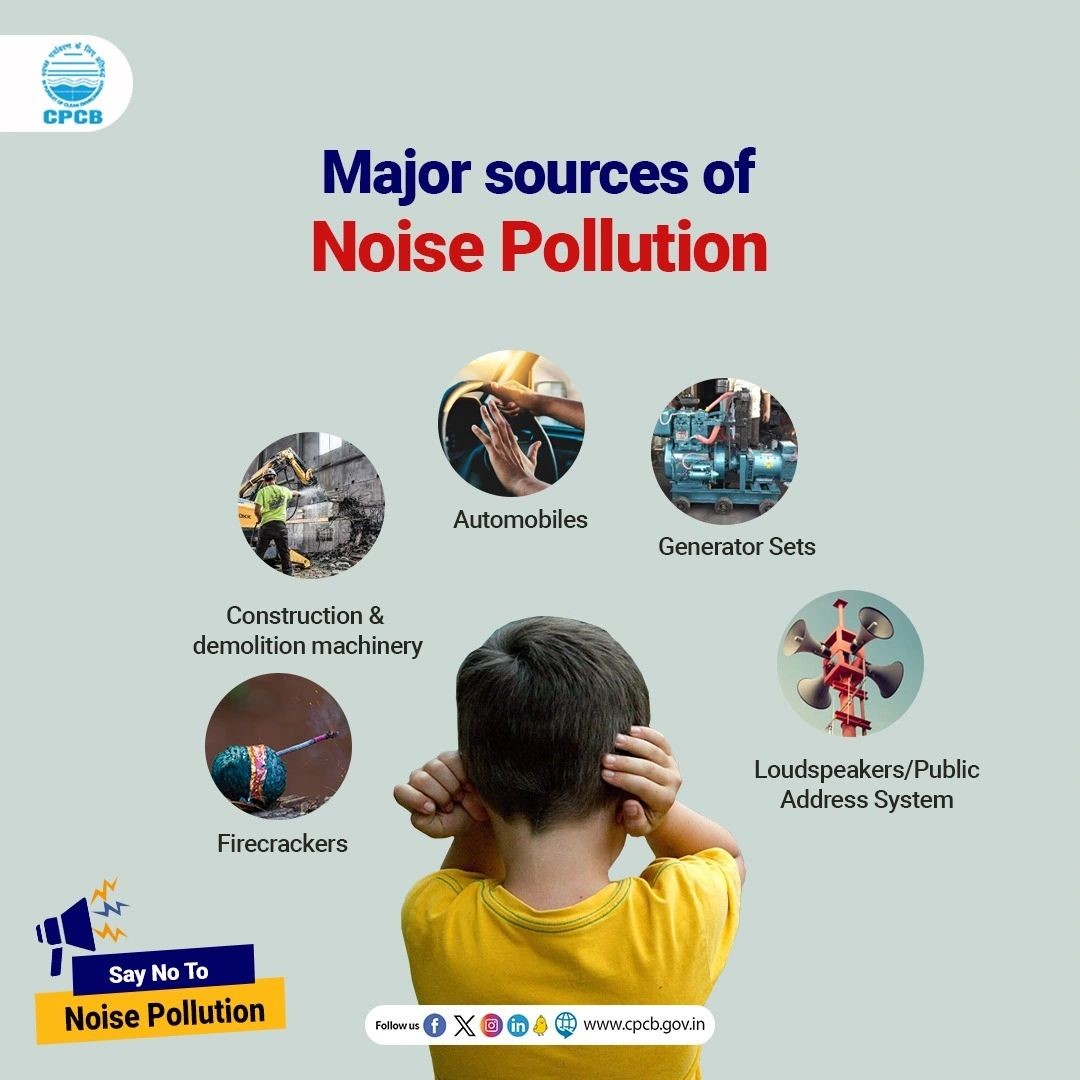
- Impacts – It can cause issues like hearing loss, increased stress, and sleep disruption in humans, and can interfere with communication and behavior in wildlife.
- Medically, it is among the leading contributors to hypertension, sleep disruption, stress disorders, and cognitive decline.
- Safe level – The World Health Organization recommends residential daytime exposure not exceed 55 dB (A) — roughly the volume of a normal conversation.
How is noise pollution regulated in India?
- Legal recognition – Legally, it is already recognised as an air pollutant under the Air (Prevention and Control of Pollution) Act, 1981.
- Regulation – In India noise pollution is regulated by The Noise Pollution (Regulation and Control) Rules, 2000.
- It set similar limits of 55 dB from 6 am to 10 pm, and 45 dB at night.
- But the decibel scale is not linear, a 10 dB increase means a ten-fold rise in intensity.
- Traffic corridors in Indian cities often exceed 70 dB (A).
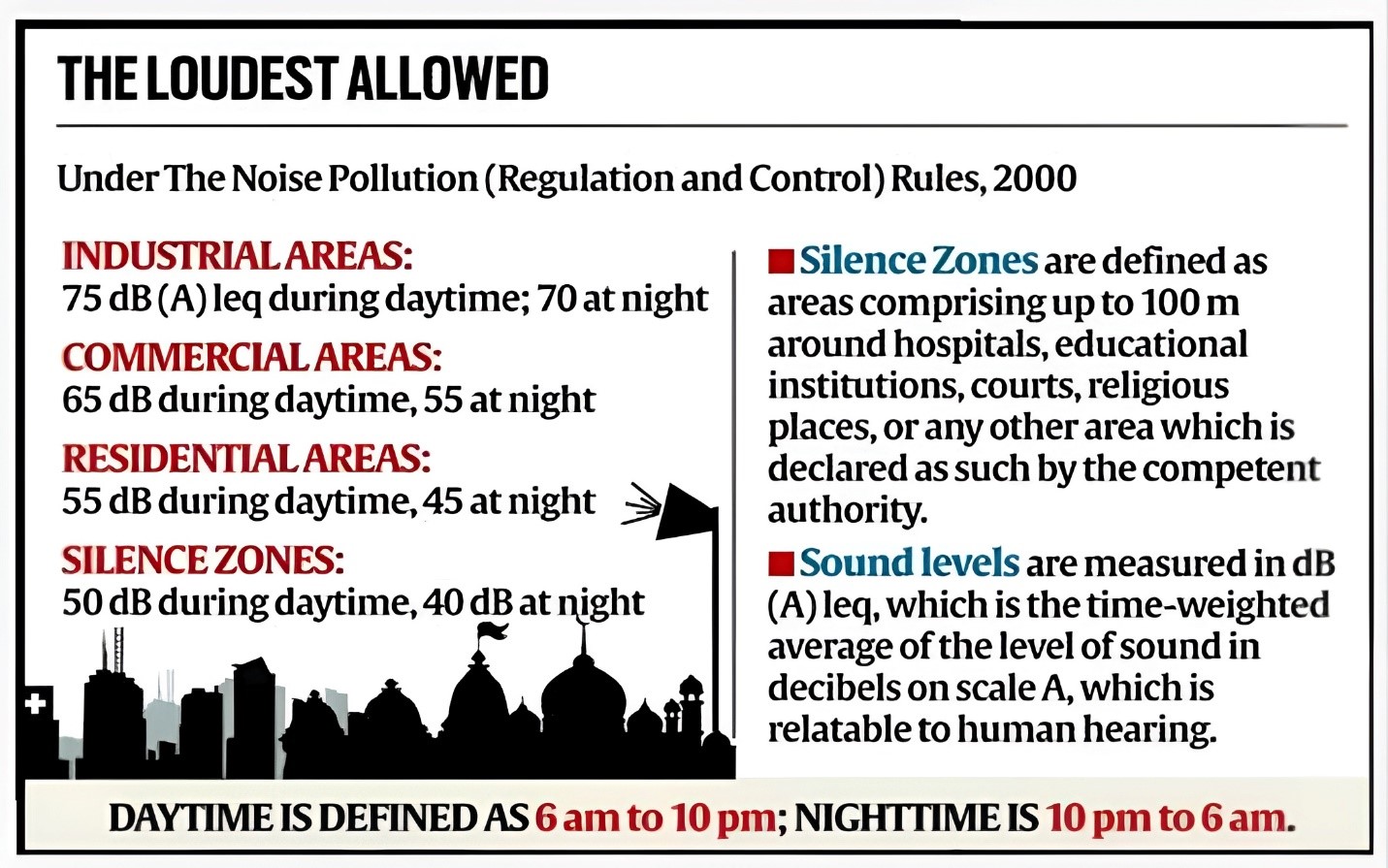
- Increased burden – Most towns and cities in India routinely endure noise levels far above what is safe.
- Most vulnerable people – Along air pollution, the burden of this unchecked exposure falls heaviest on those least able to shield themselves.
- They are street vendors, delivery workers, traffic police, and residents of informal settlements.
- For them, the roar of the city is not an occasional nuisance but an everyday occupational hazard that slowly erodes health and well-being.
What are the issues in regulation of noise pollution?
- Inadequate investment – Yet, despite this dual recognition, India has barely invested in systematic monitoring or data collection to understand the scale of the damage.
- Weak enforcement – The responsibility is scattered across multiple authorities.
- Short term interventions – As with air quality, symbolic fixes occasional honking bans or festival crackdowns do little to tackle structural drivers.
- The result is a chronic, unaddressed public health crisis.
- Inadequate monitoring – Unlike air pollution, where satellites and low-cost sensors have transformed measurement, noise data in India are sporadic, reactive, and incomplete.
- Structural and cultural barriers – These factors hinder effective enforcement.
- Lack of recognition – Without recognition that noise can be as harmful as smog, many citizens tolerate or even participate in noisy practices.
- Fragmented governance – Pollution control boards, municipalities, and police all have partial jurisdiction, limited resources, and weak incentives to act.
What must be done?
- Acknowledge the issue – Treating noise on par with air and water pollution can make a significant change.
- Monitoring – Real-time sensors can create integrated maps of sound exposure.
- Innovation – Machine-learning tools can distinguish sources like traffic, construction, industry and it may guide targeted responses.
- Including in planning and research – Urban planning must incorporate noise mitigation.
- Researchers and policymakers should design evidence-based interventions grounded in public-health data.
- Health studies should explicitly track noise exposure, especially near schools, hospitals, and low-income areas.
- Creating green buffers such as trees and parks absorb sound, while zoning can shield residential areas from high-intensity noise corridors.
- While limited experiments with green belts for noise-reduction are promising, broader efforts must be scientifically assessed and community-informed.
- Governance reforms – Noise regulations must be enforceable, backed by transparent data and accountability.
- Inter-agency collaboration – Agencies must collaborate across sectors — from pollution boards to transport departments and municipalities.
- Behavioral change – Promoting walking and cycling for urban mobility.
- For example, initiatives such as “No Honking Day” must evolve into sustained behavioural campaigns.
- Adoption to e-vehicles – A faster transition to electric buses, and enforcing honking restrictions systematically will bring measurable relief.
- Community engagement – Noise is tied to cultural and social practices, hence the solutions must be sensitive but firm.
- Campaigns and Partnerships – Awareness campaigns and partnerships with religious and community leaders can reshape norms without alienating communities.
- Ensuring equity – Those most exposed to noise often have the least means to protect themselves.
- The right to quiet must not be a privilege it must be a baseline condition of public health.
What lies ahead?
- India has already learned, painfully, that neglecting air pollution magnifies harm and widens inequity.
- The law already names it an air pollutant, what is missing is the political and civic will to act.
- By treating noise with the seriousness it deserves integrating it into clean-air agendas, embedding it in urban planning, and making it a priority for public health we can save lives, protect communities, and reclaim the basic human right to quiet.
Reference
The Indian Express| Noise pollution



