Prelims: Current events of national and international importance | International Relations
Why in News?
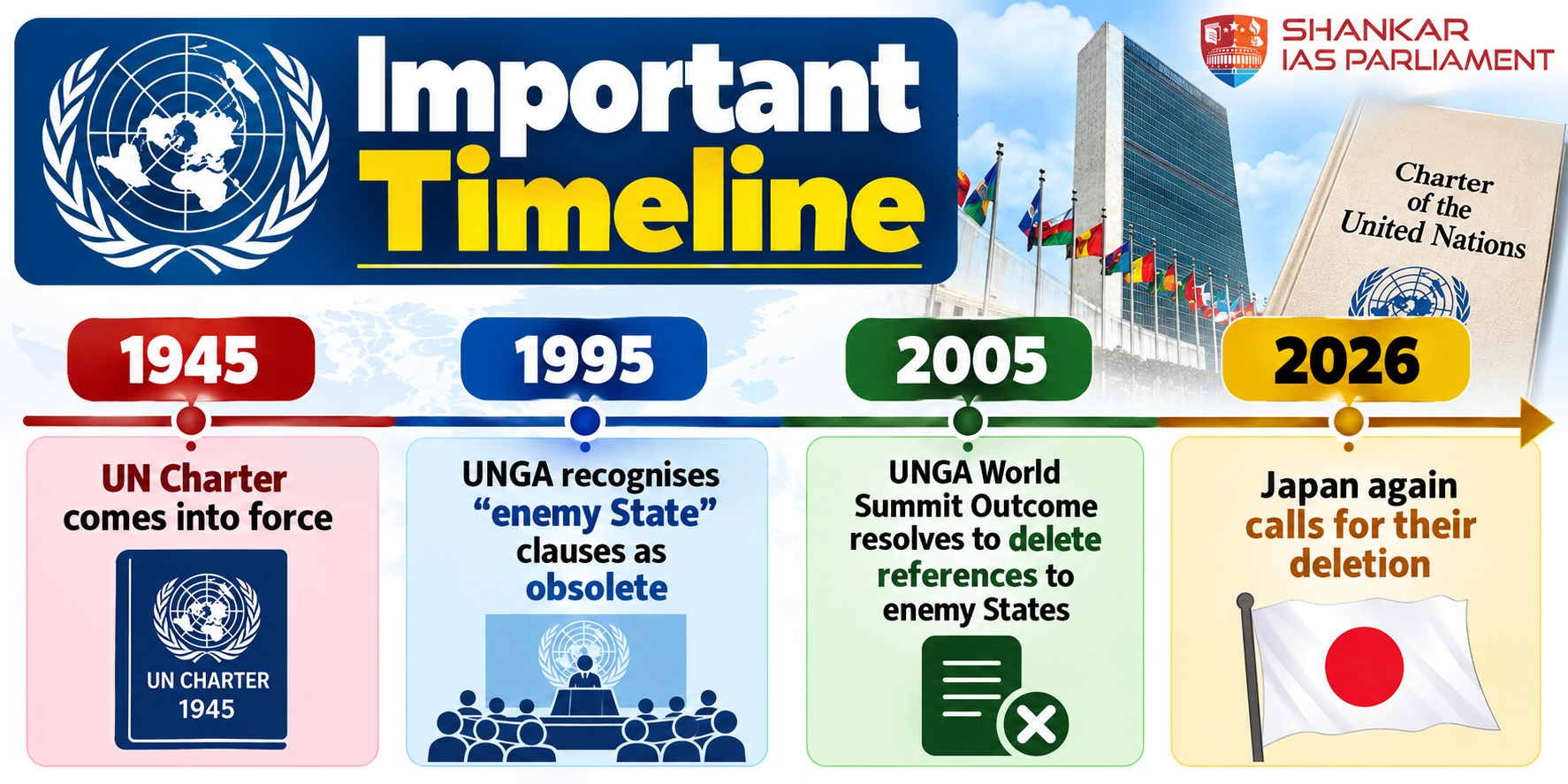
Japan’s Prime Minister Sanae Takaichi, in her address to the 81st UN General Assembly (UNGA), called for deletion of the “enemy State” clauses from the UN Charter.
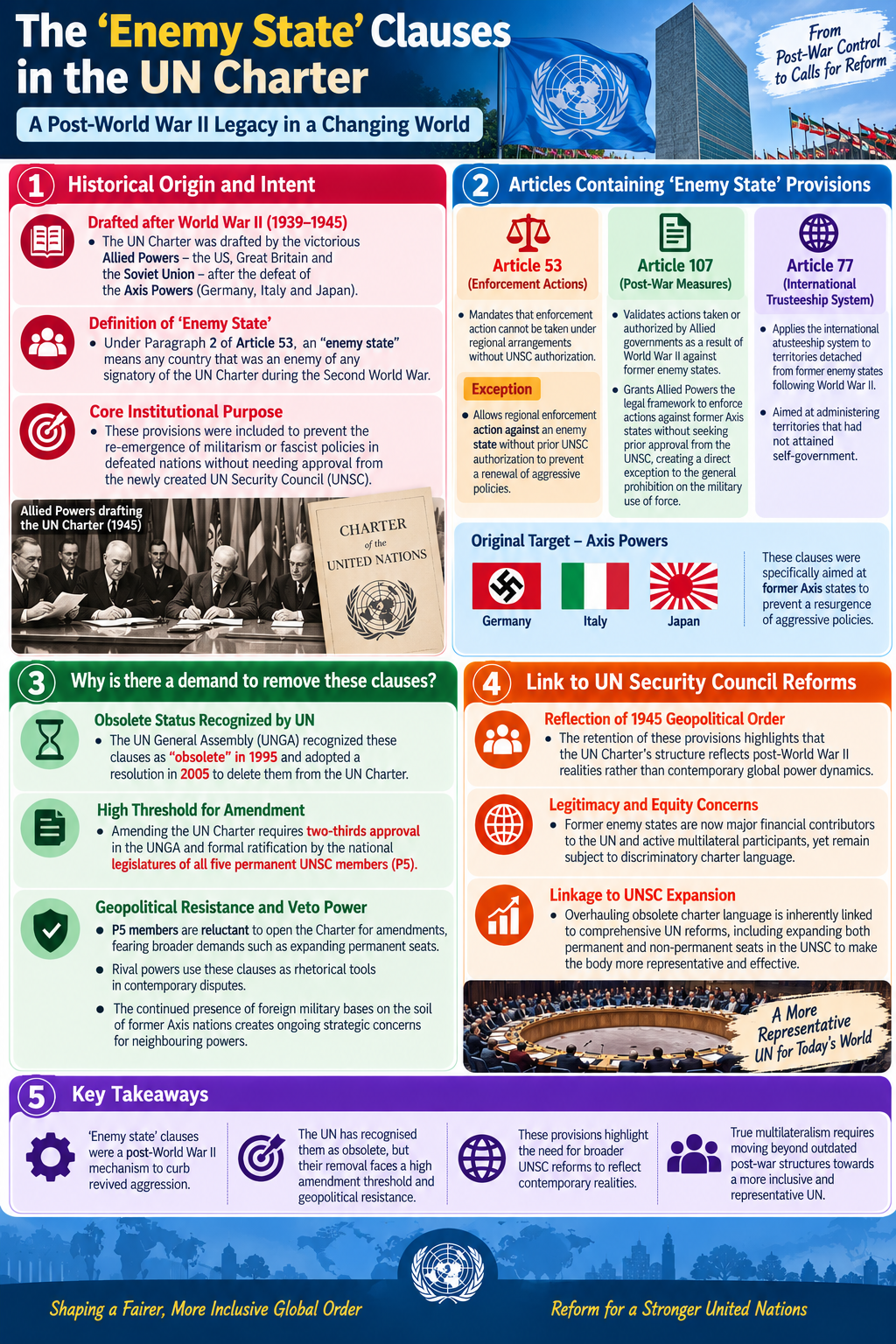
- Enemy State – The term refers to a state that was considered an enemy of a signatory to the United Nations Charter during World War II, as specified in Article 53(2).
- This term primarily applies to the former Axis Powers.
- The term originates from World War II and is not a modern designation established by the UN.
- Historical Context – World War II concluded with an Allied victory, which directly led to the drafting of the United Nations Charter in 1945.
- The United Nations Charter was drafted in the immediate aftermath of World War II.
- The victorious Allied Powers sought to retain specific legal mechanisms to prevent renewed aggression by the former Axis powers.
- Consequently, the Charter incorporated special provisions regarding so-called “enemy States.”
- These provisions remain integral components of the UN Charter.
-
- Article 53 – Typically, enforcement actions undertaken by regional arrangements or agencies require authorization from the UN Security Council.
- However, Article 53 provides an exception concerning actions against “enemy States”.
- Article 107 – It stipulates that the Charter does not invalidate or preclude actions taken or authorized as a result of World War II against States that were enemies of Charter signatories.
- Article 77 – Itaddresses the UN Trusteeship System and encompasses territories that may be detached from enemy States as a consequence of World War II.
- Reasons for Their Obsolescence – The geopolitical context that existed in 1945 has undergone significant transformation.
- States previously considered adversaries, such as Japan and Germany, have since become members of the United Nations.
- These provisions are now largely dormant and considered obsolete.
- In 1995, the United Nations General Assembly formally recognized these clauses as obsolete.
- Firm Retention of Provisions – Passing a United Nations General Assembly resolution alone does not constitute an amendment to the Charter.
- An amendment to the United Nations Charter is required.
- According to Article 108, amendments to the Charter require the following procedures:
- Adoption by a two-thirds majority in the General Assembly, and
- Ratification by two-thirds of United Nations member states, including all permanent members of the Security Council.
Permanent members are the United States, the United Kingdom, France, Russia, and China.
Japan’s Comprehensive Proposal for Reform of UNGA
- Takaichi advocated for the following reforms:
- An increase in the number of permanent members of the United Nations Security Council.
- An increase in the number of non-permanent members.
- A Security Council structure that aligns with contemporary international realities rather than the geopolitical context of 1945.
Reference
Indian Express | Enemy State



