Main: GS II – Judiciary | Governance
India’s judiciary has shifted from paper‑based to digitally enabled systems under the e‑Courts Mission Mode Project.
Launched in – 2007, to make the judicial process more affordable, accessible and transparent for all involved, including lawyers, judges and clerks.
Objective – To systematically speed up proceedings by digitising various court proceedings and documents.
Challenges
Paper‑based System – Extensive dependence on physical records results in delays in document retrieval, duplication of efforts, and increased risk of document loss.
Infrastructure Limitations – Traditional brick-and-mortar courts have limited geographical reach.
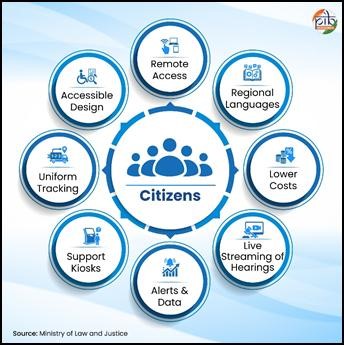
Citizens are often required to travel significant distances to attend hearings and complete necessary paperwork.
High Costs for Citizens – Excessive expenses are incurred for travel, lodging, and other incidental costs.
This financial burden is particularly severe for individuals from rural areas and economically disadvantaged groups.
Slow Justice Delivery – Reliance on manual processes contributes to a backlog of cases and significant procedural delays.
The delivery of justice has become increasingly cumbersome and time-consuming.
Accessibility Issues – Access to documents and case status remains limited.
There is a lack of transparency and significant difficulty in tracking case progress.
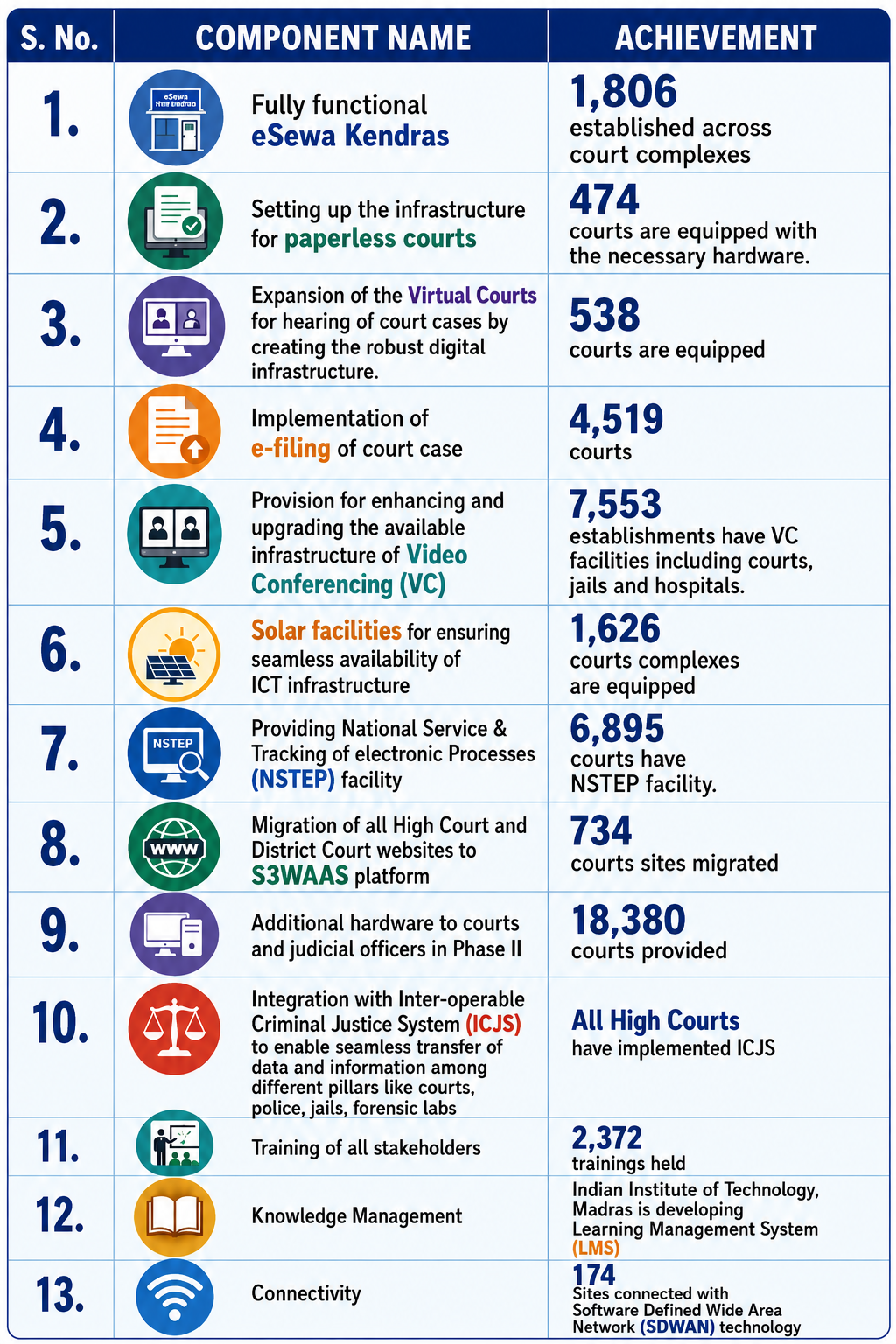
Phase I (2011–2015) – It laid the foundation of this Mission, by computerising over 14,000 courts and building basic network infrastructure needed to support technology-enabled judicial services.
Phase II (2015–2023) - It built on this with a range of citizen-centric services, introducing the National Judicial Data Grid (NJDG), eFiling, and eSewaKendras (a physical help desk providing digital court services).
It also expanded video conferencing infrastructure more than fivefold, significantly enhancing virtual access to judicial proceedings.
Third phase (2023–2027) – It targets digital, paperless courts with large‑scale record digitisation and virtual hearings.
It focuses on interoperability and adoption of AI, analytics, and OCR for smarter justice delivery.
Transparency in pending and disposed cases through National Data Judicial Grid
National Judicial Data Grid (NJDG) – It is an online public dashboard that tracks court orders, judgements and case details in real time across all levels of the judiciary.
3 dedicated dashboards – For the Supreme Court, High Courts and District Courts which provide insightful details on the functioning of courts across the country by tracking.
Objectives – To improve transparency and accountability in the system by making data on pending court cases public.
It has also helped in judicial planning, monitoring and remote administration by the High Court judges, District Judges and High Court Registry.
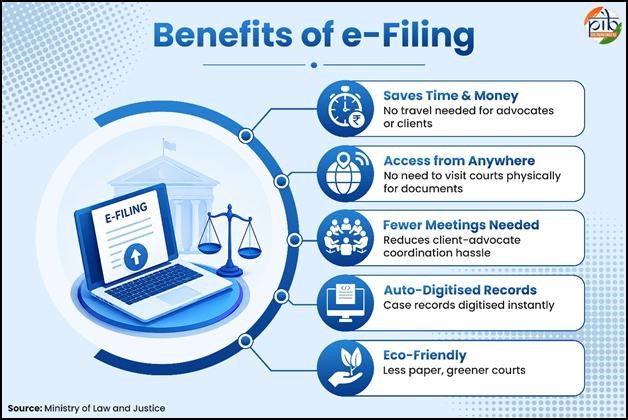
Speeding up of processes through e-Filing of documents -The e-Filing system allows documents to be filed online from anywhere.
Multilingual support – To make justice more inclusive, it supports English as well as regional languages, and works across District Courts, High Courts and the Supreme Court.
The E-filing system supports/provides for:
Online payments
Online submission of Vakalatnamas
E-signing of documents
Online video recording of oaths
Application filings
Portfolio management for advocates and litigants
Adding of colleagues, juniors etc as partners to manage cases collaboratively
Dashboards tracking the status of all completed/pending cases
Readymade templates for various commonly filed pleadings
Digitising legacy court records for efficient case retrieval and storage.
Affordable access to court proceedings through remote hearings
Remote video conferencing – It allows litigants, legal representatives, witnesses, and other stakeholders to participate in hearings without the need for travel, thereby enhancing access to justice across the country.
Nyaya Shruti (2024) – It enables virtual testimony for accused individuals, witnesses, police, prosecutors, experts, and prisoners. This initiative saves time and resources while expediting case resolution.
Connecting Police, Courts, Prisons and Forensics – Digitisation now links the entire criminal justice chain, not just the courts.
ICJS (Interoperable Criminal Justice System) – Platform letting police, courts, prisons, forensics and prosecution exchange FIRs, charge-sheets, orders and reports electronically.
CCTNS (Crime & Criminal Tracking Network and System) – computerises police processes from FIR to charge-sheet, with Nyaya Sanhita-linked deadline alerts for investigating officers.
ITSSO (Investigation Tracking System for Sexual Offences) – dashboard tracking investigations in women/child sexual-offence cases against charge-sheet deadlines.
e-Sakshya – secure app for capturing and managing digital evidence, preserving its integrity from collection to court.
e-Summons – electronic generation, transmission and execution of court summons.
MedLEaPR (Medico Legal Examination and Postmortem Reporting) – hospitals' online system for medico-legal exams and postmortem reports.
Nyaya Shruti – Video-conferencing platform for virtual testimony by the accused, witnesses, police, prosecutors and forensic experts.
e-Forensic – End-to-end digital case handling across forensic labs.
e-Prison – Cloud-based national network for prison and prisoner management.
e-Prosecution – Digital workflow linking police and prosecution for timely legal opinions.
NAFIS (National Automated Fingerprint Identification System) – Centralised biometric database for real-time fingerprint matching against criminal records.
Enabling seamless tracking of judicial business through digital platforms
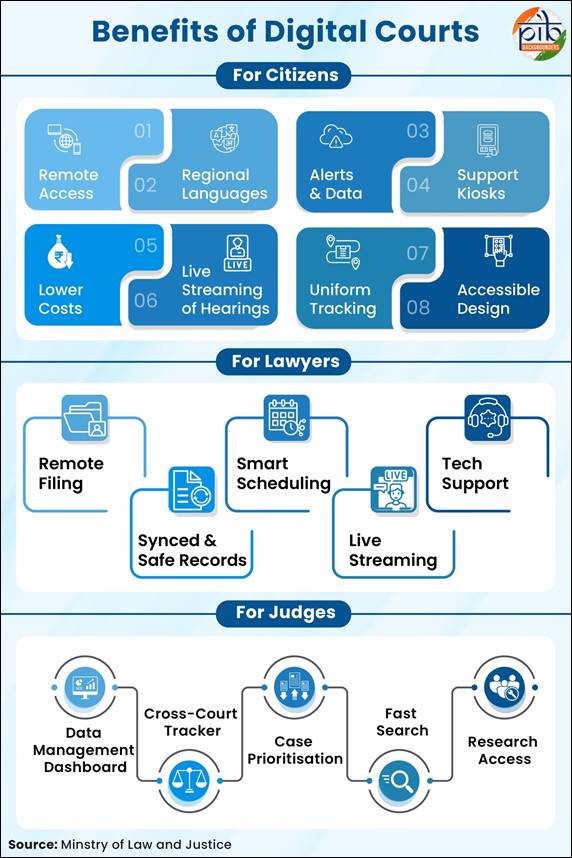
Digital platforms such as apps, portals, email, and SMS now allow lawyers, litigants, and judges to track case status and updates.
This improves transparency and reduces the need for physical court visits.
Each day, the judiciary sends approximately 400,000 SMS messages and 600,000 emails, receives 3.5 million portal visits, and has recorded 38.4 million e‑Courts app downloads.
The JustIS app also supports judges with case management.
National Service and Tracking of Electronic Processes for GPS-tracked delivery of summons:
It enables bailiffs to serve summons and notices electronically in real time using a GPS-enabled web and mobile platform.
This digital system replaces traditional paper-based processes with a transparent and trackable platform, thereby ensuring faster service delivery across districts and states.
Improved understanding of legal process through e-SEWA Kendras
E‑Sewa Kendras in court complexes serve as citizen‑friendly centers, assisting with legal procedures and providing a range of digital judicial services.
Case and Filing Support – It provides case status updates, hearing dates, certified copies, e-filing of petitions, and digital signatures.
Digital Transactions – It assists with e-stamp papers, e-payments, and the resolution of traffic challans through virtual courts.
Virtual Access – It guides video conference hearings, schedule e-Mulakat jail visits, and enable Nyaya Shruti-style testimony.
Citizen Services – It shares judgments and orders digitally, respond to queries about judges’ leave, and connect litigants with free legal aid.
Reach and Scale – Our services are designed to be accessible and scalable to meet the needs of a broad user base.
Phase III aims to establish AI and machine learning-enabled High Courts by 2027, with improvements in legal research, case management, transcription, translation, and support for judicial decision-making.
Key initiatives which are under pilot testing include:
AI and ML tools – It transcribe oral arguments in Constitutional Bench matters, with transcripts published on the Supreme Court's website.
LegRAA (Legal Research and Analysis Assistant) – It helps judges with legal research and document analysis.
Digital Courts 2.1 – Lets judges and judicial officers manage cases in a paperless format, giving them a single window for all case-related information and tasks.
It includes voice-to-text (ASR-SHRUTI) and translation (PANINI) tools to assist with order and judgment dictation.
Judgments are being translated into 18 Indian languages through the eSCR portal, with the National Informatics Centre.
The IIT Madras AI tool automatically flags defects in electronically filed petitions, extracts metadata, and is currently being integrated with the e‑filing system and ICMIS.
Phase III technologies enable the judiciary to address increasing caseloads efficiently and ensure inclusive, location-independent access to justice by 2027.
PIB | e-Courts Mission Mode Project



