Mains: GS II – Polity - Constitutional Amendments
Why in News?
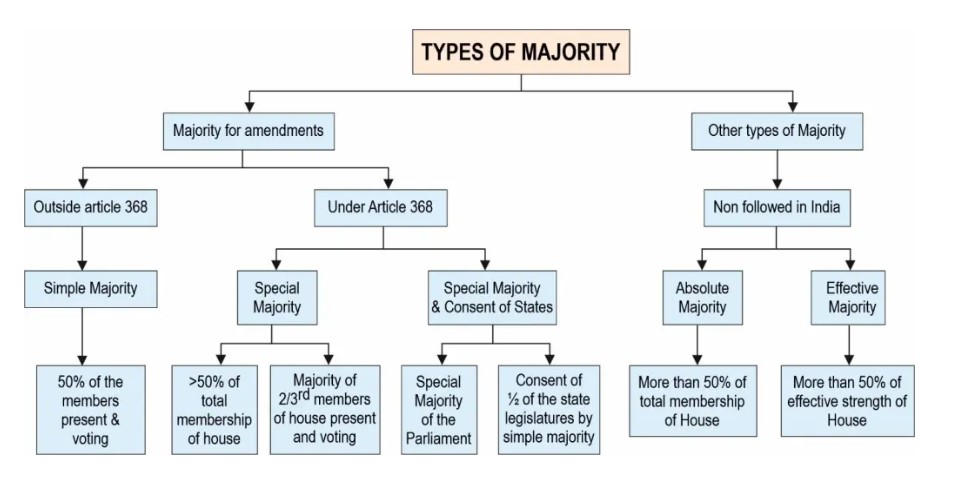
Recently, the Constitution (131st Amendment) Bill, 2026 was defeated in the Lok Sabha as it failed to secure the constitutionally mandated two-thirds majority.
What is the bill all about?
- The Constitution (131st Amendment) Bill, 2026 – It emerged as part of a broader legislative package aimed at restructuring India’s electoral framework through delimitation and facilitating the implementation of women’s reservation in the Lok Sabha.
- Delimitation – It refers to the redrawing of constituency boundaries to reflect changes in population, ensuring equitable representation under the democratic principle of “one person, one vote, one value.”
- Since 1976, delimitation has been frozen based on the 1971 Census to encourage population control measures, leading to significant disparities in constituency sizes.
The Delimitation Commission in India has been constituted four times (1952, 1963, 1973, and 2002)
- The Women’s Reservation framework – It is envisioned to reserve one-third of seats in the Lok Sabha and State Assemblies for women, has long been a subject of political debate.
- Although the enabling legislation for women’s reservation was passed earlier, its implementation was contingent upon delimitation and a fresh Census.
- The 131st Amendment Bill sought to accelerate this process by linking delimitation to the 2011 Census, thereby paving the way for the reservation to be operational by the 2029 general elections.
- Defeat of the bill – The Constitution (131st Amendment) Bill, 2026 was defeated in the Lok Sabha as it failed to secure the constitutionally mandated two-thirds majority, receiving 298 votes in favour and 230 against, out of 528 members present.
What are the key features of the bill?
- Delimitation based on 2011 census – It proposed redistribution of Lok Sabha seats based on population data from the 2011 Census instead of waiting for the next Census cycle.
- Expansion of lok sabha strength – The Bill envisaged increasing the total number of Lok Sabha seats from the current cap of 550 to approximately 850, to address population growth and ensure better representation.
- Linkage with women’s reservation – The Bill aimed to expedite the implementation of one-third reservation for women by tying it to the delimitation exercise.
- Uniform increase in representation – The government verbally assured that all States would witness a uniform 50% increase in seats to address concerns of regional imbalance.
- Associated legislative package – The Bill was part of a broader set of legislations, including the Delimitation Bill, 2026, and the Union Territories Laws (Amendment) Bill, 2026.
What are the reasons for defeat?
- Failure to achieve special majority – Constitutional amendments require a two-thirds majority of members present and voting.
- The Bill fell short of the required 352 votes.
- United opposition – A cohesive Opposition bloc voted against the Bill, demonstrating strategic coordination and shared concerns.
- Concerns over federal balance – Many Opposition parties feared that delimitation based on the 2011 Census would disproportionately benefit northern States with higher population growth, reducing the relative representation of southern States.
- Lack of written guarantees – The absence of explicit provisions ensuring uniform seat increases across States raised apprehensions about potential inequities.
- Linking women’s reservation with delimitation – The Opposition opposed the conditionality, arguing that women’s reservation should not be delayed or made contingent on delimitation.
- Political distrust – There was skepticism about the government’s intentions, with allegations that the move was aimed at redrawing the electoral map for political advantage.
What are the arguments of government?
- Democratic equity – It emphasized the principle of “one person, one vote, one value,” arguing that the current freeze has led to unequal representation due to population growth.
- Timely implementation of women’s reservation – The Bill was projected as a necessary step to ensure that women’s reservation is implemented by the 2029 elections.
- Addressing representation imbalance – The government highlighted disparities in constituency sizes, citing examples where some MPs represent vastly larger populations than others.
- Commitment to federal fairness – It assured that all States would see a proportional increase in seats, dismissing concerns about regional disadvantage.
- Expansion of SC/ST representation – Delimitation would also increase reserved seats for Scheduled Castes and Scheduled Tribes in proportion to their population.
- Criticism of opposition – The government accused the Opposition of engaging in political obstruction and misleading narratives, particularly regarding a supposed north-south divide.
What are the arguments of opposition?
- Delinking demand – It argued that women’s reservation should be implemented independently of delimitation to avoid unnecessary delays.
- Threat to southern states – Parties from southern India expressed concern that population-based redistribution would reduce their relative influence despite better performance in population control.
- Absence of legal safeguards – The lack of written guarantees regarding uniform seat increases across States was seen as a major flaw.
- Political motive allegations – The Bill was criticized as an attempt to manipulate constituency boundaries for electoral gains.
- Neglect of caste census – Some Opposition leaders argued that delimitation should consider updated caste data to ensure equitable representation.
- Gender justice concerns – Linking women’s reservation with delimitation was termed a “hollow attempt” that delays meaningful empowerment.
What are the current status of women representation and challenges?
- Lok sabha representation – Women currently constitute around 14–15% of the Lok Sabha, significantly below the proposed 33% reservation.
- State assemblies – Representation varies widely across States, often remaining below 10%.
- Structural barriers:
- Patriarchal social norms
- Limited access to political funding
- Lack of party-level support and ticket allocation
- Political tokenism – Women candidates are often fielded in unwinnable constituencies.
- Intersectional challenges – Women from marginalized communities face compounded barriers due to caste, class, and regional disparities.
- Delay in implementation – The conditional linkage of reservation with delimitation and Census has postponed actual benefits.
What is the significance of the issue?
- Positive Aspects:
- Strengthening democracy – Delimitation ensures equal representation and reflects demographic realities.
- Women’s empowerment – Reservation can significantly enhance women’s participation in decision-making.
- Inclusive governance – Increased representation of SC/ST and women can lead to more equitable policy outcomes.
- Addressing malapportionment – Corrects disparities in constituency sizes and voter representation.
- Negative Aspects:
- Federal imbalance risks – Population-based redistribution may disadvantage States that successfully controlled population growth.
- Political polarization – The issue has deepened divides between political parties and regions.
- Delay in gender justice – Linking reservation with delimitation postpones immediate benefits.
- Administrative complexity – Large-scale delimitation and expansion of seats involve logistical and financial challenges.
- Trust deficit – Lack of consensus undermines the legitimacy of reforms.
What can be done?
- Consensus building – A broad-based political dialogue is essential to address concerns of all stakeholders, especially States.
- Decoupling reforms – Women’s reservation should be implemented independently to ensure timely gender justice.
- Legal guarantees – Any assurances regarding uniform seat increases must be explicitly incorporated into legislation.
- Balanced delimitation formula – Consider hybrid approaches that account for both population and performance in population control.
- Strengthening institutional mechanisms – Empower the Delimitation Commission with transparency and stakeholder consultation.
- Promoting women in politics:
- Mandate internal party quotas
- Provide financial and training support
- Encourage grassroots political participation
- Data-driven approach – Integrate updated Census and socio-economic data, including caste data, for equitable representation.
- Public awareness and engagement – Educate citizens on the importance of delimitation and women’s representation to build democratic consensus.
What is the procedure for amending the Indian constitution?
- Constitutional provision – Article 368 in Part XX of the Constitution deals with the power of parliament to amend the constitution and its procedures.
- Types of amendment – It states that the Parliament may amend the Constitution by way of
- Addition,
- Variation, or
- Repeal, of any provision in accordance with the procedure laid down for the purpose.
- Limitations – However, the Parliament cannot amend those provisions which form the ‘basic structure’ of the Constitution.
- This was ruled by the Supreme Court in the Kesavananda Bharati case (1973).
The Constitutional amendment bill does not require the prior approval of the president.
It can be introduced either in Lok Sabha or Rajya Sabha.
It can be introduced by both the ministers and the private members.
It cannot be introduce in state legislatures
What lies ahead?
- In conclusion, the defeat of the Constitution (131st Amendment) Bill, 2026, reflects the complexity of balancing democratic equity, federal principles, and gender justice.
- While the objectives of delimitation and women’s reservation are widely acknowledged as necessary, their implementation requires careful design, transparency, and political consensus to ensure that reforms strengthen rather than divide the democratic fabric of the nation.
References
The Hindu| Defeat of the Delimitation bill
The Wire| 131 CA Bill Defeated



