Why in News?
Cyclone Arnab, the first North Indian Ocean cyclone of 2026, made landfall between Bapatla and Visakhapatnam on October 28 after rapidly intensifying into a ‘very severe’ cyclonic storm, partly influenced by El Nino conditions.
What is a Tropical Cyclone and What are its Types?
- Tropical cyclone – A rapidly rotating lowpressure weather system that develops over warm tropical oceans, characterised by strong winds, heavy rainfall and thunderstorms.
- Formation conditions – Warm ocean waters (generally 26.5°C or above), sufficient Coriolis force, atmospheric moisture, low vertical wind shear and preexisting atmospheric disturbances.
- Energy source – Tropical cyclones derive their energy from warm ocean waters through evaporation and the release of latent heat during condensation.
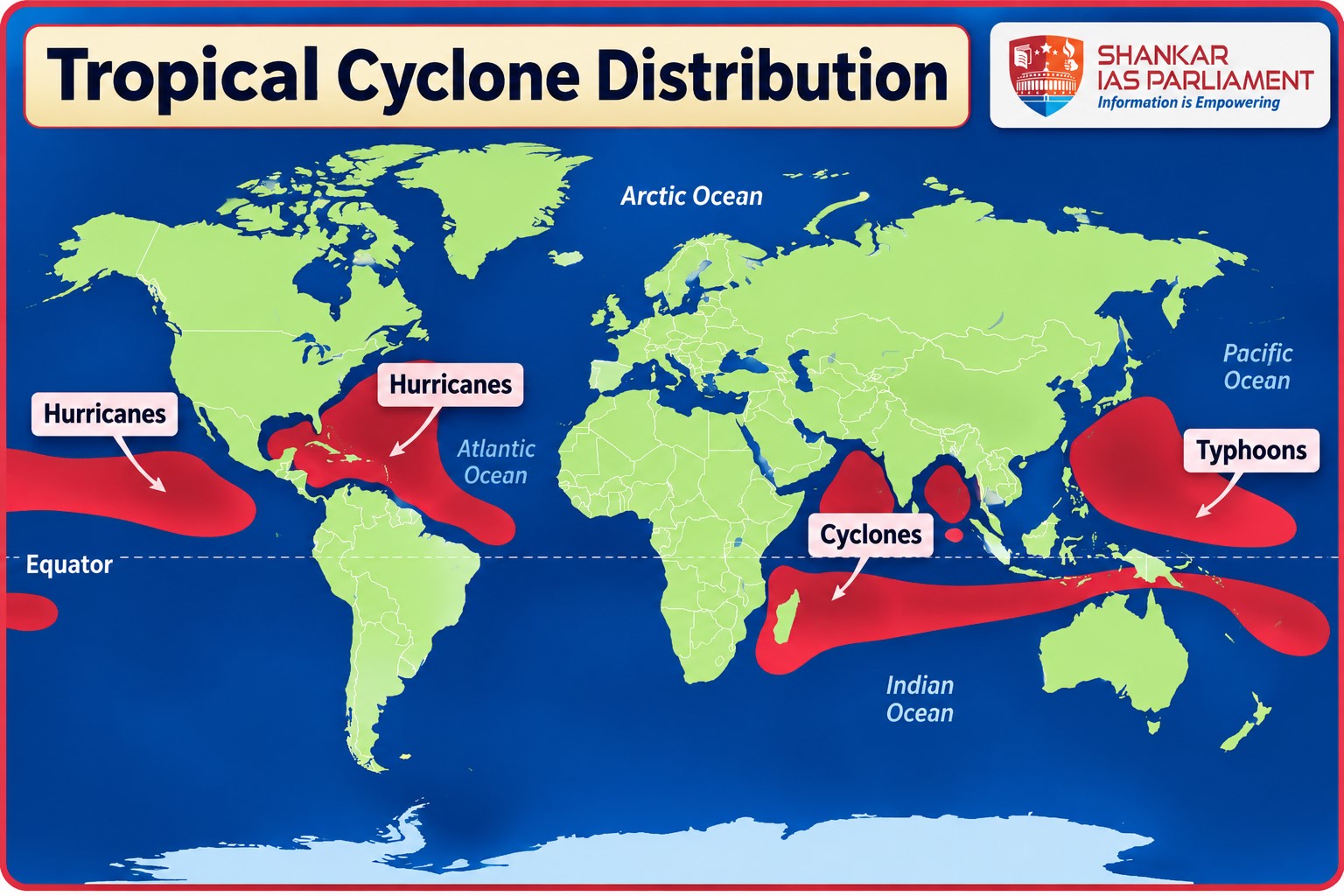
- Types of Tropical Cyclones (Based on Ocean Basins) –
- Hurricanes – At North Atlantic Ocean and northeastern Pacific Ocean.
- Typhoons – At northwestern Pacific Ocean.
- Cyclones – At the North Indian Ocean (Bay of Bengal and Arabian Sea) and South Pacific/Indian Ocean regions.
How did Cyclone Arnab Form and Intensify?
- Formation – It originated as a lowpressure system over the southeast Bay of Bengal on October 23 and intensified into a cyclone by October 26.
- Rapid intensification – It strengthened into a ‘very severe’ cyclonic storm, with wind speeds of 125–135 kmph and gusts up to 140 kmph.
- Faster movement – Its movement towards the coast was faster than initially forecast by the India Meteorological Department (IMD).
- Prolonged landfall – It remained nearly stationary near Narsapur and Yanam, maintaining its intensity for around six hours even after landfall.
- Rainfall impact – Heavy rainfall affected coastal Andhra Pradesh and Odisha, with Visakhapatnam recording 217 mm of rainfall.
How Does El Nino Influence Tropical Cyclones?
- Alteration of global wind patterns – El Nino changes atmospheric circulation, wind patterns and air pressure, causing unusual warming over regions such as the North Indian Ocean.
- Shift in cyclone formation – During El Nino years, tropical cyclones in the North Indian Ocean tend to form closer to the equator.
- Change in cyclone tracks – Such cyclones are more likely to move towards the Andhra Pradesh and Tamil Nadu coasts rather than Odisha and West Bengal.
- Rapid intensification – Warmer ocean conditions provide additional heat and moisture, enabling cyclones to intensify rapidly and potentially move faster.
- Historical example – Cyclone Hudhud (2014), which struck the Andhra Pradesh coast, also developed during an El Nino year.
How Do Warm Oceans Fuel Tropical Cyclones?
- Sea surface temperature – Ocean temperatures of 26°C or above, extending to depths of around 50–100 metres, favour tropical cyclone development.
- Ocean heat availability – Warm ocean waters provide the heat energy and moisture required for cyclone formation and intensification.
- El Nino conditions – During July–September 2026, temperatures in the equatorial Pacific's Nino 3.4 region were 2–2.8°C above normal, indicating strong warming.
- Rapid intensification – Cyclone Arnab reached its highest intensity as a ‘very severe’ cyclonic storm within a single day.
Cyclone intensification is also influenced by wind shear, convection, boundarylayer processes, upperocean circulation and air–sea interactions.
What Lies Ahead?
- Rising sea surface temperatures can increase the potential for rapid cyclone intensification and extreme rainfall.
- Strengthening IMD's earlywarning systems, satellite monitoring and realtime ocean observation is essential to predict cyclone intensity and landfall accurately.
- Strengthening cyclone shelters, coastal infrastructure, mangrove ecosystems and naturebased barriers can reduce disaster vulnerability.
Reference
The Indian Express| El Niño made Cyclone Arnab stronger



