Prelims: Current events of national and international importance | Environment
Why in News?
India reiterated its commitment to global biodiversity conservation during the 17th Conference of the Parties (COP-17) to the Convention on Biological Diversity (CBD).
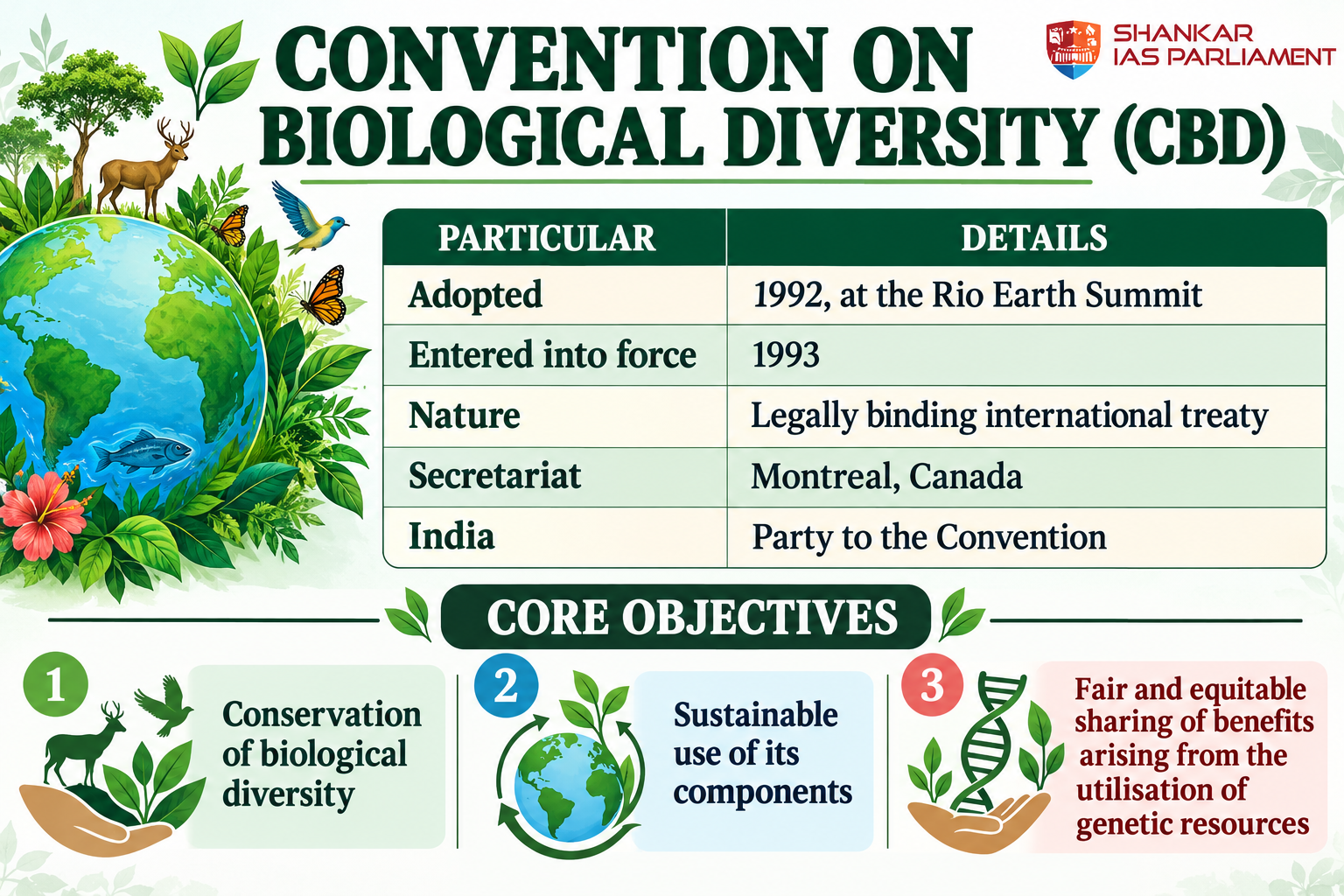
- The conference was held in Yerevan, Armenia.
- The Indian delegation was led by the Union Minister for Environment, Forest and Climate Change.
- Key areas of emphasis – It included national priorities, predictable finance, technology transfer, capacity-building, and science-based biodiversity governance.
- The Kunming–Montreal Global Biodiversity Framework (KMGBF) served as the major framework guiding the discussions.
- Key issues highlighted by India at COP-17
|
Issue
|
India's position
|
|
National circumstances
|
Implementation of KMGBF should reflect national priorities, circumstances and legislation.
|
|
Finance
|
Developed countries should provide adequate and predictable financial resources.
|
|
Capacity-building
|
Strengthen developing countries' capacity to implement biodiversity commitments.
|
|
Technology transfer
|
Improve access to relevant technologies.
|
|
Digital sequence information (DSI)
|
Support benefit-sharing through the multilateral mechanism, including the Cali Fund.
|
|
Synthetic biology
|
Apply a science-based, risk-proportionate and precautionary approach.
|
|
Biosafety
|
Ensure appropriate assessment and management of potential biological risks.
|
- Digital Sequence Information (DSI)
- Digital Sequence Information refers to digital data from genetic resources, such as DNA and RNA sequences.
- DSI is used in scientific research, biotechnology, agriculture, medicine, and conservation.
- The use of DSI raises questions about fair benefit-sharing when genetic information is used for commercial or research purposes.
Cali Fund – This multilateral mechanism supports benefit-sharing from the use of DSI on genetic resources under the Convention on Biological Diversity (CBD).
India's updated National Biodiversity Strategy and Action Plan (NBSAP)
- India has incorporated the KMGBF into its updated national biodiversity planning framework.
- 23 National Biodiversity Targets
- 142 indicators
- The NBSAP establishes a national framework to implement biodiversity commitments, monitor progress, and align conservation efforts with national priorities.
Kunming–Montreal Global Biodiversity Framework (KMGBF)
- Adopted in – December 2022, at CBD COP-15.
- Purpose – To halt and reverse biodiversity loss by 2030 and to support the achievement of the Convention on Biological Diversity’s long-term vision of living in harmony with nature by 2050.
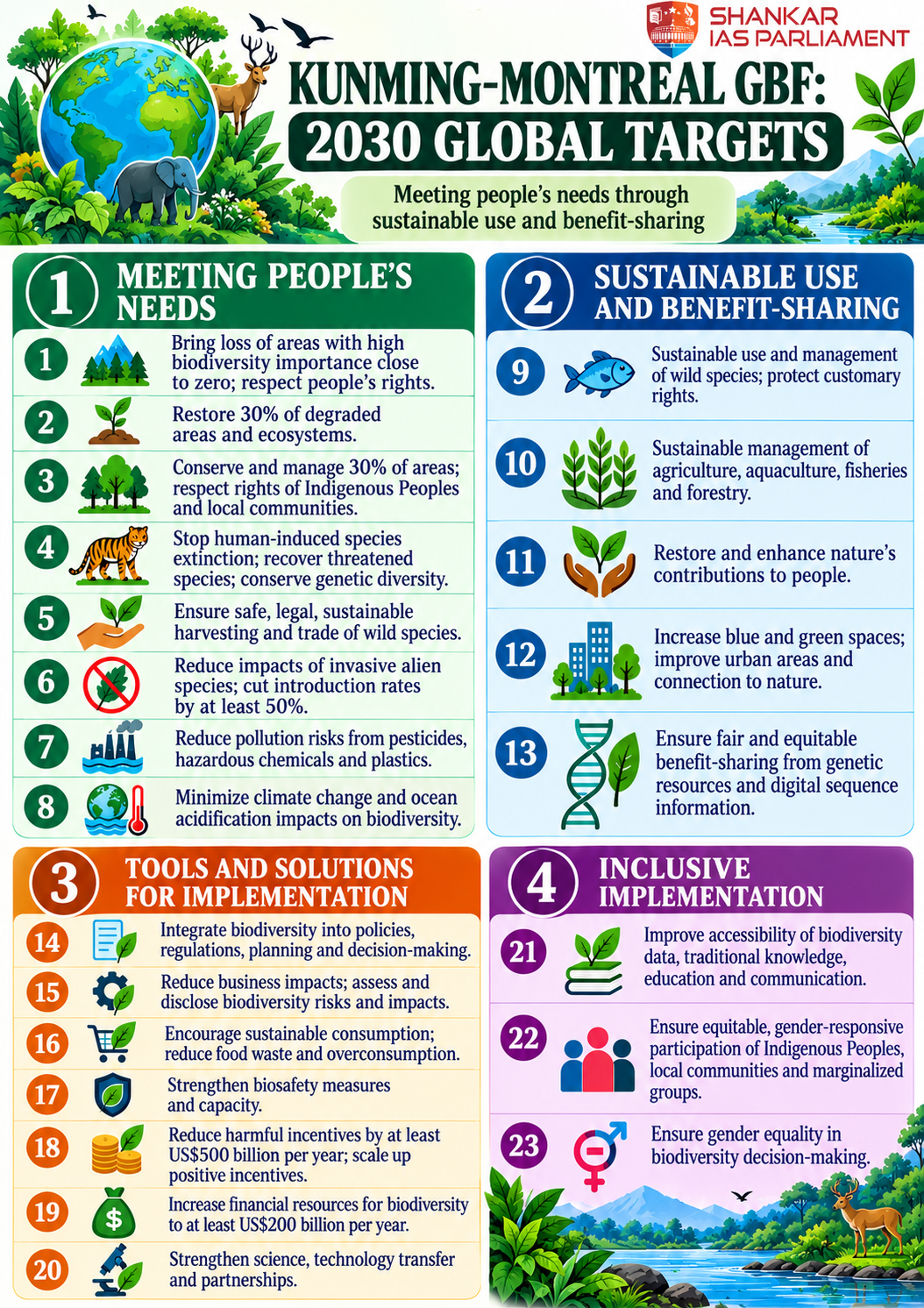
- Structure – The framework comprises four long-term goals for 2050 and twenty-three action-oriented targets for 2030.
- Key global targets
- Target 3 (30×30) – Conserve at least 30 percent of terrestrial, inland water, coastal, and marine areas by 2030 through effectively managed and conserved systems.
- Target 2 – Ensure that at least 30 percent of degraded terrestrial, inland water, coastal, and marine ecosystems are under effective restoration by 2030.
- Target 19 – Mobilize biodiversity finance, including international financial resources for developing countries.
- Target 22 – Ensure inclusive participation and access to justice in biodiversity-related decision-making processes.
Reference
PIB | Biodiversity Framework Commitment at CBD COP-17



