|
- Inter-basin water transfers- It tracks with mathematical concepts of surplus and deficit. Excess water is routed from “donor river basins” (to “recipient” dry regions.
- Conventional assumption- The river basins operate in silos without affecting the land or the atmosphere
- Mandate- National Water Development Agency, Ministry of Jal Shakti.
- Components-
- Himalayan component- Kosi-Ghagra, Kosi-Mechi etc.,
- Peninsular component- Ken- Betwa, Par-Tapi-Narmada etc.,
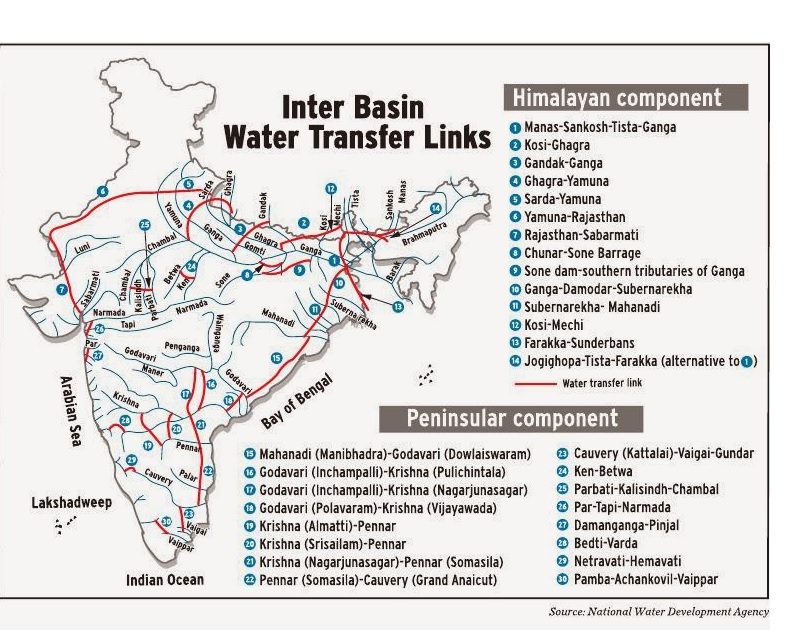
- Himalayan component- It aims to construct storage reservoirs on the Ganga and Brahmaputra rivers, as well as their tributaries in India and Nepal.
- Peninsular component- It propose to connect the rivers of South India. It envisages linking the Mahanadi and Godavari to feed the Krishna, Pennar, Cauvery, and Vaigai rivers.
- National Perspective Plan (NPP)- The NPP for inter-basin transfer has identified 16 links under the peninsular rivers component and 14 links under the Himalayan component, charged with transporting 174 billion cubic metres of water each year using some 15,000 km of canals and 3,000 reservoirs.
- Benefit- Increase the irrigated areas across the country by 30 million hectares
- 34,000 MW of hydropower generation,
- employment generation,
- Salinity control,
- Pollution abatement, among other aspects
|



