Mains: GS I – Modern Indian History
Why in News?
The Communal Award of 1932 and the subsequent Poona Pact of 1932 marked a crucial turning point in the political representation of the Depressed Classes, later designated as the Scheduled Castes.
What is the background?
- The Question of Political Representation – The British policy of communal representation had developed gradually during the colonial period.
- Separate electorates had already been introduced for Muslims under the Indian Councils Act, 1909, and were subsequently extended to other communities.
- Demand of Depressed class – During the Round Table Conferences (1930–32), the political representation of the Depressed Classes became an important issue.
- Arguments of Dr.B.R.Ambedkar – He emerged as the principal political spokesman for the Depressed Classes.
- He argued that social oppression could not be overcome merely through appeals to the conscience of caste Hindus.
- The Depressed Classes required independent political power and representatives accountable to their own community.
- Ambedkar therefore demanded separate electorates, under which members of the Depressed Classes would elect their own representatives rather than depending primarily upon votes from socially dominant castes.
What is the Communal Award, 1932?
- The Communal Award – It was announced on 16 August 1932, by British Prime Minister Ramsay MacDonald.
- Provisions – The Award recognised the Depressed Classes as a separate minority for electoral purposes and granted them separate electorates for 20 years.
- It provided 71 reserved/special seats for them in the provincial legislatures.
- Separate electorates were also continued or provided for several other communities, including Muslims, Sikhs, Indian Christians, Anglo-Indians and Europeans.
What did Ambedkar want?
- Separate electorate – Ambedkar wanted the Depressed Classes to have separate electorates, meaning that voters belonging to the Depressed Classes would elect their own representatives.
- His fundamental objective was not merely a greater number of seats but political autonomy and independent leadership.
- Apprehensions of Ambedkar – He feared that under a joint electorate, candidates from the Depressed Classes would have to depend upon the votes and political support of caste Hindus.
- Consequently, representatives might become more responsive to dominant-caste interests than to the interests of their own oppressed community.
- Thus, Ambedkar's demand was rooted in the belief that political representation was essential for social emancipation.
Why did Gandhi oppose separate electorates?
- Division between Hindus – First, Gandhi regarded the Depressed Classes as an integral part of Hindu society, rather than a separate political community.
- He feared that a separate electorate would institutionalise the division between caste Hindus and the Depressed Classes and thereby weaken the possibility of reform within Hindu society.
- Fragmentation of Society – Gandhi believed that separate electorates would fragment Indian society and undermine national unity at a time when the freedom struggle required a broad political mobilisation.
- Opinion on untouchability – Gandhi maintained that untouchability was a moral and social evil that caste Hindus themselves had to eradicate.
- He therefore viewed the political separation of the Depressed Classes as inconsistent with his larger objective of reforming Hindu society from within.
- Gandhi strongly opposed separate electorates for the Depressed Classes, although he was committed to the abolition of untouchability.
- His opposition was fundamentally different from opposition to political safeguards for the community.
- Amnedkar’s view – However, Ambedkar saw the issue very differently.
- For him, the problem was that the very social structure Gandhi sought to reform had historically denied the Depressed Classes equality.
- Therefore, relying upon caste Hindus to select their representatives could perpetuate political dependence.
Gandhi emphasised social integration and moral reform, whereas Ambedkar emphasised political safeguards, representation and institutional power.
What is the Poona pact?
- Gandhi's Fast unto Death – Gandhi had already warned the British government that he would resist separate electorates for the Depressed Classes with his life.
- After the Communal Award was announced, he began his fast unto death on 20 September 1932 in Yerwada Central Jail, Poona.
- Gandhi described his fast as a matter of conscience and argued that the Award would cause a permanent division within Hindu society.
- The fast created enormous political and moral pressure.
- Leaders across India sought a compromise that could satisfy Gandhi's concerns without abandoning the political safeguards demanded by Ambedkar.
- Ambedkar initially remained firm and he regarded the political rights of the Depressed Classes as more important than Gandhi's personal decision to fast.
- His position reflected his fear that abandoning separate electorates would leave the Depressed Classes politically vulnerable.
- The Poona Pact, 1932 – Intensive negotiations eventually produced the Poona Pact on 24 September 1932, signed by Ambedkar and other leaders representing the Depressed Classes and caste Hindu interests.
- The Pact made a significant compromise:
- Separate electorates for the Depressed Classes were abandoned.
- They would instead have reserved seats within joint electorates.
- The number of seats reserved for the Depressed Classes in the provincial legislatures was substantially increased, from 71 under the Communal Award to 148 under the Pact.
- The Pact also provided for representation of the Depressed Classes in the Central Legislature, with 18 per cent of the seats allocated to them.
- It included provisions relating to fair representation and measures for improving the educational and social position of the Depressed Classes.
- The British government accepted the Poona Pact as an amendment to the Communal Award.
- Thus, the eventual settlement answered the central question: Ambedkar did not obtain separate electorates, but he secured substantially enhanced political representation through reserved seats in joint electorates.
What is the significance of the Poona pact?
- Beginning of the reserved-seat model – The Pact established the principle of reservation of legislative seats for historically disadvantaged communities while retaining a common electorate.
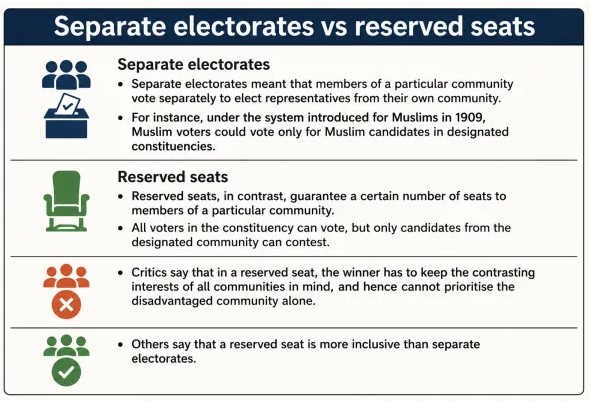
- This basic model survived after Independence and became part of India's constitutional framework.
- Recognition of political representation – The Pact demonstrated that social equality required more than formal legal equality.
- Political representation was recognised as an important instrument for empowering historically excluded communities.
- Gandhi–Ambedkar ideological divergence – The episode exposed a fundamental difference between Gandhi and Ambedkar.
- Gandhi approached caste primarily through moral and social reform, while Ambedkar increasingly emphasised constitutional rights, political representation and institutional safeguards.
- Ambedkar's strategic compromise – Although Ambedkar gave up separate electorates, he obtained a substantial increase in reserved seats.
- His approach demonstrated his willingness to compromise on institutional mechanisms when a stronger form of representation could be secured through another arrangement.
- Legacy in Independent India – The basic principle of reserved representation survived the transition from colonial rule to the Constitution of India.
- The Constitution provides reservation of seats in the Lok Sabha and State Legislative Assemblies for Scheduled Castes and Scheduled Tribes.
- In the present 543-member Lok Sabha, 84 seats are reserved for Scheduled Castes and 47 for Scheduled Tribes.
- Unlike the Communal Award, however, these reservations operate through a joint electorate – All voters in a constituency participate in the election, while only candidates belonging to the specified reserved category can contest from a reserved constituency.
Conclusion
- The Communal Award and Poona Pact represented a major debate over the relationship between social integration and political autonomy.
- Gandhi opposed separate electorates because he feared that they would permanently divide Hindu society and weaken national unity.
- Ambedkar supported them because he believed that the oppressed could not secure genuine representation without independent political power.
- The Poona Pact resolved the immediate confrontation by replacing separate electorates with reserved seats in joint electorates, while substantially increasing the political representation of the Depressed Classes.
- Its enduring importance lies in the fact that it helped establish a principle that remains central to India's democratic system – Historically excluded communities may require institutional safeguards to achieve substantive political equality.
Reference
The Indian Express| Communal Award



