0.1166
7667766266
x

Cloud Ecosystem in India

iasparliament Logo
October 30, 2026

Building the Digital Foundation for Secure and Scalable Computing

PIB Analysis

India's expanding cloud ecosystem to support digital governance, data sovereignty and emerging technologies through initiatives such as MeghRaj, indigenous data centres and the IndiaAI Mission.

Cloud Computing and it Importance

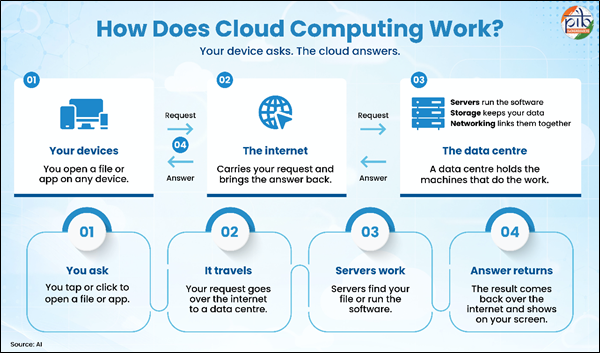
  • Cloud computing refers to the delivery of computing resources, including data storage, servers, software and processing capabilities, over the internet on demand, eliminating the need for organisations to maintain their own physical infrastructure.
  • India's internet subscriber base reached 1,092.79 million in March 2026, with average wireless data consumption of 25.51 GB per subscriber per month, increasing demand for secure and scalable digital infrastructure.
  • Data sovereignty refers to maintaining national control over the storage, processing and governance of data through domestic infrastructure and appropriate regulatory safeguards.

Major Benefits of Cloud Computing

.

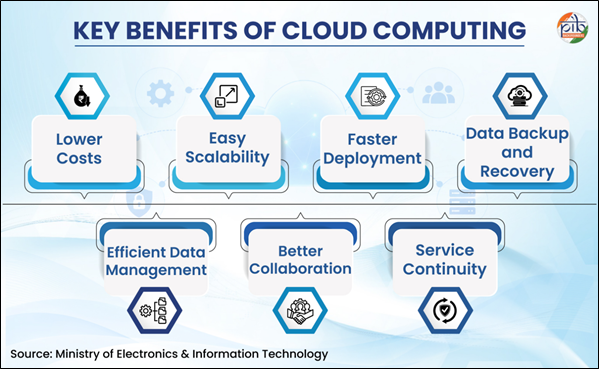
  1. Cost reduction: Reduces expenditure on purchasing and maintaining physical servers.
  2. Faster deployment: Enables organisations to launch digital services without lengthy infrastructure setup.
  3. Scalability: Allows computing resources to expand or contract according to demand.
  4. Better collaboration: Enables users across locations to access and share information.
  5. Data backup and recovery: Facilitates data restoration following system failures or accidental deletion.
  6. Service continuity: Ensures faster recovery and uninterrupted delivery of digital services.
  7. Efficient data management: Simplifies storage, organisation and retrieval of digital records.

.

Different Models and Services of Cloud Computing

A. Types of Cloud Models
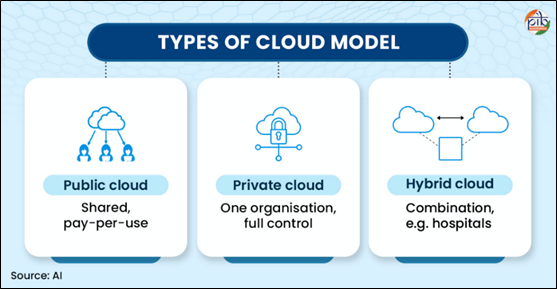
  1. Public Cloud: Infrastructure provided by third-party providers and shared among multiple customers.
  2. Private Cloud: Dedicated cloud infrastructure used exclusively by a single organisation.
  3. Hybrid Cloud: Combines public and private cloud environments according to security and operational requirements.

.

B. Types of Cloud Services

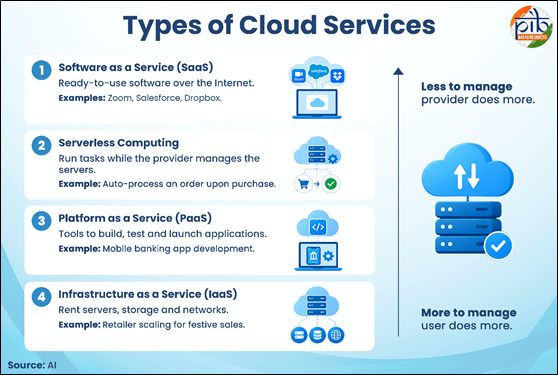
  1. Infrastructure as a Service (IaaS): Provides virtual servers, storage and networking resources.
  2. Platform as a Service (PaaS): Provides platforms and tools to develop, test and deploy applications.
  3. Software as a Service (SaaS): Delivers ready-to-use software over the internet, e.g., Zoom and Dropbox.
  4. Serverless Computing: Allows developers to execute applications without directly managing servers, as infrastructure is managed by the cloud provider.

.

India Developing its Indigenous Cloud Ecosystem

1. MeghRaj Initiative: Launched in 2014 by MeitY to accelerate e-governance and optimise public ICT expenditure. By September 2026, it covered 2,330 government departments and supported platforms such as DigiLocker, MyGov and the National Scholarship Portal.

2. Indigenous Cloud Service Providers: India has empanelled 30 Cloud Service Providers (CSPs), including Jio Platforms, TCS, BSNL, RailTel and Yotta Data Services, alongside international providers.

3. Data Centre Expansion: India's data centre capacity reached 1.57 GW (August 2026) and is projected to reach nearly 8 GW by 2030, supported by investments and emerging data centre hubs.

4. NIC Infrastructure: The National Informatics Centre operates 4 National Data Centres and 24 Mini Data Centres to provide hosting, co-location and cloud services to government departments.

5. IndiaAI Mission: With an outlay of rs.10,371.92 crore, it has onboarded over 45,000 GPUs to provide affordable AI computing resources to startups and academic institutions.

6. Skill Development: FutureSkills PRIME, launched in 2021 by MeitY–NASSCOM, promotes skills in cloud computing, AI and data analytics. By August 2026, it had 34 lakh registered candidates.

Major Policy Measures Promoting Cloud Adoption

1. Union Budget 2026–27: Recognised cloud computing and data centres as important components of India's digital infrastructure and investment ecosystem.

2. Cloud Selection Framework (March 2026): Issued by MeitY to guide government departments in selecting cloud infrastructure based on data sensitivity and criticality, prioritising government-backed clouds and hybrid deployment.

3. Digital Personal Data Protection (DPDP) Act, 2023: Establishes safeguards for personal data processing, accountability of data fiduciaries and conditions governing cross-border data transfers.

4. National e-Governance Division (NeGD): Provides technical guidance and appraisal of e-governance projects, including technology architecture, security and infrastructure standards.

Way Forward

  • Strengthen indigenous cloud infrastructure to enhance data sovereignty and technological self-reliance.
  • Improve cybersecurity, data protection and disaster recovery mechanisms.
  • Promote public-private partnerships and investment in data centres.
  • Expand skilled manpower in cloud computing, AI and cybersecurity.
  • Ensure affordable and accessible cloud services for startups, MSMEs and government institutions.

Conclusion

Developing a secure, scalable and indigenous cloud ecosystem is essential for strengthening India's digital sovereignty, improving e-governance and achieving the vision of Viksit Bharat 2047.
 

Reference

PIB

There are no reviews yet. Be the first one to review.

ARCHIVES

sidetext