Prelims: Current events of national and international importance | Space
Why in News?
Recently, the CHIME has made its first standalone detection of the faint radio glow of hydrogen from a time when the Universe was about 5 billion years old.
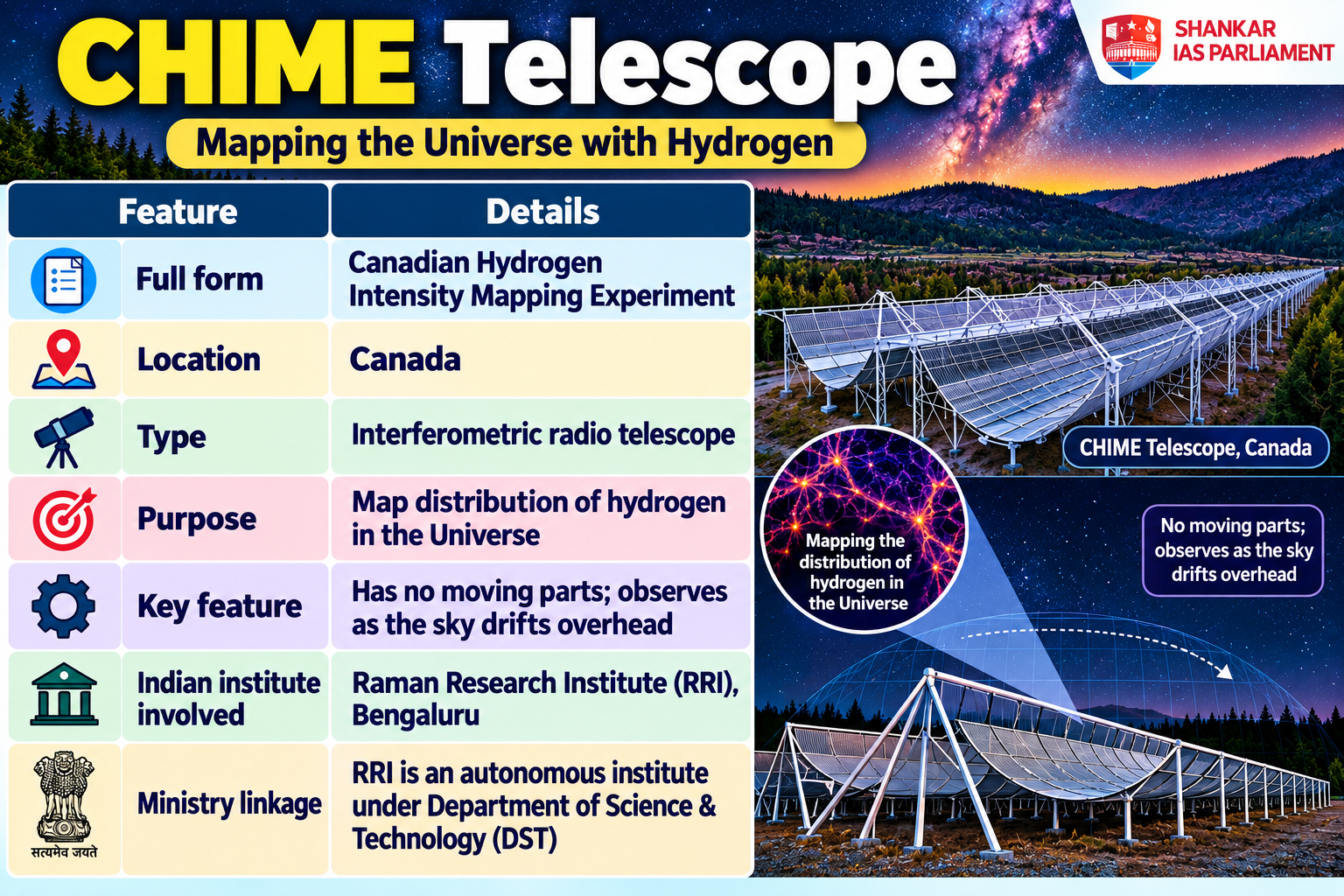
- Recent Advances
- Previous Approach – CHIME previously required cross-correlation of its hydrogen observations with galaxy survey data obtained from external telescopes.
- Current Advancement – CHIME has demonstrated the capability to detect the hydrogen signal using only its internally collected data.
- This advancement may offer a more rapid and cost-effective method for studying the large-scale structure of the Universe.
- Key Finding
- The detected hydrogen signal originates from a period approximately 5 billion years in the past.
- At that epoch, approximately 2% of the Universe's hydrogen existed in neutral atomic form.
- These observations are based on data collected over 94 nights in 2019.
- Researchers analyzed only a small fraction of the total data available from CHIME.
Hydrogen as a Tracer of Cosmic Structure
- Hydrogen is the most abundant element in the Universe.
- It serves as the primary raw material for star formation.
- Neutral atomic hydrogen emits a characteristic faint radio signal.
- Mapping this radio emission enables scientists to investigate the following aspects:
- Distribution of matter in the Universe,
- Formation and evolution of galaxies,
- Expansion of the Universe.
- Hydrogen mapping enables analysis of matter distribution, which informs understanding of the Universe's expansion and facilitates the study of dark energy.
Dark energy refers to the unknown component hypothesized to drive the accelerating expansion of the Universe.
- CHIME can help test competing theories about the nature of dark energy.
- It offers an alternative approach for investigating cosmic expansion.
- Significance
- Facilitates the examination of the large-scale structure of the Universe.
- Offers insights into the processes of galaxy formation and evolution.
- Enables investigation of cosmic expansion and the nature of dark energy.
- Allows for the study of the Universe at earlier epochs.
- Reduces reliance on costly external galaxy surveys.
Reference
PIB | Earliest Glow of Hydrogen



