Why in news?
Bio-CNG has been on the Government agenda since 2018, but the challenges faced by this technology remains unaddressed.
What is Bio-CNG?
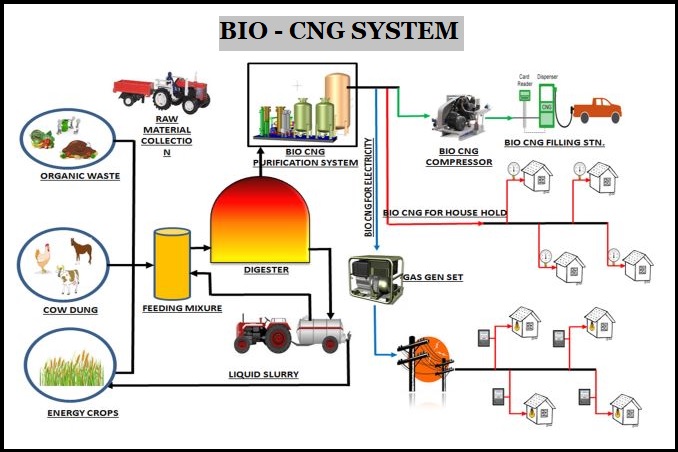
- Bio-CNG - Bio-CNG is also known as Compressed Biogas (CBG).
- It is an upgraded version of the humble biogas, the dung-based version of which serves as cooking fuel.
- Compressed Biogas proposes to build large biogas plants that will continuously produce biogas from urban, domestic and industrial wastes.
- Feedstock - Apart from biodegradable waste, agricultural residue, cow dung and chicken litter and press mud from sugar factories are also used as feedstock in CBG plants.
- The biogas produced will be stored under pressure in gas cylinders for easy distribution to urban and semi-urban customers as alternative to charcoal and firewood.
- CH4 content - CBG has methane (CH4) content of more than 90% and has calorific value and other properties similar to Compressed Natural Gas.
- Application - CBG is used in automotive, industrial and commercial areas.
What is SATAT?
- Sustainable Alternative towards affordable transportation (SATAT) was launched in 2018 by Ministry of Petroleum and Natural Gas (MoPNG).
- It envisages targeting production of 15 MMT of CBG from 5000 plants by 2023.
- Under SATAT, oil and gas marketing companies are supposed to pick up ready gas from CBG companies.
- Advantages
- Lesser dependence on crude oil import
- Decarbonisation of the economy
- Waste management
- Job creation
What are the challenges faced by Bio-CNG technology?
- Feedstock availability - The companies are finding it difficult to generate adequate and consistent feedstock.
- Segregation of wastes - Badly segregated waste can lead to construction/demolition waste or other hard particles entering the digester which not only reduce its energy efficiency but also damage it.
- Investment - High capital investment is stopping small investors from entering the CBG scene.
- Limited technical capabilities of municipal bodies - Usually, only one person in the Municipal Solid Waste section is in charge of multiple roles which is too much to handle.
- Nascent stage - CBG technology also lacks sector experts at the ground level.
- Distribution Challenges - Under the CBG-CGD synchronisation scheme of SATAT, there is a provision for injecting CBG in the city gas distribution (CGD) network.
- But the differential tax structure of CNG and CBG is a hurdle for gas distributors from utilising this scheme.
- Infrastructure issues - Lack of infrastructure also place uncertainty in the user’s consciousness while making a purchase decision.
- Market for manure - It is mandatory for fertiliser companies to offtake fermented organic manure from CBG companies under SATAT as part of Integrated Nutrient Management.
- But there are still no buyers.
- Farmers also find it expensive to buy as compared to the highly-subsidised chemical fertilisers.
References
- Down to Earth│ Challenges faced by Bio-CNG technology
- Down to Earth│ A primer on this coming of age tech



