Mains: GS II – Polity| Interstate Dispute
Why in News?
Recently the 53rd meeting of the Cauvery Water Management Authority (CWMA), held in New Delhi on July 22, 2026.
What is the Cauvery water dispute?
- States involved – It is a long-standing conflict over the sharing of the Cauvery River's waters primarily between the Indian states of Karnataka (the upstream state) and Tamil Nadu (the downstream state), along with Kerala and Puducherry.
- It flares up during poor monsoon seasons when there isn't enough water to satisfy both Karnataka's agricultural needs and Tamil Nadu's heavily irrigation-dependent delta.
- Origins and Core Issues – The dispute dates back to the British colonial era, stemming from agreements signed in 1892 and 1924 between the Madras Presidency and the Princely State of Mysore.
- Karnataka’s Stance – Argues that the pre-Independence agreements were heavily skewed in favor of the Madras Presidency, restricting its own development.
- It demands a larger share of the water to meet the growing drinking and industrial needs of cities like Bengaluru, as well as its farming communities.
- Tamil Nadu’s Stance – Depends heavily on the river to support millions of farmers in the Cauvery delta who have cultivated the land for generations. Tamil Nadu argues that any reduction in flow will severely impact its livelihood.
What are the Legal and Tribunal Rulings?
- CWMT – With rising tensions, the Government of India formed the Cauvery Water Disputes Tribunal (CWDT) in 1990.
- After 17 years, the CWDT delivered its final award in 2007, which was largely modified and finalized by the Supreme Court of India in 2018.
- Water sharing – The apex court declared the river a "national asset" and finalized the annual water-sharing formula.
- The Court accepted the Tribunal’s assessment that the total availability of water in the Cauvery basin during a normal year is 740 thousand million cubic (tmc) feet and allocated the water among the basin constituents.
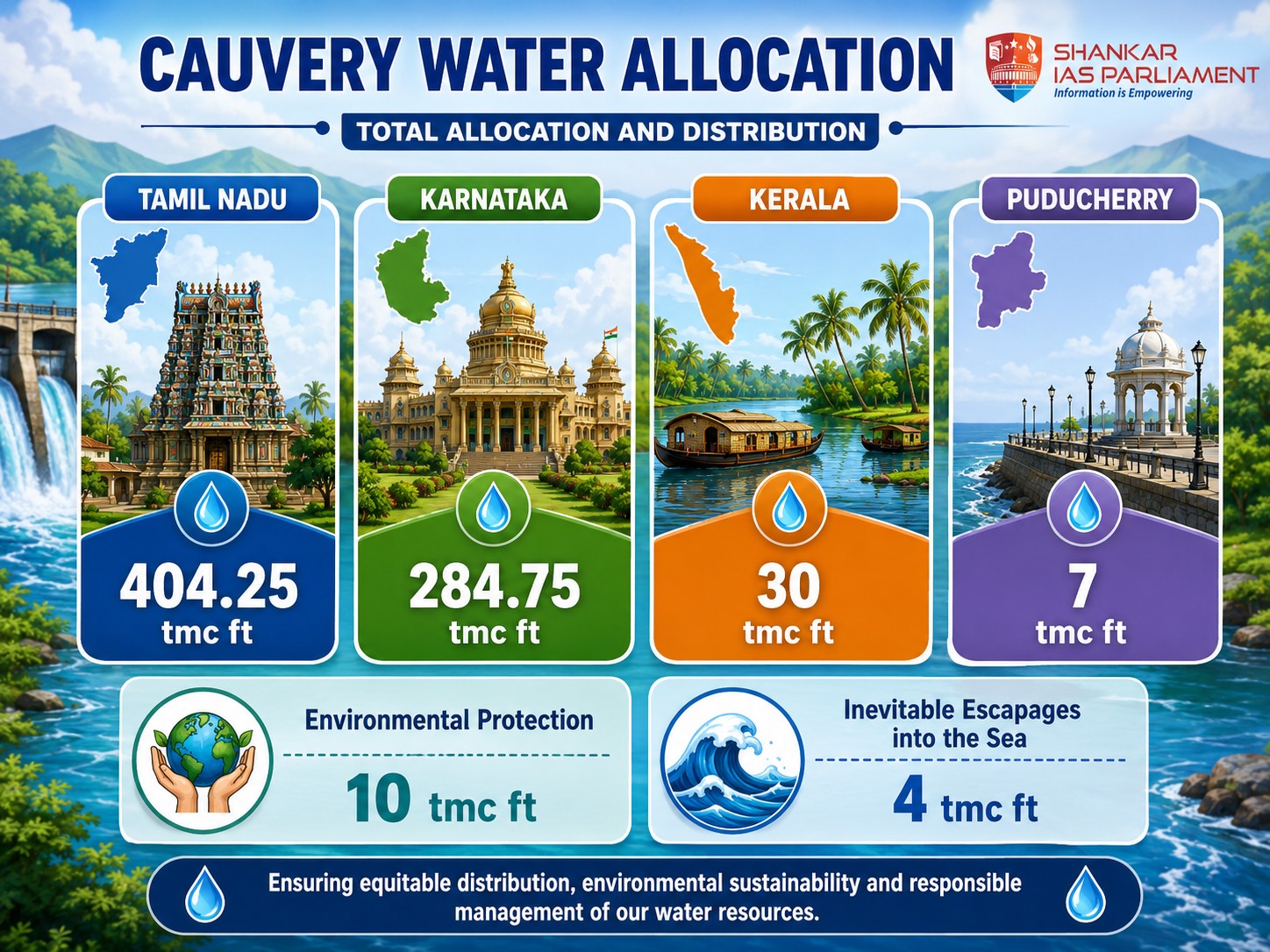
- A significant aspect of the Supreme Court’s judgment was the allocation of 4.75 tmc ft specifically for Bengaluru’s drinking water needs, recognising that the city had attained “global status” and its water requirement had increased substantially.
The Biligundlu gauging station serves as the inter-state border point where these releases are measured.
What is the Cauvery Water Management Authority (CWMA)?
- CWMR – It is a statutory, quasi-judicial body established by the Government of India in 2018.
- Role – To regulate, allocate, and monitor the water-sharing of the Cauvery River among the basin states of Karnataka, Tamil Nadu, Kerala, and Puducherry.
- Statutory Basis – It was constituted under Section 6A of the Inter-State River Water Disputes Act, 1956, following the landmark Supreme Court ruling on the Cauvery River dispute.
- Headquarters – Headquartered in New Delhi under the Union Ministry of Jal Shakti, the authority is chaired by a senior engineer or IAS officer appointed by the Center.
- Institutional Structure and Functioning – The CWMA is headed by a full-time Chairman and includes two whole-time members responsible for water resources and agriculture.
- Two part-time members from the Union Ministries of Jal Shakti and Agriculture.
- Representatives from the four basin constituents – The Member-Secretary of the CWMA simultaneously serves as the head of the Cauvery Water Regulation Committee (CWRC), which assists the Authority in making operational decisions.
- The CWRC also includes, among others, a representative of the Meteorological Department.
- Meetings – The CWRC is required to meet once every ten days in June and October, and at least once every fortnight after the onset of the southwest and northeast monsoons.
- The CWMA has no fixed meeting schedule.
- It generally meets at the beginning of the water year (June–May) to determine the total residual storage in the eight specified reservoirs and to issue directions regarding water releases.
- Additional meetings are convened whenever necessary.
- Ordinarily, meetings of the CWMA are preceded by deliberations of the CWRC.
What are the issues in sharing Cauvery water?
- Deficient Rainfall & Drought Years – The primary trigger for conflict occurs during years with poor southwest monsoon rains.
- Both states suffer from low reservoir levels and require the water for drinking needs and standing crops.
- Competing Agricultural Livelihoods – The Cauvery delta in Tamil Nadu requires continuous water flows for its historically established, three-crop paddy cycles.
- Meanwhile, upstream in Karnataka, the expansion of agriculture and high-yield crops also demands substantial water allocation, sparking local farmer protests when water is released downstream.
- The Mekedatu Project – Karnataka proposes building the Mekedatu balancing reservoir to secure drinking water for Bengaluru and generate hydroelectricity.
- Tamil Nadu strongly opposes this, fearing the dam will restrict natural water flows and compromise their agricultural rights.
- Historical Disagreements – The dispute dates back to pre-independence agreements (1892 and 1924) that favored the Madras Presidency.
- Following the expiration of these accords, Karnataka argued for a renegotiated settlement, noting the agreements unfairly hindered its ability to utilize the basin's resources.
- Pro-Rata Disputes – When total water yields are low, the Supreme Court-mandated water shares should be reduced proportionately.
- However, determining exactly how much water remains in the basin and how to distribute these shortages equitably leads to intense political standoffs and frequent meetings of the Cauvery Water Management Authority (CWMA).
What could be done to resolve the disputes?
- Smart Agricultural Practices – Shifting from water-intensive crops (like paddy) to less water-intensive options and millets can drastically reduce water demand in the states.
- Modernized Irrigation – Upgrading from flood irrigation to drip or sprinkler systems ensures high irrigation efficiency and minimizes water wastage.
- Catchment Area Afforestation – Planting trees along river basins and catchment areas (such as the Kodagu region) improves soil moisture retention and natural river flow over time.
- Strict Urban Water Management – Municipalities (especially in Bengaluru) must aggressively curb water loss through aging pipes, mandate rainwater harvesting, and strictly treat and reuse wastewater.
- Depletion Mitigation – Enhancing groundwater recharge by restoring local village tanks and ponds helps reduce reliance on river water during distress periods.
- Collaborative Infrastructure – Utilizing dispute-resolution mechanisms like the Cauvery Water Management Authority (CWMA).
What lies ahead?
- The revival of the Cauvery dispute in 2026 is closely linked to the severe deficiency in the southwest monsoon and the consequent decline in reservoir storage across the basin.
- Greater transparency, stakeholder participation, and systematic monitoring remain integral to improving understanding and facilitating the implementation of water-sharing decisions under challenging hydrological conditions.
References
- The Hindu| CWMA
- The Wire| Ways to Solve Cauvery Dispute
- Frontline| Cauvery Dispute