What is the issue?
To make India a global hub for electronics manufacturing, the government must come up with more incentives beyond The National Policy on Electronics 2019
What is India’s position with respect to electronics?
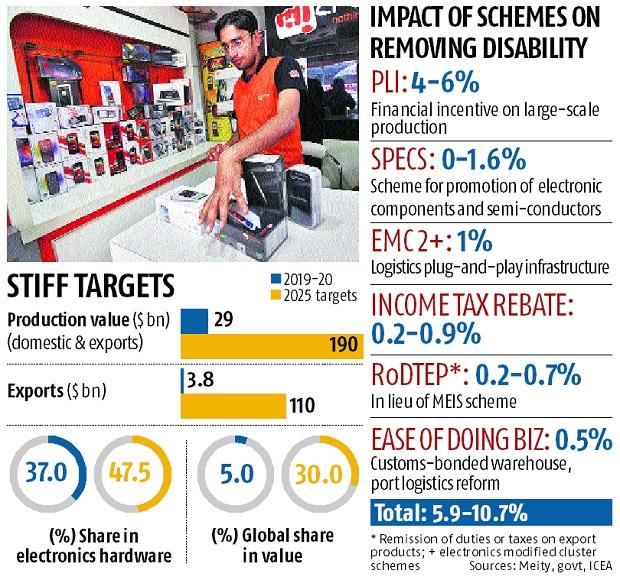
- Between 2015 and 2020, domestic electronics production jumped from $29 billion to $81.5 billion, a 23 per cent Compounded Annual Growth Rate (CAGR).
- India is the second largest manufacturer of mobile phones, though most of the components are imported.
- Now electronics manufacturing makes up 2.7 per cent of India’s GDP.
- This growth is attributed to the assembly of finished products from imported electronic components
- Electronics made up as much as 3.74 per cent of total exports in 2019-20.
- However, electronics imports fell only four per cent in 2019-20.
- Domestic demand for electronics hardware is expected to increase to around $400 billion by 2025.
- Even 10 per cent of this manufactured domestically would lead to significant revenue or employment being generated.
What are the issues in this sector?
- Inadequate infrastructure
- Domestic supply chain and logistics challenges
- High cost of finance
- Inadequate availability of quality power
- Limited design capabilities and focus on R&D by the industry
- Inadequacies in skill development
What initiatives have been taken to promote electronics manufacturing?
- Modified Special Incentive Scheme (MSIPS) - offers subsidies for electronics industry was launched in 2012.
- Phased Manufacturing Programme – was launched to promote use of locally made components in mobile phones.
- Scheme for Promotion of Manufacturing of Electronic Components and Semiconductors (SPECS)- aims to provide financial incentive of 25 per cent on capital expenditure for the identified list of electronic goods
- PLI scheme - provides a 4-6 per cent incentive on incremental sales of goods manufactured in India for a period of 5 years
What can we learn from China and South Korea?
China and South Korea control around 48 per cent of the electronics manufacturing market in the world
- The Chinese government has provided investment and grants of up to 60 per cent of project cost and even 50 per cent subsidies in R&D costs.
- South Korean government has provided financial support to specific clusters, fund for building plants, tax incentives, low-interest loans and duty-free import of select capital goods.
- India needs heavy investment in building the R&D ecosystem.
- To make India a global hub for electronics manufacturing, the government must come up with more short-term incentives.
Source: The Hindu, Business Line



