0.1144
7667766266
x

Blue Tigers Head Towards Western Ghats

iasparliament Logo
October 26, 2026

Prelims: Current events of national and international importance | Environment

Why in News?

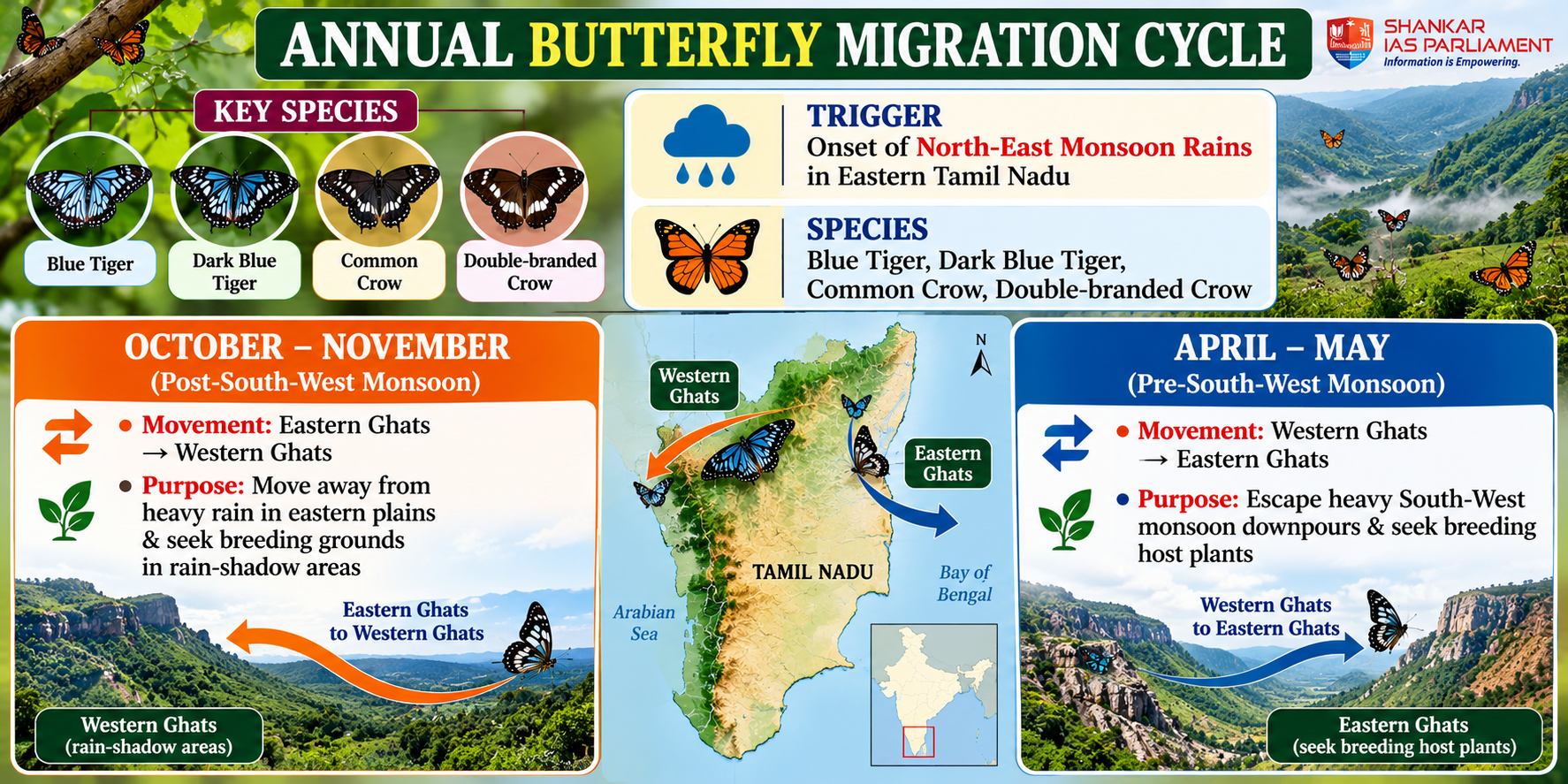
Recently, millions of milkweed butterflies predominantly Blue Tigers and Dark Blue Tigers, began their annual westward seasonal migration from the Eastern Ghats across the Tamil Nadu

Key Highlights

Aspect

Feature / Mechanism

Participating Species

  • Blue Tiger (Tirumala limniace)
  • Dark Blue Tiger (Tirumala septentrionis)
  • Common Crow (Euploea core)
  • Double-branded Crow (Euploea sylvester)

Family & Taxonomy

  • Nymphalidae (Milkweed butterflies), known for feeding on toxic host plants (Crotalaria, Asclepiadaceae) to deter predators.

Migratory Corridor

  • Begins in eastern coastal plains and Eastern Ghats, moving through Salem, Namakkal, Erode, Tiruppur, and Coimbatore toward the Nilgiris, Anamalai, and Siruvani ranges of the Western Ghats.

Ecological Purpose

  • Avoids heavy flooding downpours along the eastern coast while utilizing post-monsoon vegetation growth in the Western Ghats for feeding, breeding, and egg-laying.

Blue tigers migration

Strategic Significance

  • Bio-Indicators - Butterfly migration patterns directly mirror micro-climate changes, monsoon shifts, and habitat fragmentation across the ecological gap between the Eastern and Western Ghats.
  • Road Mortality - High mortality rates reported along highways emphasize the need for eco-sensitive transport corridors, canopy bridges, and vegetative speed buffers during peak migration windows.
  • Conservation- Monitored by bodies such as The Nature and Butterfly Society (TNBS) using field counts and crowdsourced logging, showcasing the role of community-led data collection in biodiversity mapping.

Reference

The Hindu | Blue tigers head towards Western Ghats

There are no reviews yet. Be the first one to review.

ARCHIVES

sidetext