Prelims: Current events of national and international relations | Species
Why in news?
A decade after reintroduction, the Satpura tiger reserve's Barasingha population tops around 303 and three population units established across the landscape.
- Scientific name – Rucervus duvaucelii
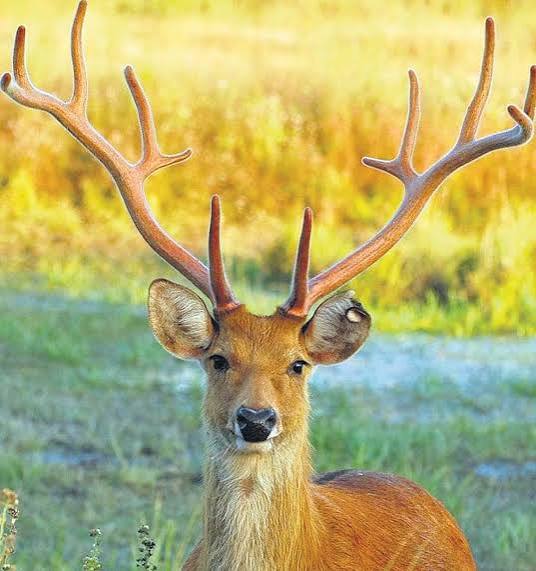
- It commonly known as the swamp deer, is a large and majestic deer species native to the Indian subcontinent.
- Family – ‘Artiodactyls’ or ‘even-toed ungulates’
- Name – "Barasingha" translates to "twelve-tined" or "twelve-horned" in Hindi, which highlights the magnificent, multi-branched antlers found on mature males.
- Distribution – It is distributed across the Indian subcontinent; an isolated population is found in Nepal.
- Habitat – Grasslands, meadows, open woodland areas, wetlands and swampy regions.
- Present mainly in Kanha Tiger Reserve (largest natural population) of Madhya Pradesh.
- Subspecies of Barasingha in India
- Wetland Barasingha (Rucervus duvaucelii duvaucelii)
- Hard-ground Barasingha (Rucervus duvaucelii branderi) – in Kanha Tiger Reserve. Hard-ground swamp deer is the state animal of Madhya Pradesh.
- Eastern Barasingha (Rucervus duvaucelii ranjitsinhii)
- Presence in other regions includes
- Dudhwa Tiger Reserve & Pilibhit National Park (Uttar Pradesh) – Where the Barasingha proudly serves as the State Animal of Uttar Pradesh.
- Kaziranga and Manas National Parks (Assam)
- Bardia National Park & Shukla Phanta (Nepal).
- Size – They stand about 110 to 120 cm (44 to 46 inches) at the shoulder and can weigh up to 170–180 kg.
- Appearance – Their woolly coat is a bright rufous or yellowish-brown in the summer, shifting to a thicker, paler brown during the winter.
- Hooves – They possess unique, wide and splayed hooves that spread out as they walk.
- This serves as an evolutionary adaptation providing crucial stability on soft, muddy, and marshy ground.
- Behaviour – They are strictly herbivorous, feeding mostly on swamp grasses and aquatic plants.
- Conservation Status
- IUCN Red List – Vulnerable
- Wildlife (Protection) Act, 1972 – Schedule I.
- CITES – Appendix I
- Threats – Habitat loss & fragmentation, hunting, poaching, human encroachment, grazing pressure, etc.
Reference
TOI | Decade after reintroduction, Satpura reserve’s Barasingha population tops 300



