Prelims: Current events of national and international importance | Economy
Why in News?
The Union Home Minister launched ‘Bank in a Box’.
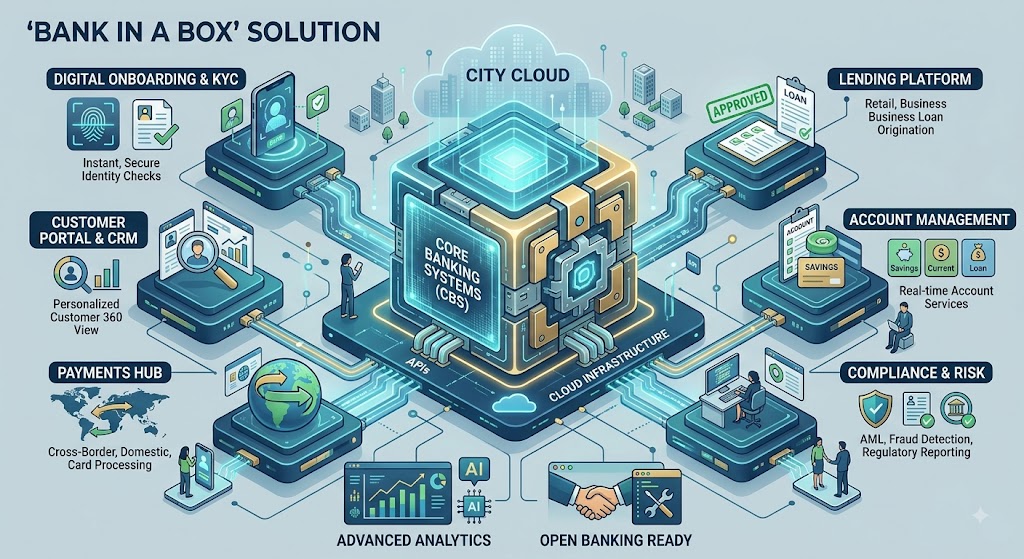
Bank in a Box’, an integrated service bundle offering core banking, digital payments, cloud services and regulatory compliance facilities.
'Bank in a Box’ would allow even a small, single-branch urban cooperative bank to provide world-class banking services without having to make heavy investments in technology.
The integrated platform will include core banking services, digital payments, cloud infrastructure and regulatory compliance solutions.
UCBs are allowed to open up to 15 per cent additional branches without separate permission, extending doorstep banking services, simplifying the process for eligible Tier-3 cooperative banks to obtain scheduled-bank status and appointing an RBI nodal officer for regular interaction with the sector.
The Priority Sector Lending target for UCBs has been reduced from 75 per cent to 60 per cent, while housing-loan limits have been enhanced.
UCBs, State Cooperative Banks and District Cooperative Banks had also been accorded the status of ‘Member Lending Institutions’, enabling risk coverage of up to 85 per cent and access to collateral-free lending.
The priority sector lending limit for cooperative societies has been increased from Rs 5 lakh to Rs 10 crore.
Urban Cooperative Banks
Its origins trace to the 1904 Cooperative Credit Societies Act.
The constitutional reforms which led to the passing of the Government of India Act in 1919 transferred the subject of "cooperation" from the Government of India to the provincial governments.
The Government of Bombay passed the first State Cooperative Societies Act in 1925.
In 1963, the Varde Committee recommended that such banks should be organised at all urban centres with a population of 1 lakh or more and not by any single community or caste.
The committee introduced the concept of minimum capital requirement and the criteria of population for defining the urban centre where UCBs were incorporated.
The Madhavdas Committee (1979) evaluated the role played by urban co-operative banks in greater detail.
The term 'Urban Co-operative Banks' (UCBs), though not formally defined, refers to primary cooperative banks located in urban and semi-urban areas.
These banks, till 1996, were allowed to lend money only for non-agricultural purposes, but this distinction does not hold today.
These banks were traditionally centred around communities; localities work in place groups.
They essentially lent to small borrowers and businesses. Today, their scope of operations has widened considerably.
Maharashtra has 449 urban cooperative banks, the highest number in the country.
About 79% of these are located in 5 states: Andhra Pradesh, Gujarat, Karnataka, Maharashtra and Tamil Nadu.