Why in news?
Recently India inaugurated its first 3D-printed post office in Bengaluru.
What is 3D Printing?
- Additive Manufacturing (AM) – It is the industrial production name for 3D printing.
- It is a process that uses computer-created design to make 3-dimensional objects layer by layer.
- It is an additive process, in which layers of a material like plastic, composites or bio-materials are built up to construct objects that range in shape, size, rigidity and colour.
- It differs from the traditional subtractive manufacturing techniques involving cutting large blocks of material to form the desired object.
- The addition of material can happen in multiple ways, namely powder deposition, resin curing and filament fusing.
- The deposition and solidification are controlled by computer to create a 3D object.
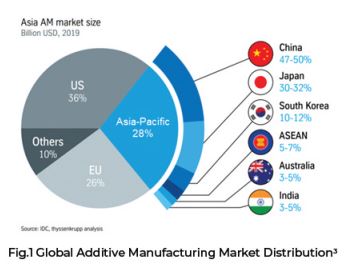
- Potential of India- India has an excellent opportunity as the world begins to adopt AM techniques.
- Additive manufacturing development and adoption can help India in become a leading manufacturing hub.
- To achieve this, the Ministry of Electronics and Information Technology (MeitY) formulated the ‘National Strategy on Additive Manufacturing’.
- The strategy aims to increase India’s share in global AM to 5% with a target to add nearly US 1$bn to the GDP by 2025.
What are the advantages of 3D printing?
- Simplified Supply Chains- It is likely to simplify supply chains as semi-fabricated products substitute raw materials and suppliers consolidate.
- Cost effective-Procurements and labour costs will decrease.
- This will help Make in India campaign and the Atmanirbhar Bharat Abhiyan as successful.
- Gross Value Addition Growth- It can lead to democratisation in innovation by empowering individuals to create and actively participate in the global value chain.
- Many product designs are freely available and individuals can purchase a 3D printer and start manufacturing and selling products.
- Employment Opportunities- It is expected to increase productivity which may lead to reduction in employment.
- However, higher productivity and new products create new employment opportunities.
- Workers may need to be provided upskilling opportunities to ensure they remain competent.
- Sustainable Development- It would lead to significant reduction in raw material due to
- Material-efficient designs
- Reduced wastage and
- Less need for manufacturing tools, moulds and dies.
- Energy efficient- The products will be more energy-efficient. This will help India reduce its carbon footprint and lead to eco-friendly environment.
- Flexibility-It allow manufacturers the ease to redesign their products.
- This reduces design constraints and associated costs.
- Foster innovation-Flexibility in AM will allow small businesses to innovate and experiment, thus making their products more efficient and enabling product differentiation.
What are the applications of 3D printing?
- Prosthetics- It has revolutionized how prosthetics are created. As 3D printing processes and techniques are refined, the creation of custom, tailored prosthetics becomes more straightforward.
- Replacement Parts- It has the ability to fabricate replacement parts easily. 3D printing enables consumers and businesses to maximize the value of their purchases.
- Implants- It allows the construction of more specialized products for patients.
- Patient outcomes are improved when parts with complex geometries can be fabricated quickly.
- Example- Tooth implants, heart valves, knee replacements etc.,
- Pharmaceuticals- 3D-printed drugs to have special delivery profiles that can be tailored to patients’ specific needs.
- Emergency structures- 3D printing can help alleviate the hardships of affected families by building houses, hospitals, and other structures much faster than by traditional means.
- Automotive- Testing and production of lightweight, high strength parts.
- Electronics- Production of light weight, impact resistant structures with multiple functionality.
- Example- Wearable devices, soft robots etc.,
- Consumer goods- Fabrication of complex internal and external structures compels innovative product design.
- Aerospace- Relativity Space launched a test rocket made entirely from 3D-printed parts, measuring 100 feet tall and 7.5 feet wide.
- Healthcare industry- During Covid-19 pandemic the healthcare industry used 3D printers to make much-needed medical equipment, like swabs, face shields, and masks.
What are the concerns of 3D printing?
- Scalability- In conventional techniques, once a design has been set, multiple copies can be made much faster. But 3d printing is slow.
- High cost- The initial set up of 3d printing and pre and post processing in healthcare is costly.
- Job loss- Due to automation it may have impact on employment opportunities.
- Limited materials- Raw materials is not exhaustive in 3d printing, it poses a serious challenge.
- Skilled labour- It needs talented individuals to work with additive manufacturing.
What are the initiatives taken to promote 3D printing?
- Atal Innovation Mission (AIM)- It is a flagship initiative to create and promote entrepreneurship and innovation across the country.
- Atal Tinkering Labs - It is launched under AIM which aims to foster creativity and innovation in young minds.
- It focuses on Science, Technology, Engineering and Math (STEM) concepts.
- Dedicated workspaces have been set up with do-it-yourself (DIY) kits including 3D printers, robotics and miniaturised electronics are installed.
- National Strategy on Additive Manufacturing- The strategy aims to increase India’s share in global AM to 5% with a target to add nearly US 1$bn to the GDP by 2025.
What lies ahead?
- Private Partnership Model- Establish National Additive Manufacturing Centre as a dedicated agency to promote the adoption of AM technologies.
- Strengthening Technology Leadership-There is a need to address the skilled workforce.
- Research- There is a need to promote Research and Development in AM, encourage competition, and create a next generation workforce.
- Supply Chain Development- The government can provide incentives to small businesses aligned with the AM Technology Advancement Plan and include AM in various schemes and incentives.
References
- Indian Express- How does 3D printing work
- MEITY- National Strategy on Additive Manufacturing



