Mains: GSIII – Science & Technology
Why in News?
Recently there is a growing opposition to AI data centres over environmental concerns, resource consumption and limited local benefits, particularly regarding the proposed project in Visakhapatnam.
What are Data Centres?
- Data centres – These are physical facilities housing servers, computers, storage devices and cooling systems to store, process and manage digital information.
- They provide the computing infrastructure supporting cloud services, internet applications, digital platforms and Artificial Intelligence.
- AI Data Centres
- AI data centres use advanced computing infrastructure, particularly Graphics – Processing Units (GPUs), to train and operate Large Language Models (LLMs).
- Growing AI applications have increased demand for inference, which involves computing required to generate responses to user prompts.
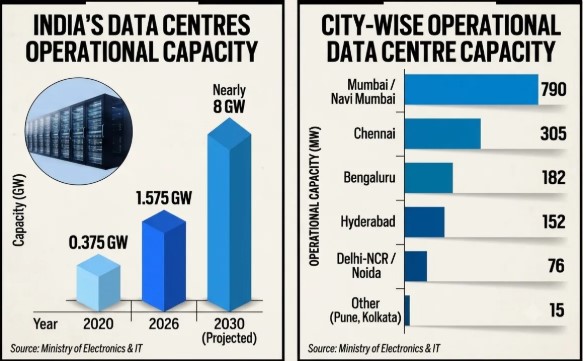
What is the Need for Data Centres?
- Growing AI Adoption – Increasing use of AI applications requires large-scale computing and data-processing infrastructure.
- Low Latency – Locally situated data centres reduce delays in accessing digital services and processing information.
- Data Sovereignty – Domestic data storage enables countries to exercise greater control over data security, access and governance.
- Digital Infrastructure – They support cloud computing, financial services, businesses and digital governance.
Why Are AI Data Centres Facing Opposition?
- High Electricity Consumption – AI data centres require huge and uninterrupted electricity supplies for servers and cooling.
- A typical AI data centre consumes as much electricity as 100,000 households (IEA).
- High Water Consumption –
- Data centres use large amounts of water to cool servers.
- This may reduce local water availability and affect drinking water supplies.
- Advanced cooling systems reduce but do not eliminate water consumption.
- Environmental Concerns – Rising electricity demand may increase fossil fuel dependence.
- Infrastructure development can affect groundwater, wildlife and local ecosystems.
- Projects near reservoirs and wildlife sanctuaries raise ecological concerns.
- Limited Local Employment – Data centres generate thousands of construction jobs but create few permanent jobs.
- A 150 MW facility may employ only slightly over 100 permanent workers.
- Unequal Distribution of Costs and Benefits – Businesses and distant users receive economic benefits, while local communities bear environmental costs.
- This creates opposition known as the NIMBY (Not In My Backyard) phenomenon.
- Concerns over Economic Priorities – Large investments raise questions about the optimal use of scarce land, electricity and water.
- The actual economic and social benefits of AI remain uncertain compared to its infrastructure costs. infrastructure and operational costs.
What is the Significance of Data Centres for India?
- Strengthening Digital Infrastructure – Data centres support India's growing digital economy, cloud computing ecosystem and AI-based services.
- Data Sovereignty and Security – Domestic data centres strengthen control over sensitive information, including financial, healthcare and government data.
- Economic Growth and Investment – They attract foreign investment, develop technological capabilities and create opportunities in construction, technology and clean energy.
- Global AI Competitiveness – Expanding domestic computing infrastructure can strengthen India's position in the global AI ecosystem.
- Energy Infrastructure Development – Investments in associated renewable energy projects can support electricity grid resilience and clean energy expansion.
What are the Challenges in Regulating Data Centres in India?
- Absence of National Policy – India lacks a comprehensive national data centre-specific regulatory framework, resulting in fragmented state-level policies.
- Investment Competition – States may engage in a race to attract investments by offering land, electricity and other concessions without adequate environmental safeguards.
- Resource Allocation – Data centres compete with households, agriculture and industries for scarce electricity, water and land.
- Environmental Governance – Inadequate public consultation and environmental scrutiny can undermine community participation and accountability.
- Uncertain Benefits – Limited permanent employment and uncertain social returns raise questions about the developmental justification of large projects.
What are to Measures to Ensure Sustainable Data Centre Development?
- Develop a Comprehensive National Policy – Establish a national regulatory framework covering land allocation, environmental clearances, energy consumption, and water use and community safeguards.
- Harmonise state-level policies to prevent unhealthy competition and regulatory dilution.
- Promote Green Data Centres – Encourage renewable energy procurement, energy-efficient servers and advanced cooling technologies.
- Promote direct-to-chip cooling and other resource-efficient cooling systems.
- Ensure Sustainable Resource Management – Mandate transparent disclosure of water and electricity consumption.
- Encourage treated wastewater reuse and water-efficient cooling technologies.
- Prevent excessive pressure on local electricity grids and drinking water supplies.
- Encourage Efficient AI Infrastructure – Promote smaller, task-specific AI models requiring less computing power.
- Encourage decentralised computing networks and efficient hardware utilisation to reduce infrastructure requirements.
- Strengthen Environmental Governance – Ensure transparent environmental impact assessments and meaningful public consultations.
- Assess cumulative impacts on groundwater, biodiversity, local ecosystems and electricity infrastructure.
- Ensure Community Participation – Involve local communities in project planning and approval processes.
- Establish grievance-redressal mechanisms and ensure equitable sharing of economic benefits.
What lies ahead?
- India must balance AI infrastructure expansion with environmental sustainability, energy security and community welfare.
- Data centre development should follow the principles of resource efficiency, transparency, accountability and inclusive growth.
- Public acceptance and social legitimacy must become essential conditions for approving large-scale AI infrastructure projects.
Reference
The Indian Express| why don’t people want AI Data Centres?



