Mains: GS-III – Agriculture, Technology
Why in News?
Artificial Intelligence (AI) is increasingly being integrated into Indian agriculture amid climate uncertainty, fragmented landholdings, resource constraints and changing markets.
What is the Potential of AI in Agriculture?
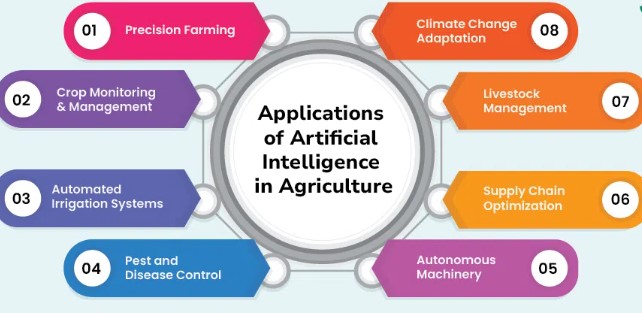
- Climate-Smart Agriculture – AI can analyse weather, satellite and soil data to provide localised weather forecasts and climate-risk advisories.
- It helps farmers make better decisions on sowing, irrigation and harvesting.
- Precision Agriculture – AI-based systems can optimise the use of fertilisers, pesticides, water and other inputs.
- It can reduce input costs and improve resource-use efficiency.
- Crop Health Management – AI and remote sensing can help in early detection of pests and diseases.
- It enables timely intervention and reduces crop losses.
- Better Market Intelligence – AI can analyse price, demand and supply trends.
- It can improve farmers' decisions regarding crop selection, timing of sale and choice of markets.
- Livestock and Fisheries – AI can support disease surveillance, productivity monitoring and early diagnosis in livestock.
- Similar applications can improve fisheries management and productivity.
What are the Key Challenges Associated with Agricultural AI?
- Risk of AI Divide – Better-capitalised farmers may adopt advanced AI technologies faster than small and marginal farmers.
- This could widen existing inequalities in productivity, market access and farm incomes.
- Data Concentration – Agricultural data from land records, crop surveys, satellites, weather, insurance and digital marketplaces is becoming increasingly valuable.
- Excessive concentration of such data with private platforms could create informational asymmetry and economic rents.
- Small and Fragmented Holdings – Technologies designed for large commercial farms may not be economically viable for India's small and fragmented farms.
- AI solutions need to account for diverse crops, farming systems and agro-climatic conditions.
- AI Cannot Replace Basic Infrastructure – AI-generated advice has limited value if farmers lack:
- Irrigation
- Storage
- Affordable credit
- Rural roads
- Reliable connectivity
- Access to markets
- Unequal Distribution of Productivity Gains – Higher productivity does not automatically translate into higher farmer incomes.
- Gains may be absorbed through higher technology costs, Lower market prices due to increased production, Platform fees, and Unequal bargaining power.
- Limitations of AI Models – India's agriculture is highly diverse across regions, soils, crops and irrigation systems.
- An AI model successful in one agro-climatic region may not perform equally well elsewhere.
- AI recommendations therefore require local validation and continuous evaluation.
What measures can be taken?
- Agricultural AI as Public Digital Infrastructure – Develop interoperable datasets, common standards, open interfaces and affordable computing infrastructure.
- Reduce entry barriers for startups, universities, FPOs and State governments.
- Prevent excessive concentration of essential digital infrastructure.
- Strengthen Farmer Data Rights – Farmers should have meaningful rights regarding the collection, access and use of agricultural data.
- Promote responsible use of data for innovation and ensure transparency regarding how farmer data is monetised.
- Strengthen FPOs and Cooperatives – Farmer Producer Organisations (FPOs), cooperatives to act as intermediaries between technology providers and farmers.
- Collective adoption can reduce technology costs and improve farmers' bargaining power.
- Integrate AI with Human Extension Services – AI should provide localised and timely information,
- While agricultural extension workers help farmers implement recommendations.
- Human intervention remains important because farming decisions depend on local knowledge, resources and risk preferences.
- Focus on Outcomes, Not App Adoption – AI programmes should be evaluated on whether they deliver:
- Higher farm incomes
- Lower input costs
- Reduced crop losses
- Better price realisation
- Lower water use
- Reduced income volatility
- Greater climate resilience
- The number of farmers using an AI platform should not be treated as a substitute for measuring actual farm-level impact.
What is the Way Forward?
- Public Infrastructure Approach – Build open and interoperable digital agricultural infrastructure.
- Data Governance – Establish strong frameworks for farmer data ownership, consent, privacy and responsible data sharing.
- Inclusive Access – Ensure AI solutions are affordable and accessible to small and marginal farmers.
- Institutional Participation – Integrate FPOs, cooperatives, Panchayats and agricultural extension networks into AI deployment.
- Localised Solutions – Develop AI models suited to Indian crops, agro-climatic zones and regional languages.
- Outcome-Based Evaluation – Link public support and funding to measurable improvements in farm incomes, resilience and resource efficiency.
- Infrastructure Convergence – Combine AI with investments in irrigation, storage, rural connectivity, credit, insurance and market infrastructure.
What lies ahead?
- AI has the potential to transform Indian agriculture from reactive farming to predictive and precision farming.
- However, technological sophistication alone cannot guarantee inclusive agricultural development.
- India needs an AI ecosystem that is inclusive and farmer-centric, ensuring that gains translate into higher incomes, greater resilience for farmers.
- AI should complement rather than substitute traditional agricultural infrastructure.
Reference
Down To Earth| Agricultural AI in India



