Mains: GSIII – Agriculture
Why in News?
The Agri-photovoltaics (AgriPV) is showing better opportunity for Indian agriculture future and with providing energy security.
What Is Agri–Photovoltaics (Agrivoltaics)?
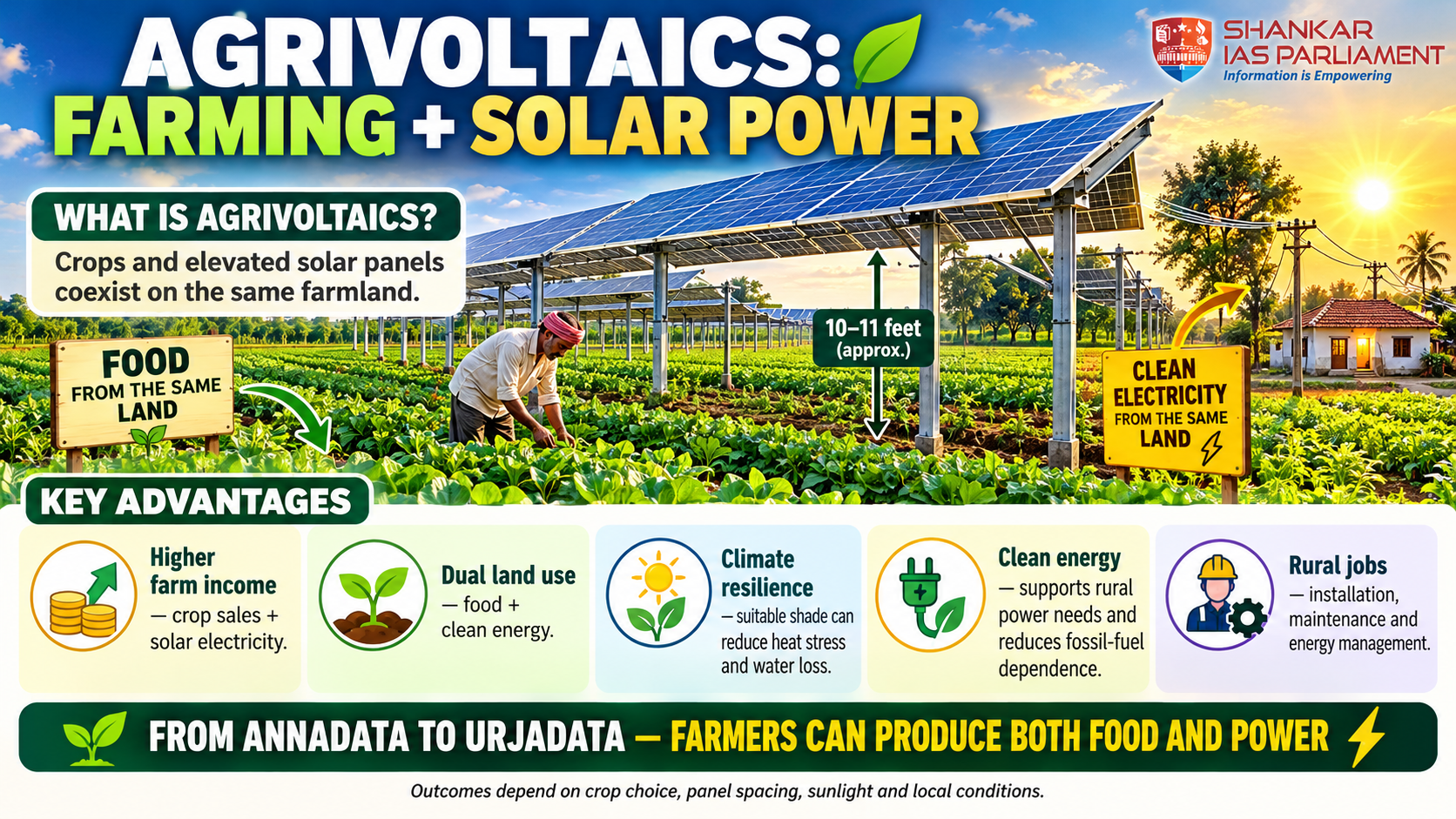
- Agri–photovoltaics – It is a system in which agricultural crops and solar panels coexist on the same land.
- Solar panels are installed at a height of approximately 10–11 feet, with adequate spacing to allow sunlight to reach crops.
- Enables – Farmers to generate income from both agricultural production and solar electricity.
- Farmers become both annadatas (food providers) and urjadatas (energy providers).
What are Potential Benefits of Agri–Photovoltaics?
- Higher farm incomes – Farmers earn from crop sales as well as electricity generation.
- Efficient land use – The same land supports food production and renewable energy generation.
- Climate resilience – Panel shade may reduce heat stress and water loss for suitable crops, depending on local conditions and system design.
- Clean energy transition – Solar electricity can support rural energy needs and reduce dependence on fossil fuels.
- Additional rural employment – Installation, maintenance and energy management can create local economic opportunities.
An ICRIER pilot project in Rajasthan increased a farmer’s income by 8 to 10 times.
How Can Agri–Photovoltaics Be Promoted in India?
- Reforms PM–KUSUM – Adapt the scheme to support agrivoltaic installations, drawing on the subsidy approach of PM–Surya Ghar.
- Ensures remunerative electricity tariffs – Provide a predictable feed–in tariff for surplus electricity supplied to the grid.
- Promotes farmer participation – Enable farmer producer organisations (FPOs), cooperatives and self–help groups to aggregate investments and share infrastructure.
- Facilitates affordable finance – Offer concessional loans, credit guarantees and suitable insurance to reduce initial investment risks.
- Supports research and development – Identify crop varieties and panel configurations suited to different agro–climatic regions.
- Strengthens grid infrastructure – Improve rural transmission and distribution networks to absorb decentralised solar power.
What Are the Major Challenges in Implementing Agrivoltaics?
- High initial investment – Solar panels, mounting structures and grid connections require substantial capital.
- Land and design constraints – Poor panel placement may reduce sunlight and agricultural yields.
- Unequal access – Small and marginal farmers may struggle to secure finance and technical assistance.
- Grid connectivity issues – Limited evacuation capacity and uncertain tariffs can reduce project viability.
- Maintenance and technical capacity – Farmers need training, reliable maintenance services and transparent power–purchase agreements.
What Is the Role of Government Schemes?
|
Scheme / initiative
|
Potential role in promoting agrivoltaics
|
|
PM-KUSUM
|
Supports decentralised solar generation and solar pumps; could be adapted to encourage crop-compatible installations.
|
|
PM-Surya Ghar
|
Offers a reference for subsidy design, although its existing residential rooftop framework does not directly cover agrivoltaics.
|
|
Agriculture Infrastructure Fund (AIF)
|
Can support eligible post-harvest infrastructure and related agricultural assets.
|
|
Kisan Credit Card (KCC)
|
Provides access to agricultural credit; additional financing arrangements may be needed for solar infrastructure.
|
|
Formation and Promotion of 10,000 FPOs
|
Facilitates collective investment, bargaining power and access to technical services.
|
|
PMKSY – Per Drop More Crop
|
Promotes micro-irrigation and efficient water use, complementing suitable agrivoltaic systems.
|
What is the Way Forward?
- Adopt an integrated approach – Link farmers’ income enhancement with food production, water conservation and renewable energy.
- Undertake region–specific implementation – Design projects based on local crops, climate, soil and electricity demand.
- Ensure equitable benefits – Prioritise small and marginal farmers through FPOs, shared infrastructure and affordable financing.
- Strengthen energy markets – Ensure grid connectivity, timely payments and predictable electricity tariffs.
- Evaluate outcomes – Measure changes in net farm income, crop productivity, water use and environmental impacts.
- Integrate crop diversification – Encourage suitable pulses, oilseeds, horticulture and fodder crops alongside solar generation.
What lies ahead?
- Agrivoltaics can help transform Indian agriculture from a predominantly food–producing activity into a dual–income system combining food and renewable energy.
- However, its success depends on appropriate technology, viable electricity tariffs, affordable finance and protection of farmers’ interests.
- Integrating agrivoltaics with existing agricultural and renewable energy programmes can contribute to sustainable rural development and the broader goal of doubling farmers’ incomes.
Reference
The Indian Express| Agri-photovoltaics (AgriPV)



