0.1001
7667766266
x

Africa and Latin America’s Biodiversity-Based Trade

iasparliament Logo
October 17, 2026

Prelims: Current events of national and international importance | Environment

Why in News?

A report by the United Nations Conference on Trade and Development (UNCTAD) highlights the unequal distribution of economic benefits derived from global biodiversity-based trade.

Key highlights

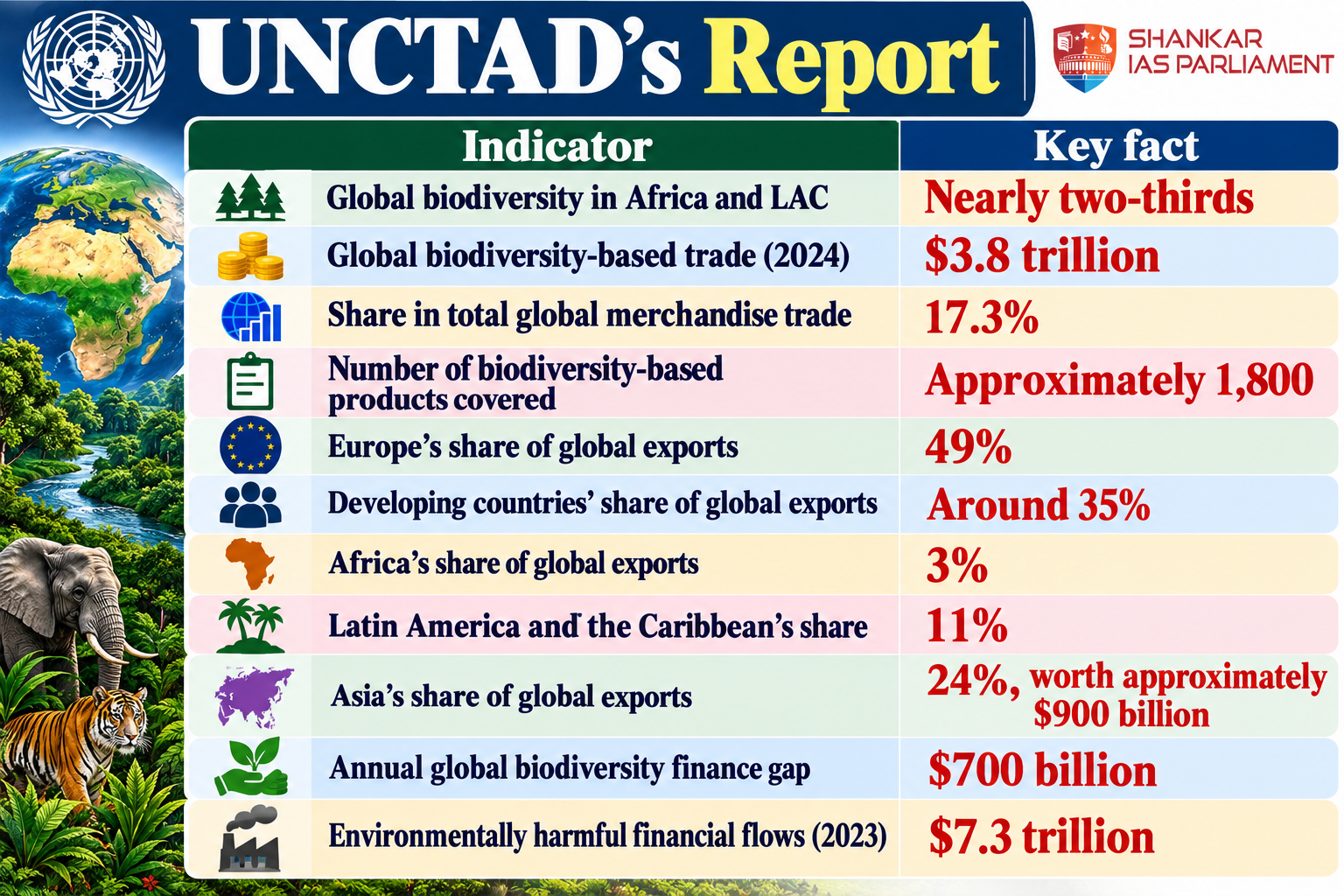
  • Africa and Latin America and the Caribbean (LAC) collectively possess nearly two-thirds of global biodiversity, yet in 2024, these regions accounted for only 14% of global biodiversity-based product exports.
  • The report recommends sustainable production, increased domestic processing, and enhanced market access for developing countries rich in biodiversity.
  • Released in – Advance of the 2026 UN Biodiversity Conference, which will be held in Yerevan, Armenia, from October 19 to 30, 2026.
  • Sustainable Use of Agricultural Residues – The report highlights opportunities to turn agricultural waste into commercially valuable products.

Country

Agricultural residue

Potential product

Kenya

Pineapple leaves

Textile fibres

Uganda

Banana stems

Yarn

—

Coconut coir

Biodegradable fishing ropes

unctad-biodiversity-trade-infographic-2.png

Biodiversity-Based Products

  • Biodiversity-based products are derived from biological resources, such as plants, animals, microorganisms, and other components of biodiversity.
  • Examples include:
    • Food and beverages, such as fruits, spices, and plant-derived food ingredients.
    • Natural ingredients, including gum arabic and other plant extracts.
    • Natural fibres: Cotton, jute, hemp, banana fibre and pineapple-leaf fibre.
    • Other biological materials, including coconut coir, seaweed, and animal fibres.
  • When produced and harvested responsibly, these products can support livelihoods, facilitate trade, and contribute to sustainable development.

BioTrade

  • BioTrade encompasses the collection, production, processing, and commercialization of goods and services derived from biodiversity, conducted in alignment with environmental, social, and economic sustainability criteria.
  • Key Objectives
    • To conserve biodiversity and promote the sustainable use of biological resources.
    • To generate income and employment opportunities for local communities.
    • To support sustainable livelihoods and foster inclusive economic development.
    • To increase the value captured by developing countries rich in biodiversity.

Kunming–Montreal Global Biodiversity Framework (GBF)

  • It establishes a global framework to halt and reverse biodiversity loss by 2030.
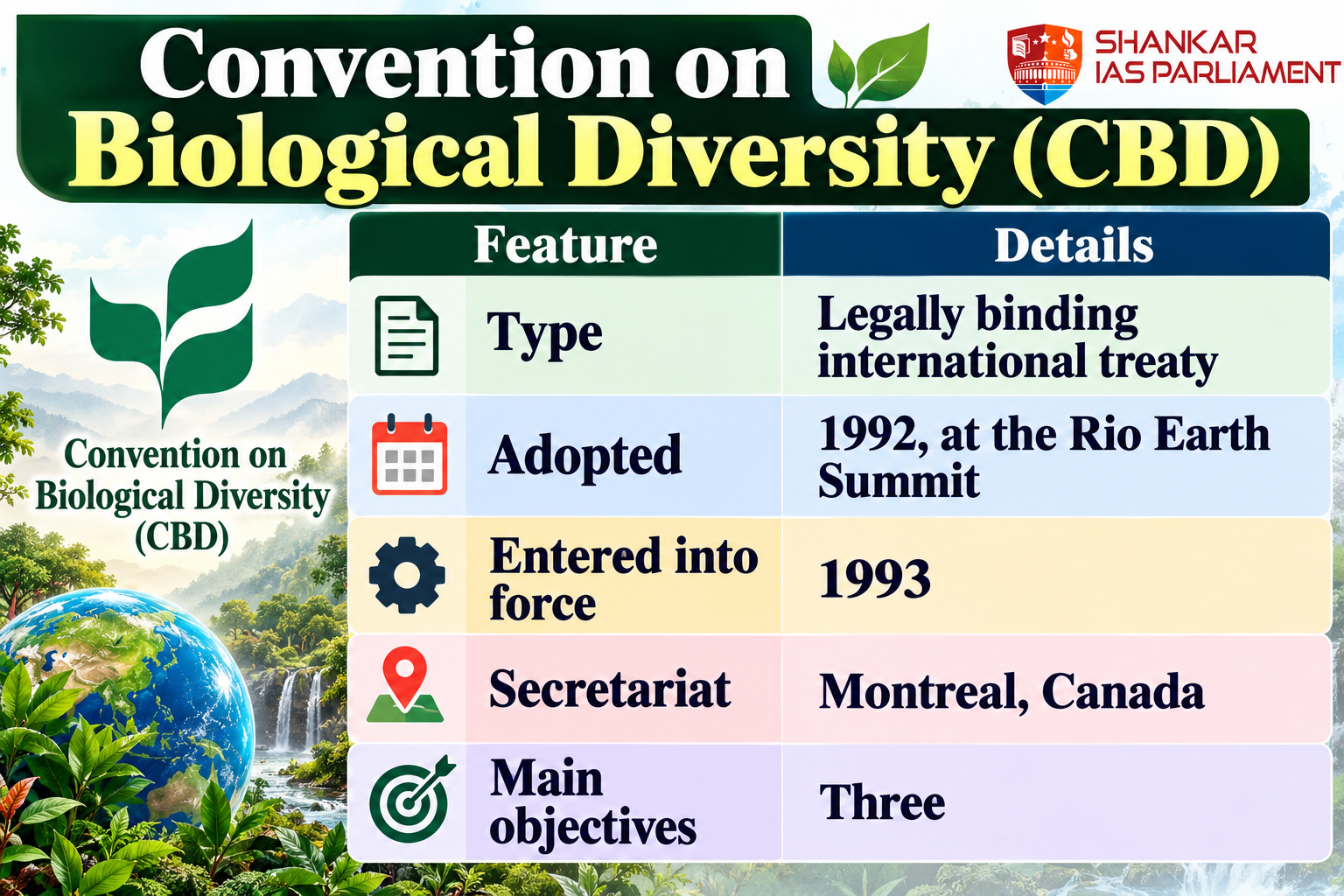
  • Adopted at – 15th Conference of the Parties (COP15) to the Convention on Biological Diversity (CBD) in Montreal, Canada, in December 2022.
  • It includes 23 targets to be achieved by 2030 and four long-term goals set for 2050.
  • The framework identifies an annual biodiversity finance gap estimated at $700 billion.
  • 30-by-30 target
  • Target 3 of the framework – It seeks to ensure that at least 30% of terrestrial and inland water areas, as well as 30% of marine and coastal areas, are effectively conserved and managed by 2030.

Convention on Biological Diversity (CBD)

convention-on-biological-diversity-infographic.png

  • 3 objectives
  1. Conservation of biological diversity.
  2. Sustainable use of its components.
  3. The fair and equitable sharing of benefits arising from the utilization of genetic resources.

It is important to distinguish that the CBD refers to the convention itself, while the Kunming–Montreal Global Biodiversity Framework (GBF) is a global framework adopted under the CBD.

Reference

Down To Earth | Africa and Latin America’s Biodiversity-Based Trade

There are no reviews yet. Be the first one to review.

ARCHIVES

sidetext