Prelims: Current events of national and international importance | Space
Why in News?
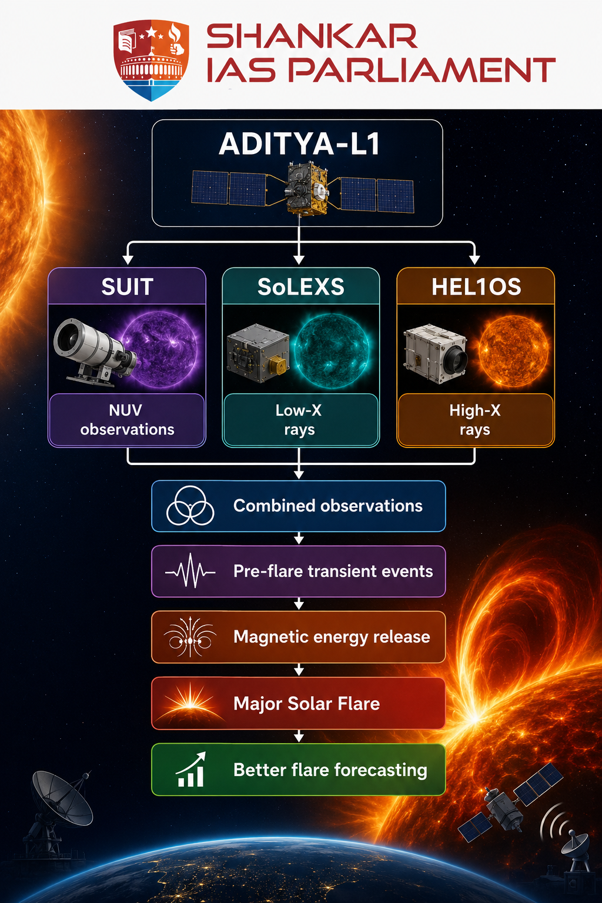
Recently, India’s Aditya‑L1 mission has detected small, short‑lived brightening in the Sun’s atmosphere hours before major solar flares, clustered around the future flare site.
- Study conducted by – Manipal Centre for Natural Sciences, Manipal Academy of Higher Education (MAHE), ISRO & Department of Space.
- Key findings
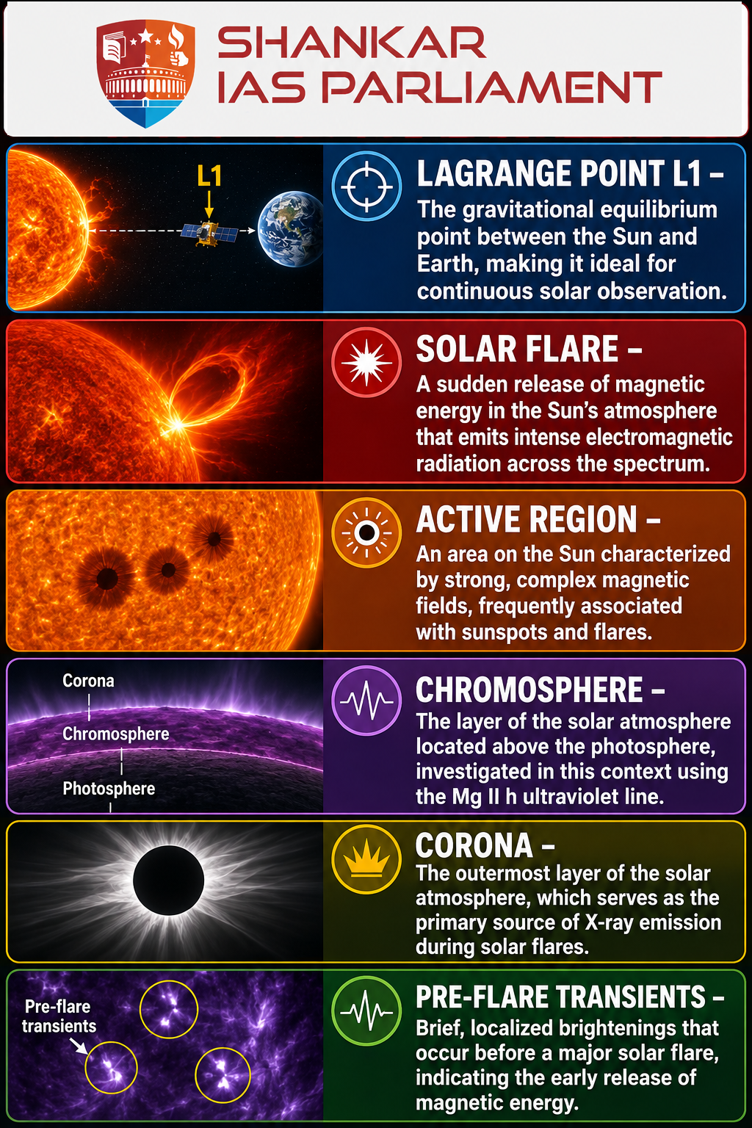
- Pre-flare transient events – These are characterized by small, short-lived brightenings in the solar atmosphere.
- These events typically appear several hours prior to a major solar flare.
- They are primarily detected using the Mg II h filter of the Solar Ultraviolet Imaging Telescope (SUIT), which observes the chromospheric layer.
- Spatial clustering – These transients cluster around the exact location where the major flare later occurs.
- Energy signature – Some transients show corresponding X‑ray signatures, indicating magnetic energy release even at this small scale.
- Interpretation – Repeated small-scale energy releases progressively destabilize the magnetic field within an active region, ultimately triggering a major solar flare.
- Instruments – Simultaneous use of UV (SUIT) and X‑ray (SoLEXS, HEL1OS) data.
- SUIT (Solar Ultraviolet Imaging Telescope) – It observes the Sun using 11 near-ultraviolet (NUV) filters.
- It probes solar atmospheric layers ranging from the upper photosphere to the chromosphere.
- Because near-ultraviolet (NUV) radiation is largely blocked by Earth's atmosphere, space-based observation is essential.
- SoLEXS & HEL1OS (X‑ray spectrometers) – These instruments measure X-ray emission resulting from energetic processes in the solar corona.
- They facilitate the correlation of lower atmospheric activity in the chromosphere with coronal energy release during flare development.
- L1 orbit advantage – Continuous monitoring enables tracking of pre-flare evolution without data gaps.
- Early Warning Indicators – Transient brightenings occurring hours before flares indicate potential pre-flare activity.
- Better Solar‑Flare Forecasting – Verified transient events may serve as reliable indicators of impending flares.
- Understanding Flare Formation – Minor energy releases gradually destabilise active regions prior to major flares.
- Space Weather Insight – Accurate flare prediction enhances preparedness for impacts on Earth and in near-Earth space.
- Satellite Protection – Advance forecasts support precautionary measures to protect spacecraft.
- Communication & Navigation Safety – Improved prediction reduces disruptions to radio, GPS, and satellite services.
- Astronaut Safety – Early warnings help mitigate radiation hazards for astronauts and space missions.
Reference
ISRO | Sun's Early Warning Signs Before Solar Flares



