Prelims: Current events of national and international importance | Environment
Why in News?
The Central Government has inaugurated the Integrated Atmospheric Chemistry and Aerosol Toxicity Analysis Laboratory (AATAL) for the Delhi National Capital Region (NCR).
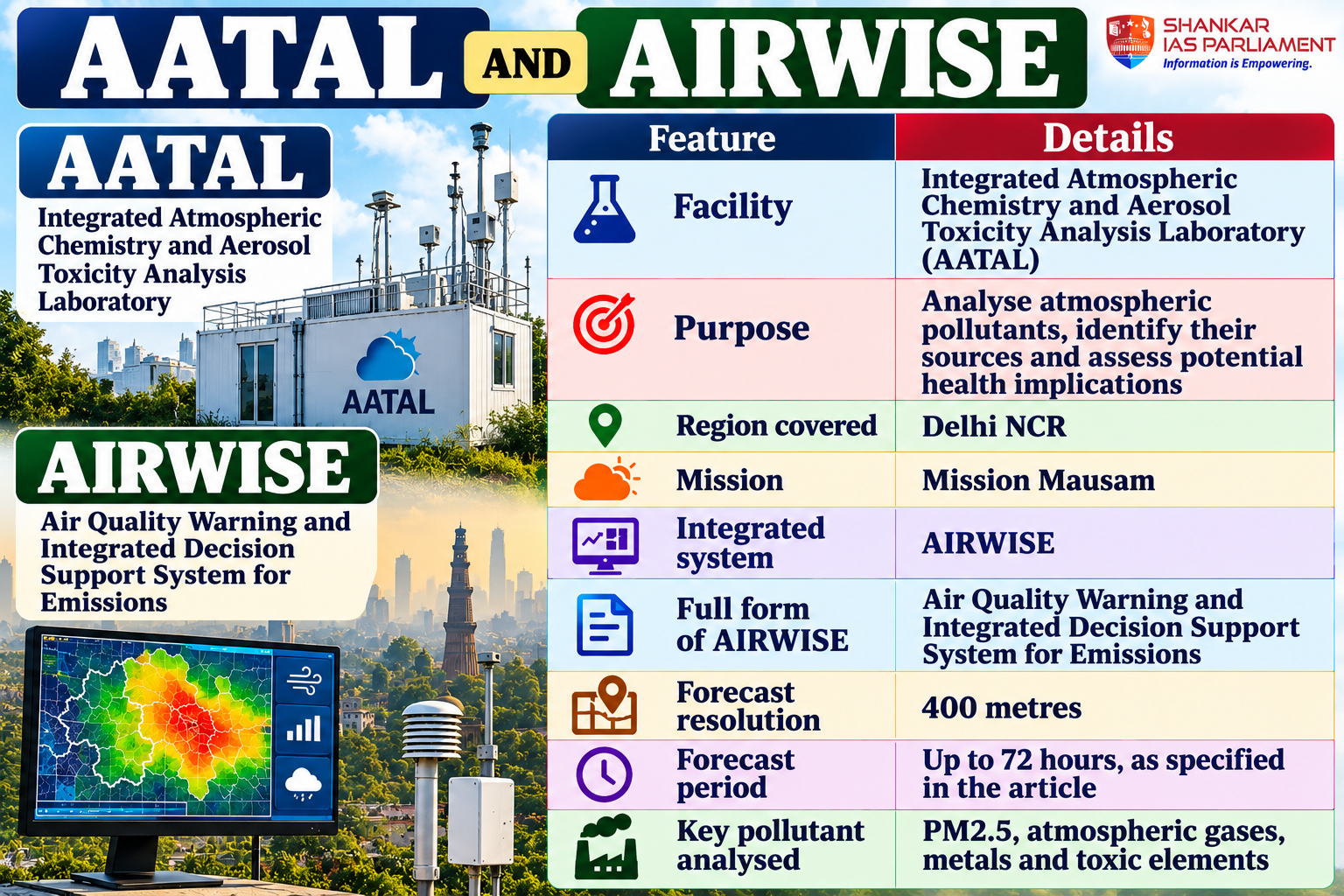
Integrated Atmospheric Chemistry and Aerosol Toxicity Analysis Laboratory (AATAL)
- It is an integrated laboratory established to advance scientific understanding of air pollution, extending beyond the mere measurement of pollution levels.
- Function under – Mission Mausam, to improve air pollution forecasting, pollutant analysis and evidence-based pollution management.
- Major functions
- Chemical analysis – Analyzes the composition of atmospheric gases and aerosols.
- Source identification – Determines pollution sources and quantifies their respective contributions.
- Pollution transformation – Investigates the interactions and transformations of pollutants within the atmosphere.
- Health assessment – Examines the potential health impacts associated with specific pollutant components.
- Decision support – Supplies scientific evidence to inform the development of targeted pollution-control strategies by authorities.
- Significance
- Targeted pollution control – Facilitates identification of primary sources responsible for pollution at specific locations.
- Public health protection – Enhances understanding of toxic components and their associated health impacts.
- Early warning – Allows authorities to anticipate and respond to declining air quality.
- Scientific policymaking – Informs interventions through empirical evidence and analysis of source contributions.
- Improved urban governance – Facilitates coordination of pollution control initiatives throughout Delhi NCR.
Air Quality Warning and Integrated Decision Support System for Emissions (AIRWISE)
- It is an integrated air-quality forecasting and decision-support system developed in collaboration with the Indian Institute of Tropical Meteorology (IITM).
- Its key capabilities include:
- Forecasting air quality with a spatial resolution of 400 metres.
- Generating air quality forecasts for up to 72 hours in advance.
- Integrating air-quality forecasts, observational data, and source-apportionment information.
- Identifying probable sources of pollution at specific locations.
- Facilitating timely and location-specific interventions.
- Significance – Rather than relying solely on general pollution-control measures, authorities can prioritise interventions based on the sources that contribute most significantly to pollution in a given area.
Reference
Indian Express | AATAL and AIRWISE



