Mains: GS III – Infrastructure
Why in News?
Andhra Pradesh is launching a national-level pilot project to construct rural houses using 3D Concrete Printing (3DCP) under Pradhan Mantri Awas Yojana-Gramin (PMAY-G).
What is 3D Concrete Printing?
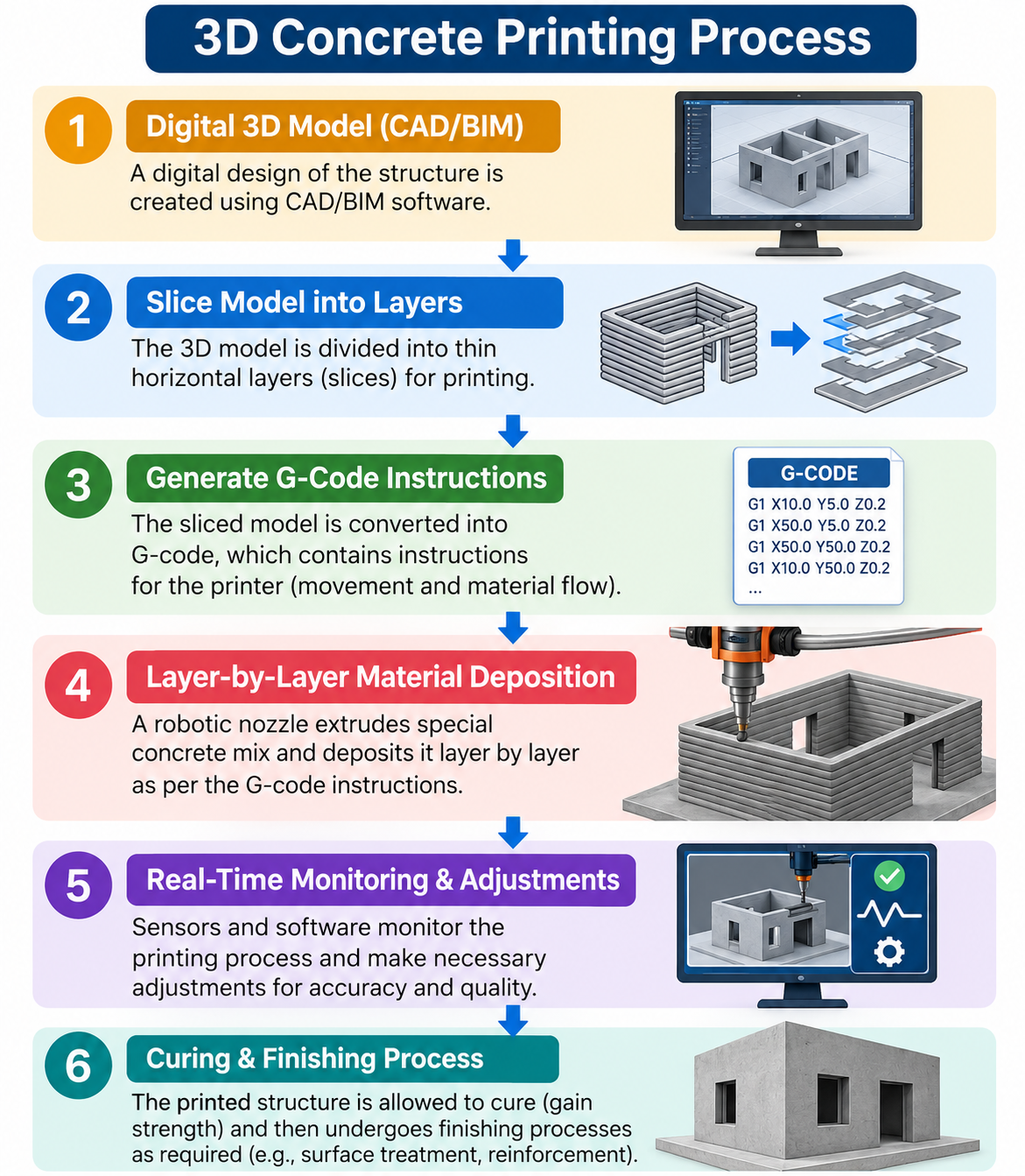
- 3D Concrete Printing – It is an automated construction technology based on additive manufacturing.
- A computer-controlled robotic printer converts a digital Building Information Modelling (BIM) design into a physical structure.
- Special concrete mixtures are extruded through a nozzle in successive layers.
- Material – Must have suitable extrudability, buildability and rapid setting properties.
- 3D Construction Technology Evolution –
- Construction-scale 3D printing began with global academic and industrial experiments.
- Countries such as the U.S., China, Japan and the UAE have developed large-scale applications.
- In India, IIT Madras and Tvasta developed the country's first 3D-printed house in 2021.
- Dubai has emerged as a major centre for large-scale 3D-printed construction.
- Applications – 3D concrete printing can be used for:
- Affordable housing
- Disaster-relief shelters
- Remote-area infrastructure
- Defence structures
- Public buildings
- Rapid construction in areas with difficult access.
What are the Advantages of 3D Concrete Printing?
- Faster Construction – It can significantly reduce construction time.
- The Andhra Pradesh pilot expects construction of a house in around 45–60 days.
- Reduces Material Waste – Concrete is deposited only where required.
- It reduces wastage associated with conventional construction.
- Reduces Dependence on Manual Labour – Automated printing reduces dependence on skilled masonry labour.
- It can be useful in areas facing shortages of construction workers.
- Suitable for Affordable Housing – Standardised designs can enable faster and potentially cost-effective construction.
- This can support large-scale rural housing programmes such as PMAY-G.
- Better Thermal Comfort – 3D-printed structures can provide better thermal performance, helping maintain cooler interiors.
What are the Challenges?
- Not Fully Automated – Foundations, reinforcement, roofing, plumbing and electrical work still require conventional or hybrid methods.
- Doors and windows also need traditional installation.
- Material and Structural Concerns – Long-term durability and structural strength need to be established.
- Specialised concrete mixtures require strict quality control.
- Regulatory Challenges – Building codes and approval systems need to adapt to automated construction technologies.
- Wider adoption requires clear standards for safety and structural reliability.
- Technology and Infrastructure Constraints – Large printers can be difficult to transport and operate in remote areas.
- Skilled personnel are still required for designing, programming and operating the systems.
- Economic Viability – High initial investment in printers, software and specialised materials can be a challenge.
- Large-scale adoption requires proof of long-term cost-effectiveness.
What is the Way Forward?
- Standardisation of codes – Develop clear standards and building codes for 3D-printed structures.
- Enhance Sectoral coordination – Promote collaboration between government, IITs, CSIR institutions and private innovators.
- Develop Research Capabilities – Encourage research into low-cost and locally available construction materials.
- Conduct long-term studies on structural safety, durability and lifecycle costs.
- Reach to unreachable – Develop portable systems suitable for rural and remote areas.
- Integrate With Technology – Integrate AI, robotics and BIM with conventional civil engineering.
What lies ahead?
- 3D Concrete Printing can become an important tool for technology-driven and affordable housing in India.
- Its integration with schemes such as PMAY-G can improve the speed and efficiency of construction.
- However, regulatory readiness, structural reliability, affordability and integration with conventional construction will determine whether the technology can move from pilot projects to large-scale rural deployment.
Reference
The Hindu| 3D concrete printing houses breaking ground in Andhra Pradesh



