Prelims: Current events of National and International Importance| Science and Technology
Why in News?
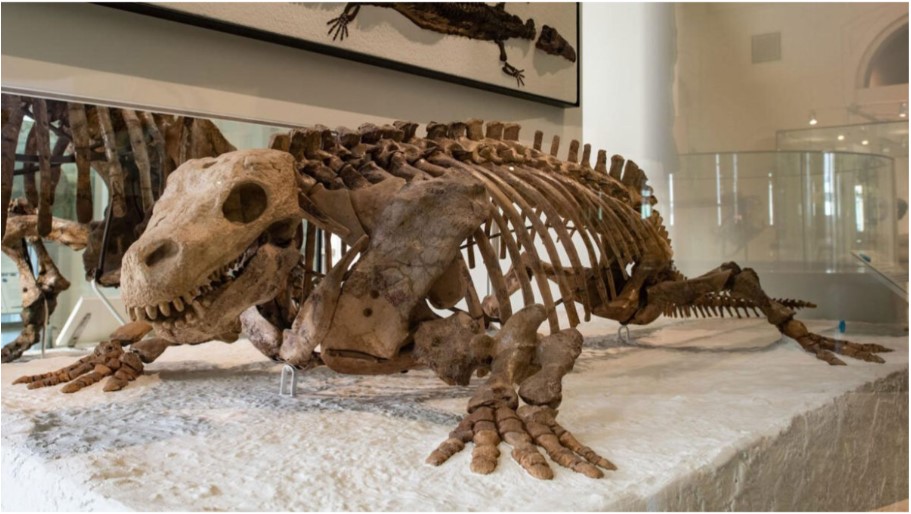
The 345-million-year-old fossil nicknamed "Lizzie" belongs to Westlothiana lizziae, a Carboniferous-period creature discovered in Scotland in 1984 that scientists long misidentified as an early land-dwelling reptile (amniote).
Why Scientists Were Deceived?
- Reptile-like exterior – Described in 1990, the fossil had five-toed feet and claw-like tips that made it look like an early amniote adapted for life on land.
- X-ray revelations– Advanced synchrotron X-ray scans uncovered a primitive skull, internal gills, and a fish-like mouth filled with thousands of tiny teeth, pointing to an aquatic or amphibious lifestyle rather than a true reptile.
What It Means for Evolution?
- Gradual transition– Land-associated traits like claws evolved earlier on the tetrapod family tree—while creatures were still living in or around water—rather than appearing only after animals fully moved onto land.
- Trackway rethinking– Ancient claw-like fossil trackways older than 359 million years can no longer be assumed to belong strictly to amniotes.
Reference
Science Daily| 345-million-year-old fossil



