India’s Journey towards a Manufacturing Nation
On 25 September 2026, Make in India completes 12 years since its launch in 2014.
The initiative has expanded India’s manufacturing base, investment ecosystem and domestic capabilities across electronics, automobiles, pharmaceuticals, steel, railways, defence and advanced technologies.
Evolution of Make in India
Launched in 2014, Make in India aimed to make India a global hub for manufacturing, design and innovation, guided by “Minimum Government, Maximum Governance.”
Under Make in India 2.0, the initiative covers 27 sectors—15 manufacturing and 12 services.
Growth of Manufacturing
- Manufacturing GVA recorded a 10.88% CAGR between 2022-23 and 2025-26 at constant prices.
- Manufacturing IIP grew 7% during April-July 2026 over the corresponding period of 2025.
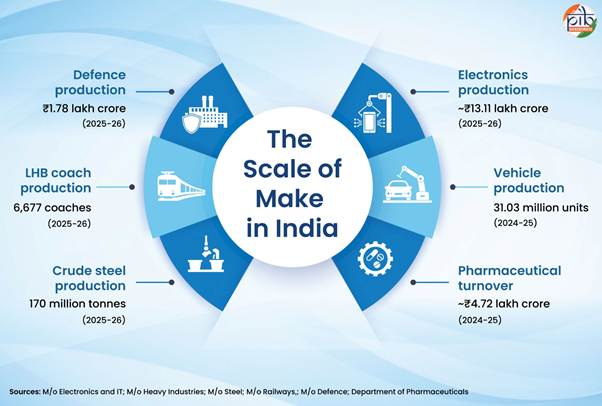
- Electronics production increased from about ₹1.9 lakh crore in 2014-15 to ₹13.11 lakh crore in 2025-26; mobile-phone production rose from ₹18,000 crore to ₹6.27 lakh crore.
- Vehicle production reached 31.03 million units in 2024-25, around 33% higher than in 2014-15.
- Pharmaceutical turnover reached ₹4.72 lakh crore in 2024-25, while domestic medical-device manufacturing increased to ₹41,500 crore.
- Crude steel production more than doubled from 81.7 MT in 2014-15 to 170 MT in 2025-26.
- Indigenous defence production rose from ₹46,429 crore to a record ₹1.78 lakh crore during the same period.
Deepening Domestic Manufacturing Capabilities
The focus has shifted from assembling final products to developing components, systems, machinery and strategic materials.
- India has developed advanced pharmaceutical products, including biosimilars and innovative drugs.
- A pilot plant for Nd-Fe-B rare-earth permanent magnets was established at ARCI, Hyderabad, supporting EVs, renewable energy and electronics.
- ISRO and SCL developed VIKRAM3201 and KALPANA3201 microprocessors for space applications.
- Solar module capacity increased from 2.3 GW in 2014 to 192 GW in June 2026, while solar-cell capacity reached about 30 GW.
- Indigenous 30 kW EV drive technology has been developed and validated.
- HAL’s third LCA Tejas Mk1A production line raised annual capacity to 24 aircraft.
- Rail Wheel Factory produced 2.10 lakh wheels, 1.22 lakh axles and 1.20 lakh wheelsets in 2025-26.
- Domestic production of capital goods and heavy engineering equipment nearly doubled from ₹2.87 lakh crore in 2019-20 to ₹5.70 lakh crore in 2024-25.
Major Enabling Reforms
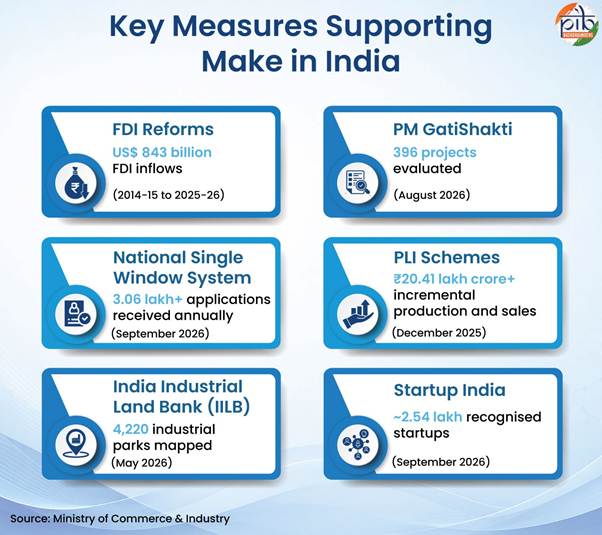
FDI: India received USD 843 billion in cumulative FDI during 2014-15 to 2025-26.
National Single Window System (NSWS): Provides access to 327+ Central and 3,452 State approvals, simplifying business clearances.
India Industrial Land Bank: Mapped 4,220 industrial parks covering about 6.98 lakh hectares.
PM GatiShakti: Promotes integrated infrastructure planning and multimodal connectivity. By August 2026, the Network Planning Group had evaluated 396 projects worth ₹18.66 lakh crore.
PLI Schemes: Across 14 sectors, PLI attracted ₹2.40 lakh crore investment, generated over ₹22.66 lakh crore production and sales, and created more than 14 lakh jobs by June 2026.
New Manufacturing Push
Recent initiatives aim to strengthen strategic and high-value manufacturing:
- PLI for Specialty Steel: Supports advanced steel such as CRGO, super alloys and titanium alloys.
- Rare-Earth Magnets Scheme: ₹7,280 crore for 6,000 MTPA integrated NdFeB capacity.
- BHAVYA: ₹33,660 crore for 100 industrial parks.
- Mobile Phone Manufacturing Scheme: ₹62,500 crore to expand production and domestic value addition.
- Semicon 2.0: ₹1,27,500 crore for semiconductor design, manufacturing, packaging, materials, equipment, R&D and talent.
- BHAVYA Rasayan: ₹3,030 crore for three dedicated chemical parks.
Conclusion
- After 12 years, Make in India has evolved from increasing production to building deeper domestic value chains, technological capabilities and strategic manufacturing capacity.
- Its continuing focus on infrastructure, investment, innovation, components, skills and advanced technologies seeks to strengthen India’s role in global manufacturing and supply chains.
Reference
PIB



